Friday, April 28, 2023

Muni Metro Fix-It Week Maintains the Subway Infrastructure

Muni Metro Fix-It Week Maintains the Subway Infrastructure
By Jessie Liang

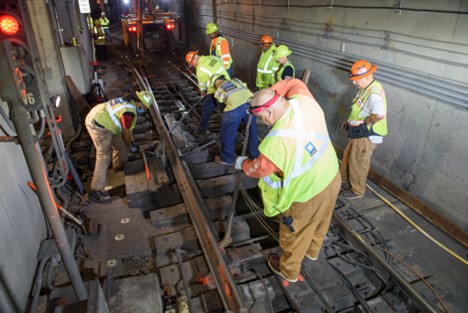
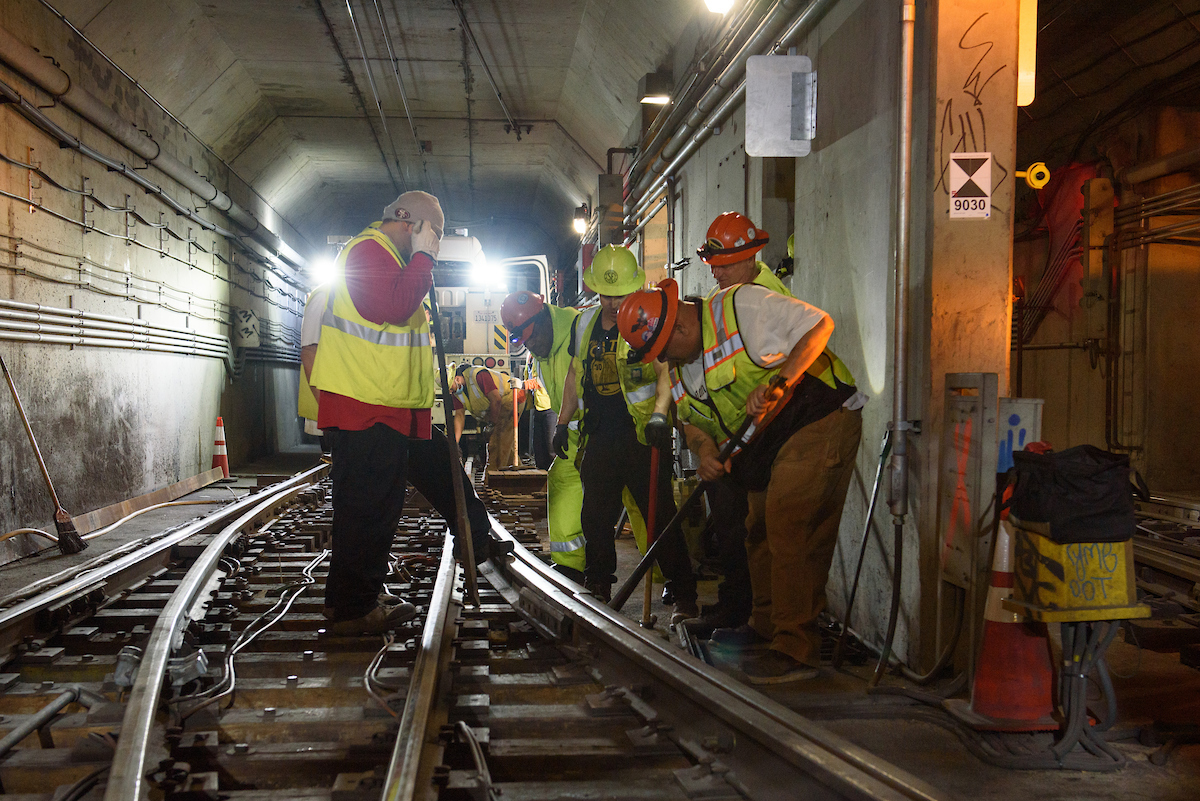
Several crew in safety gear standing over a rail track with tools angled in hand.

Track crew removing old rail at the Van Ness crossover 

The first Muni Metro Fix-It Week of 2023 was a resounding success in March, and it’s also the first Fix-It Week since the SFMTA launched the Central Subway in early January of this year. Here is a behind-the-scenes video recap. Fix-It Week is the SFMTA’s quarterly effort to optimize work time by closing Muni Metro early for critical maintenance. The SFMTA’s Maintenance of Way (MOW) teams did an excellent job maintaining the subway and preventing future breakdowns. 

Fix-It Week helps the Muni Metro get a 20% improvement in speed and about a 20% improvement in reliability in the subway. It takes fewer minutes to take the N Judah from the Outer Sunset to Embarcadero now than it did in 2019. 

 From March 16 to March 22, 2023, the Muni Metro Subway between Embarcadero and West Portal closed at 9:30 p.m. to provide SFMTA maintenance crews an extended window to perform underground infrastructure improvement work that cannot be completed during the usual overnight windows. During the subway closure, buses provided substitute service for Muni Metro lines on the surface and connected all stops on Market Street.   
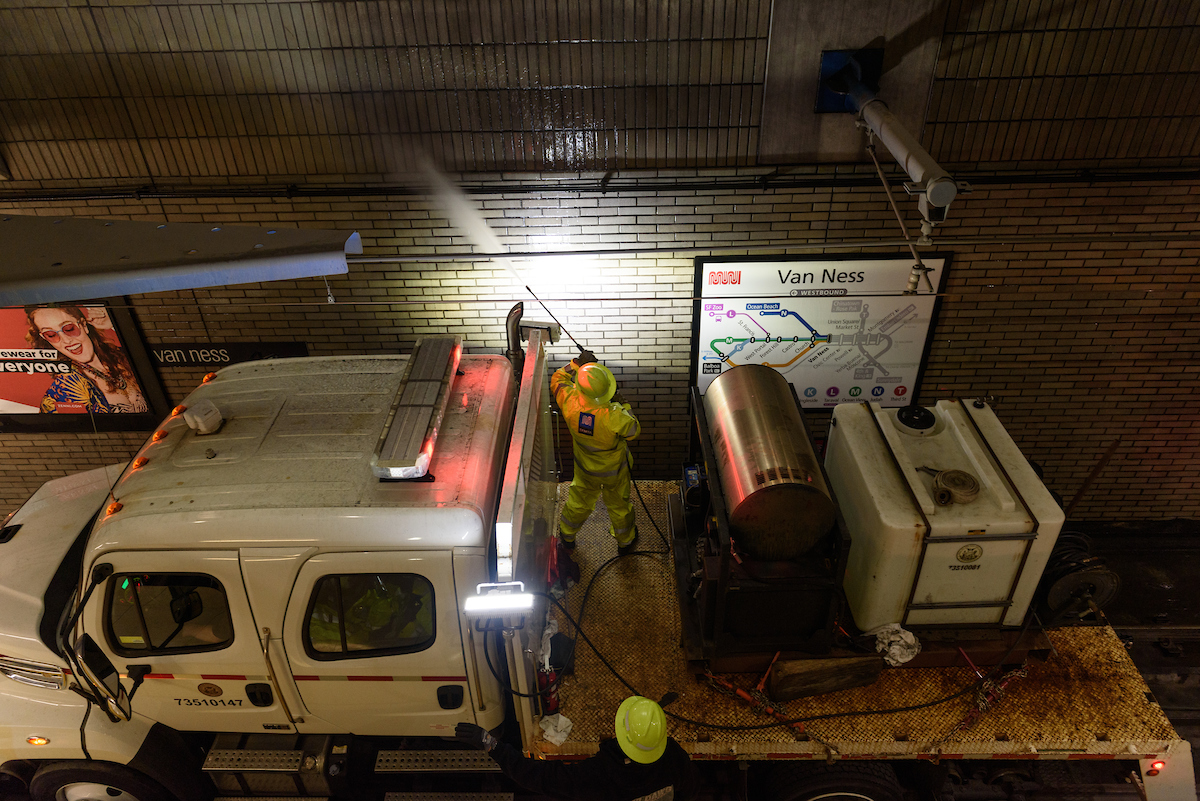
Crew member on the back of a truck spraying water along the side of the tunnel wall. There is a map on the right side and a advertisement board on the left of a woman with sunglasses smiling.

Track crew powerwashing station walls

The goal of Fix-It Week is to make Muni metro subway operations more reliable, ensure safety, and improve the customer experience. Nine MOW teams, Track, Cable Car, Motive Power, Maintenance Engineering, Mechanical Systems, Overhead Lines, Underground, Paint Shop and Signal, were involved in the maintenance work. 

Major maintenance work includes: 

  • Track replacement and reinstallation from the Ferry Portal to the Van Ness Crossover 
  • Mechanical systems cleaning, maintenance and installation  
  • Signal repairs and upgrades, including the demolition of old train control system racks, equipment and wiring 
  •  Track fastener and subway lighting surveys, and drain cleaning around switches  
  • Overhead Line inspections and Overhead Section Break hardware adjustments 
  • Debris removal and traction power substation inspections 
  • Cable Car maintenance and repairs 

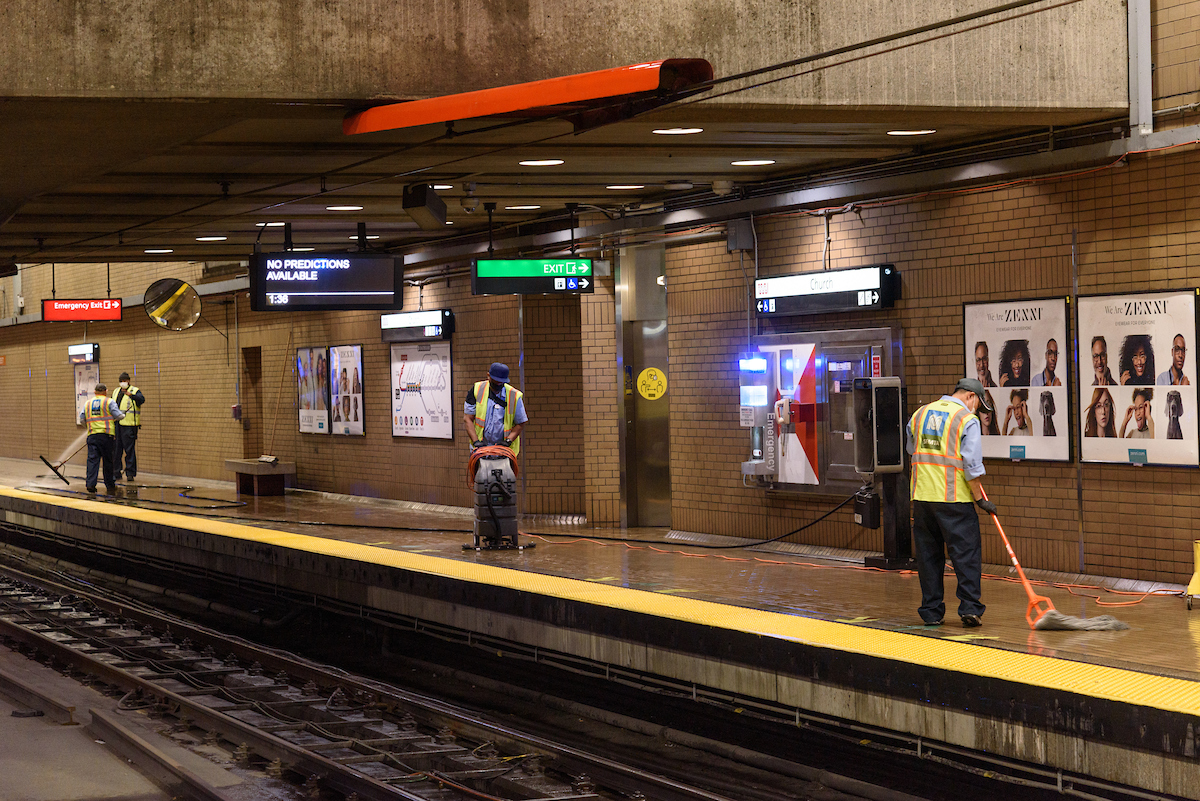
Several crew seen cleaning the ground in a station with a variety of posters and lights on the wall.

Custodial staff cleaning Church Station

The SFMTA teams completed over 2,000 hours of maintenance and inspections over the seven night shutdown. They were able to perform 161 feeder operations, replace more than 125 bulbs for trackway lighting in multiple locations, renew 750 feet of Overhead Contact System contact wire, replace eight blue light phones and inspect approximately 8,000 track fastener plates from the Ferry Portal to Powell Station. 
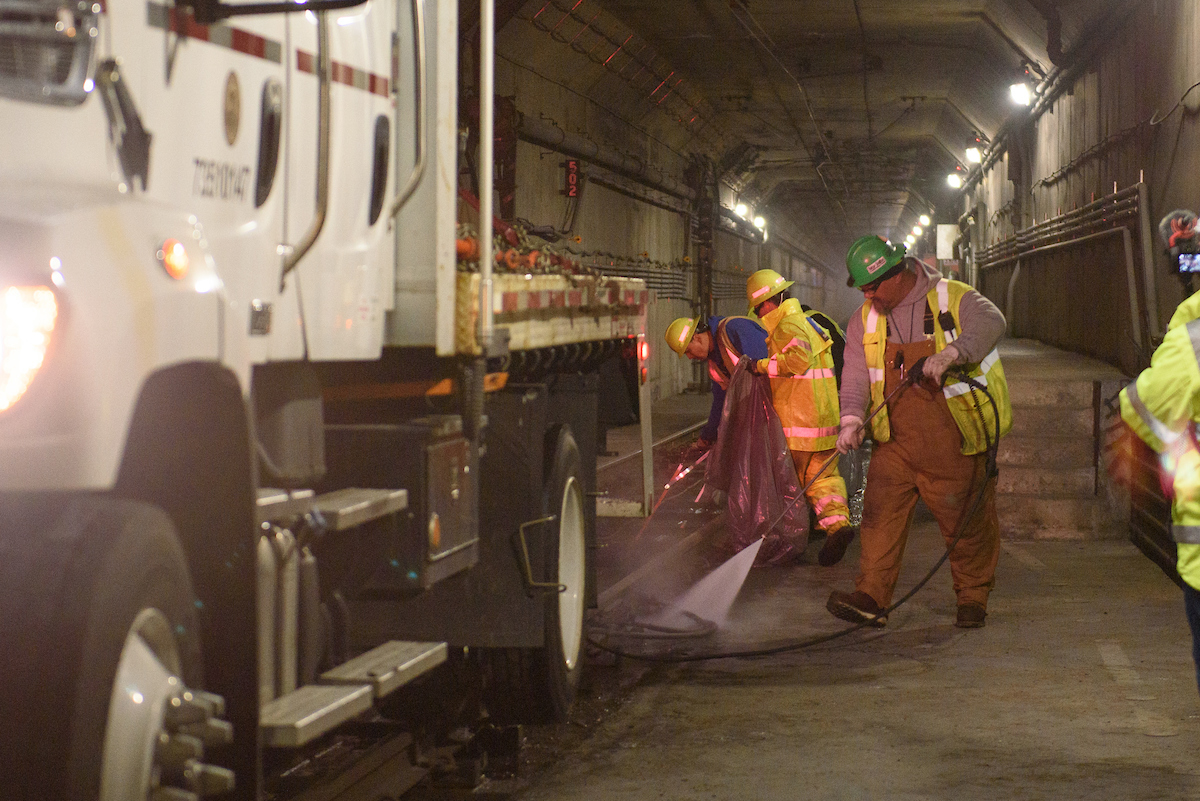
Several crew on spraying water on the tracks alongside a truck.

Track crew powerwashing and removing trash from trackway 

A support team was also contributed to the success of Fix-It Week. These staffers helped coordinate maintenance work, upheld all safety standards and ensured that subway service resumed on time every day. 

The SFMTA will continue to keep the Muni Metro system in a state of good repair. The next Fix-It Week is scheduled for July 2023, and we thank you for your patience and understanding while we do this vital work.  

For more information, visit Muni Metro Maintenance Project (SFMTA.com/SubwayMaintenance).  
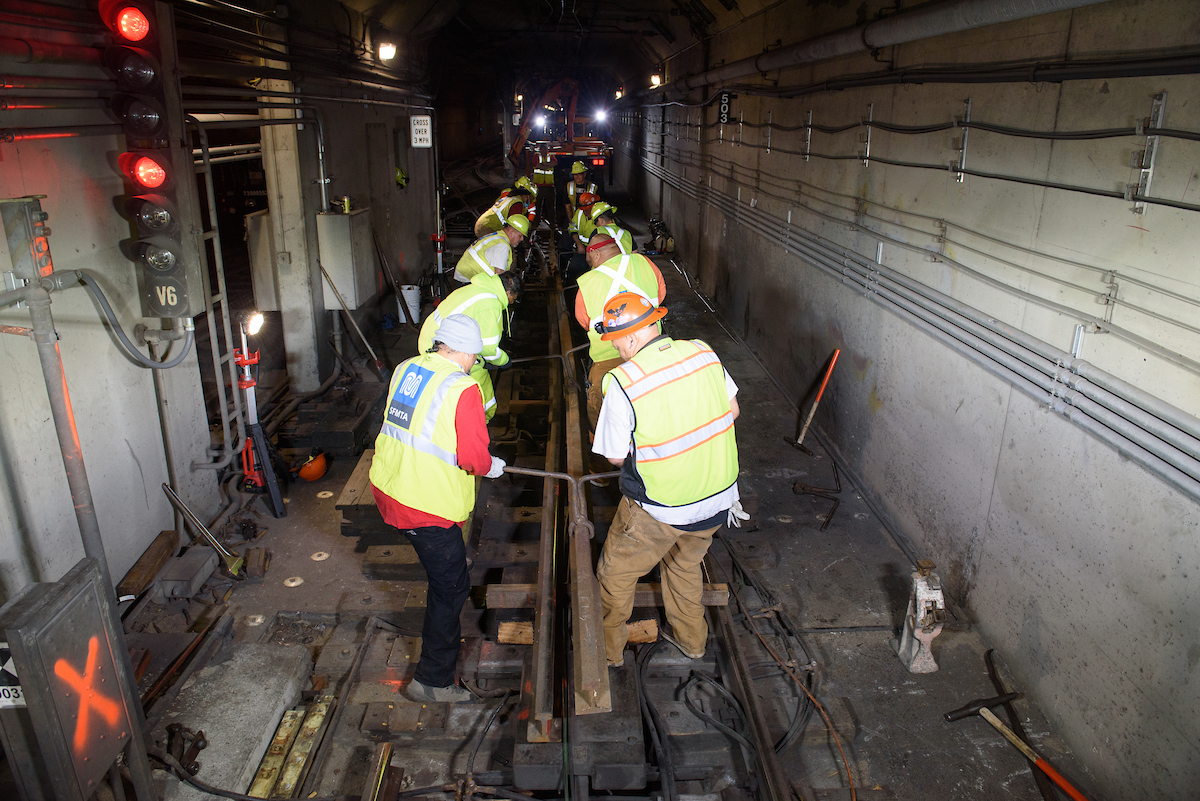
Nearly a dozen crew in safety gear all standing on each side of rail track. They are holding the track.

Track crew moving new rail into position by hand at the Van Ness Crossover 


Published April 28, 2023 at 11:17PM
https://ift.tt/3K6C8be

Wednesday, April 26, 2023

Track Work Through the Years

Track Work Through the Years
By Jeremy Menzies

San Francisco’s unique rail system brings together 150-year-old cable cars, historic electric streetcars of all shapes and sizes and modern light rail vehicles.  

Many trades across the SFMTA play a critical role in keeping the system moving. This month we look back in time at the work of one such group, the Track Department. While the lines and technologies of SF’s street railway have changed over the years, some of the base-level work, tools and skills needed to maintain our tracks are the same today as they were over 100 years ago. 

A decade before Muni was founded, the United Railroads Company (URR) dominated San Francisco’s transit system. URR owned and operated nearly 400 miles of street and cable car track all over the city. To keep this network in service, their track department was fully equipped to handle any possible construction or repair job. 

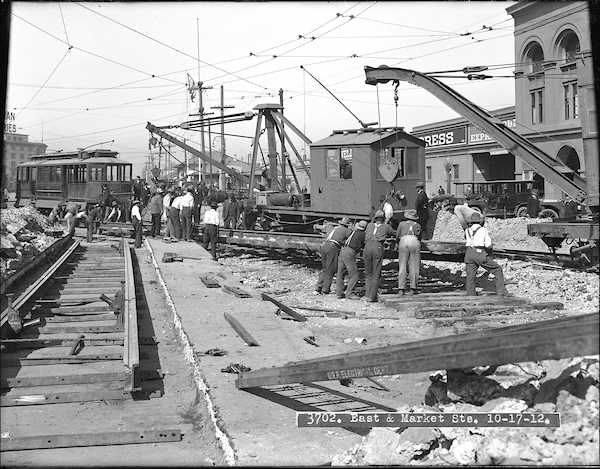
Black and white photo of group of people moving section of tracks with cranes

All hands were on deck for this job outside the Ferry Building in 1912. Here, two special work streetcars equipped with cranes lift an entire section of track in one piece. 

The Municipal Railway was built in 1912 and expanded over the next 16 years to include multiple lines and two dedicated tunnels. The city relied on its own team to maintain this system on a daily basis.  

Following World War II, many streetcar lines were converted to bus routes, but Muni retained the J, K, L, M, and N streetcar lines. With those core lines still in service, the work of the Track Dept. continued. 

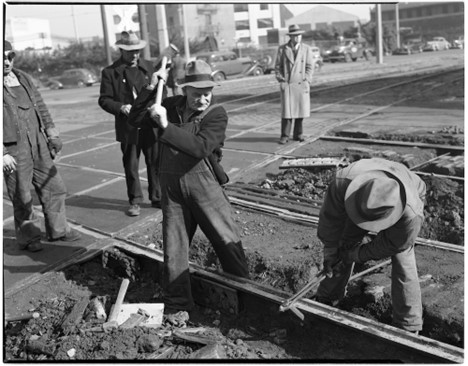
Black and white photo of two people working on tracks. One holds a rail spike while the other strikes it with a large hammer

Taken on January 31, 1947, this photo shows Muni track workers Pat Kellerher and Con Maloney at Division and Bryant Streets.

In the 1970s, construction of the Market Street Subway transformed the city’s streetcar lines into the Muni Metro system. Miles of tracks were rebuilt to handle light rail vehicle (LRV) traffic, and an automatic train control system was introduced for subway operations.

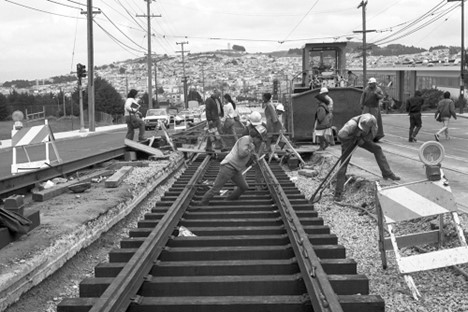
Group of people working on tracks, one pushes a rail while the other lifts a tie into place

In this 1977 shot, a crew replaces K Line tracks on Ocean Avenue just outside Lick-Wilmerding High School.

Today the SFMTA Track Department is primarily responsible for maintaining and repairing our rail infrastructure. Outside of this, they take on other jobs moving cable cars to and from the cable car carpentry shop, hauling heavy equipment in the subway, and supporting the work of the teams that maintain and repair our stations. With the skilled labor, know-how, and equipment to do a variety of heavy jobs, the department plays a critical role in keeping Muni moving.

Photo of group of people lifting rail with a jack and pry bars

Whether it’s 1903 or 2023, track work is a team effort. This photo was taken during the March 2023 Fix-It Week when the Track team replaced sections of rail in the Van Ness Crossover.


Published April 27, 2023 at 03:23AM
https://ift.tt/m9korde

Tuesday, April 25, 2023

SFMTA Retires the Orion, First Hybrid Bus in Cleanest Transit Fleet

SFMTA Retires the Orion, First Hybrid Bus in Cleanest Transit Fleet
By Clive Tsuma

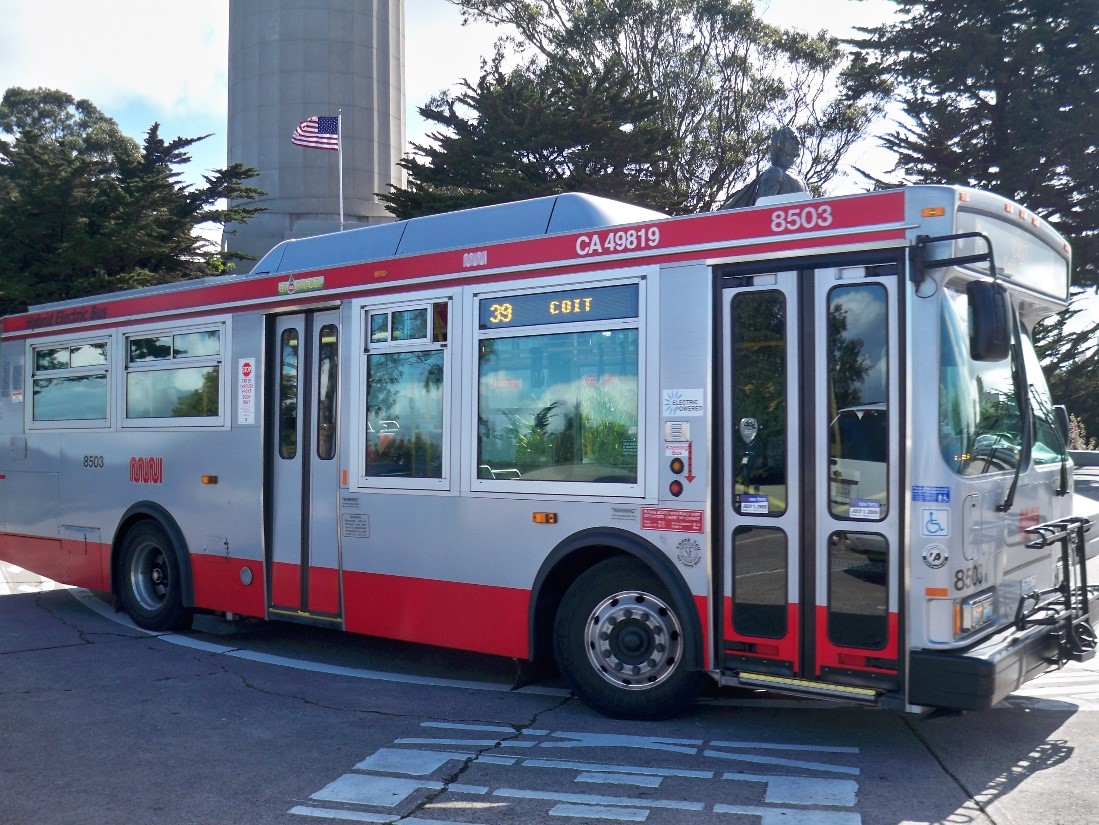
39 Coit Muni bus stopped on the street in front of Coit Tower.

San Francisco’s first low-emissions electric hybrid Orion bus

Muni’s Orion hybrid buses are headed for retirement as we phase in a brand-new batch of El Dorado hybrid electric buses. It’s the end of an era for San Francisco’s first low-emissions electric hybrid fleet that travels the city’s toughest routes.

Orion hybrid fleet tackles Muni’s toughest routes starting in 2007

The Orion buses have been a testament to the SFMTA’s commitment to the latest green transportation technologies. Muni, which previously had relied on a diesel bus fleet in coordination with our electric trolley bus fleet, transitioned to its first 30-foot Orion diesel hybrid-electric buses in 2007. This was the start of the SFMTA’s addition of these lower emission vehicles to one of the greenest fleets in the country, ensuring better air quality city wide.

The Orions brought the agency closer to achieving its goal of an all-electric fleet and a carbon-neutral San Francisco by 2040. This is consistent with San Francisco’s Climate Action Plan to dramatically reduce harmful emissions in communities. 

The Orions’ pint size made them ideal for winding routes like the 36 Teresita, which weaves through Twin Peaks, Diamond Heights, Glen Park and Bernal Heights. Many riders have taken Orions on their adventures along San Francisco’s curving streets, steep hills and tight turns. One can only imagine their sentimental value, especially among those who frequent the 36, as well as the 35 Eureka, 37 Corbett, 39 Coit and 56 Rutland routes.

The Orions were among the first low-floor hybrid buses to serve San Francisco, and the first with closed-circuit security cameras to help keep Muni riders safe. Their interior was fitted with internal destination signs to help customers know when their stop was approaching. The 30-foot coaches were designed to accommodate easier boarding and provide quieter, more efficient operation.

Their arrival offered us an opportunity to train Muni mechanics on hybrid vehicle maintenance. The agency continued to maintain the fleet even after the Orions’ assembly manufacturer went under in 2012.

The new El Dorados are primed to fill the gap left by their predecessors. Like the Orions, they are low-floor buses with a short wheelbase, making them ideal for navigating San Francisco. 

As their taillights fade into the horizon, the Orion hybrid bus fleet takes a much-deserved place in the history of San Francisco transit. They conquered the winding hills of Glen Park and navigated the twisting turns of Telegraph Hill. They will be remembered as the first of Muni’s fleet to pioneer hybrid batteries, moving Muni closer to a zero emissions future.  


Published April 25, 2023 at 11:30PM
https://ift.tt/M2HFQV7

Monday, April 24, 2023

This Week is Bike & Roll to School Week!

This Week is Bike & Roll to School Week!
By Crysta Highfield

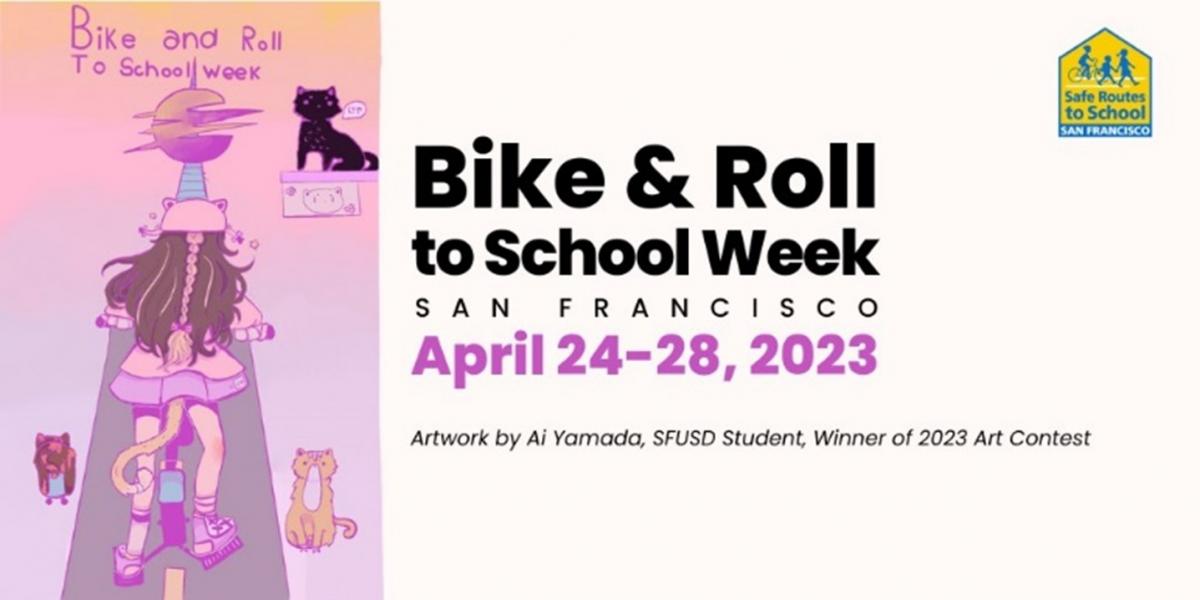
Lightly shaded image of a young bicyclist on a pathway en route to the horizon up ahead with several cats seen including text information

Artwork by Ai Yamada, SFUSD student and winner of 2023 art contest, showing a girl bicycling down a road away from the viewer and featuring three cats. Additional text reads Bike & roll to School Week, San Francisco, April 24-28, 2023.

Hey. San Francisco! It's time to lace up your shoes, put on your helmets, and get ready to roll for Bike & Roll to School Week! Every year, our Safe Route to School program puts on this event to celebrate students getting around on their own power, whether by bike, wheelchair, scooter or skateboard, walking, or any other form of active transportation! This year’s celebration is April 24-28, at schools citywide.

San Francisco Safe Routes to School is a partnership of city agencies and nonprofits, led by the SFMTA, that helps make walking and bicycling to school safer and more accessible for all San Francisco children and youth and to increase the number of families who choose to walk, bicycle, take public transit, or join carpools on their way to and from school.

Bike & Roll to School Week demonstrates the joy and empowerment that comes with choosing sustainable modes of transportation and encourages students to adopt healthy habits that will benefit them for the rest of their lives. Walking, biking or rolling to school embodies the importance of being environmentally conscious and prioritizing health and well-being. And with fewer students being driven to school, pick-up and drop-off times are less congested with car traffic, and therefore safer and easier for everyone.

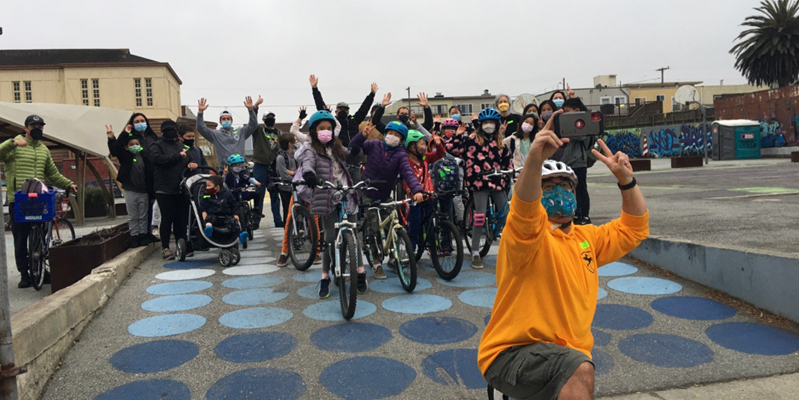
A large group of youth and students taking a photo on a courtyard. Some are on bikes. Everyone is smiling and raising their hands. There is an adult in the foreground taking the selfie picture.

: Photograph of a group of students and parents on bicycles in a schoolyard enthusiastically raising their arms in the air, with one adult in the foreground taking a “selfie” photo of the group on a cell phone.

Join in on the fun! There are many ways for students, families and school staff to get involved:

See if your school is registered! Each school’s celebration is made possible by volunteer “Bike Champions” from the school community who are eager to share the joy of healthy and sustainable mobility with their students and families. San Francisco Safe Routes to School provides everything needed to make it a great event.

Pledge to bike or roll to school during the week! Everyone who pledges to participate will be entered into a drawing for great prizes, courtesy of Cleary Bikes and Mike’s Bikes.

You can even join the fun from inside your home or classroom by entering the Bike & Roll Art Contest. All SFUSD students are invited to enter the art contest, in which students at every age level can win prizes. Entries are due by May 10, 2023 and the grand prize winner will be featured on the BR2SW poster for 2024!

Learn more about our Safe Routes to School program by visiting www.sfsaferoutes.org


Published April 25, 2023 at 01:21AM
https://ift.tt/pa89O0s

Thursday, April 20, 2023

Muni Improvements Draw Increased Ridership

Muni Improvements Draw Increased Ridership
By Kate McCarthy

Buses driving towards downtown on Geary Boulevard.

38 Geary buses zip downtown on new transit lanes that improve travel times for Muni riders.

As Earth Day approaches and we think about how to encourage more people to take non-car trips, recent Muni improvement projects are drawing increased ridership across the city. While Muni ridership downtown has not yet rebounded to pre-pandemic levels, ridership has gone up on Muni lines where we have improved speed and frequency of Muni service. 

Muni is a lifeline for many of our riders: 70% of Muni riders have an annual income of less than $50,000. As we restored and added Muni service after the start of the pandemic, we invested in the routes that serve people who rely on transit and need it most. For example, after we installed transit lanes, increased frequency and re-routed the 22 Fillmore to bring people to their jobs and medical appointments in Mission Bay, ridership increased to 107% of pre-pandemic levels on weekdays and 118% on weekends. 

Since the start of the pandemic, we’ve implemented more than 21 miles of new transit priority lanes, growing our transit lane network (https://ift.tt/gkl17oU) to over 70 miles. These transit lanes are improving travel times for Muni riders across the city. After transit lanes were installed on Mission Street in downtown, travel times on the 14 Mission and 14R Mission Rapid are now 31% quicker. 

Ridership numbers on the 49 Van Ness-Mission also blossomed to 109% of pre-pandemic ridership on weekdays and 114% on weekends after construction on the Van Ness BRT corridor was completed last April. With physically-separated transit lanes and transit signal priority that gives the green light to Muni and Golden Gate Transit buses, riders there are seeing travel times reduced by 35%. 

A similar story has emerged on San Francisco’s busiest transit boulevard — Geary. Like other lines that serve downtown, the 38 Geary hasn’t fully recovered to pre-pandemic ridership levels. But the route did nab a spot in the top 10 highest recovered routes in the Muni system. The 38 Geary’s 36,000 daily riders have recently seen travel time savings of up to 18% since we installed three miles of new transit lanes, bus stop changes and other improvements as part of the Geary Rapid Project. We plan similar improvements on the western end of the corridor as part of the Geary Boulevard Improvement Project.     

Muni riders have noticed that improvements to our busiest Muni lines are making service faster and more reliable than it has been in decades. Two-thirds (66%) of Muni riders who took our Annual Muni Rider Survey last fall rated Muni service as “good” or “excellent” — a 9% increase from 2021 and the strongest increase since 2018. 

These improvements can’t come soon enough. Most of San Francisco’s greenhouse gas emissions come from cars and trucks. As the urgency to address climate change mounts, so does the need to get the most out of our Muni system. To inspire riders to come back to Muni, we’re working hard to bring back the Muni system our city deserves: One that is thriving with the better frequency, improved reliability and better connections that these projects are delivering. 


Published April 21, 2023 at 01:54AM
https://ift.tt/EZbgHvm

Tuesday, April 18, 2023

There’s a Community Shuttle Coming to the Bayview

There’s a Community Shuttle Coming to the Bayview
By

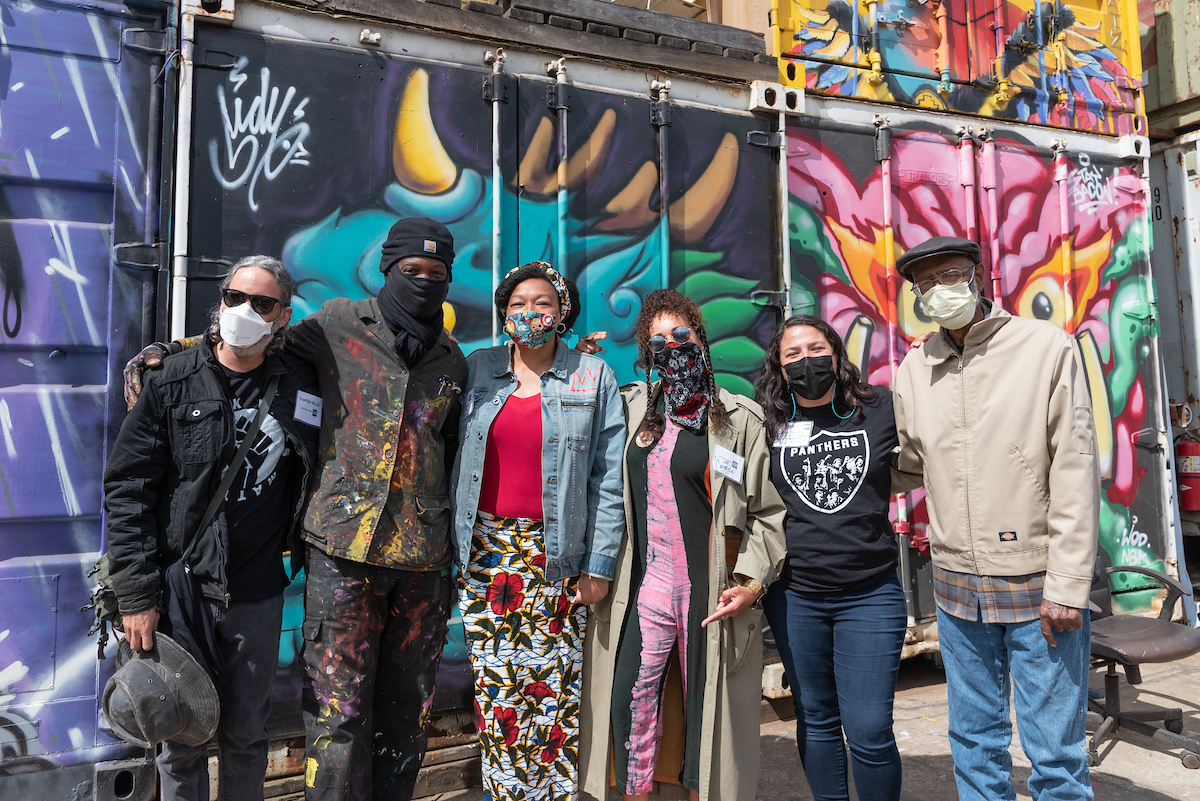
Several individuals with masks huddle for a group photo in front of a colorful mural backdrop in an our setting.

A new shuttle to serve Bayview’s diverse communities

A new community shuttle is coming to Bayview-Hunters Point in January of 2024, and we need your help designing it! The SFMTA is partnering with the California Air Resources Board and nine community-based organizations to launch a dynamic service community shuttle that truly meets your needs. A community shuttle has been a long-desired service for this geographically isolated community, and was identified as a top priority in the Bayview Community Based Transportation Plan. This program builds off of previous community shuttle efforts like the Bayview Moves program. To share your voice, take our survey now or attend one of our upcoming community partner events.

A “dynamic service” shuttle is one that doesn’t have a fixed route like a bus line, but instead operates in a “service area.” The shuttle will pick up and drop off riders anywhere within the Bayview area and connect them to hard-to-reach destinations like community centers, regional transit and grocery stores. Combined with Muni service, this program will help Bayview-Hunters Point residents get around more easily while reducing car trips and improving air quality.

A Community Shuttle only works if it is accessible, feels welcoming and gets people where they need to go. That’s why the SFMTA will be working with residents through the summer and fall of 2023 to build a service plan that works for the community.

This is where you come in. We want to know how you might use a shuttle like this. Would you use it during commute hours or on nights and weekends? Would you ride within your immediate neighborhood or to destinations like the 24th Street BART station and SF General Hospital? How long would you wait for a shuttle to arrive? Would you walk to the corner or a block away for a pickup? Answers to these questions will help us build a shuttle that meets your needs.

We want to establish shuttle service that effectively serves the people living in Bayview-Hunters Point today, and the more feedback we get, the better. You can get involved in the following ways:

This program also includes job training, a Community Congress that will provide project oversight, and a Third Street storefront for transit information and services. You can find more information on our Fact Sheet.


Published April 19, 2023 at 02:12AM
https://ift.tt/z3lFNfG

Tuesday, April 11, 2023

10 Reasons to Love San Francisco Parking Control Officers

10 Reasons to Love San Francisco Parking Control Officers
By Pamela Johnson

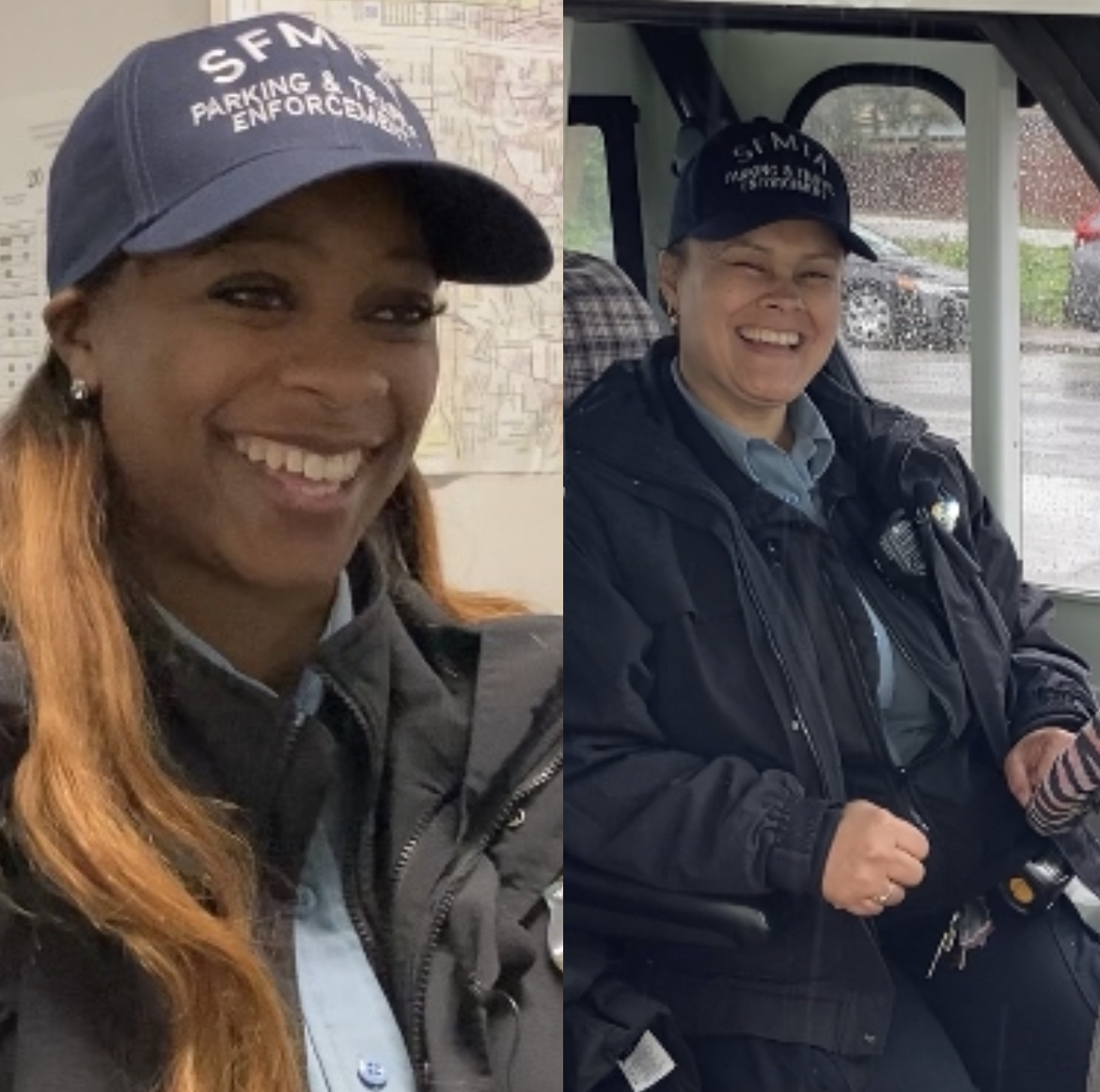
Two Parking Control Officers side by side smiling in an office setting and while sitting in a parking enforcement vehicle.

SMILE, ready for our close ups! To learn more about the day in the life of a hard working Parking Control Officer (PCO), take a look here.

It isn't easy being a parking control officer (PCO) in San Francisco. None of us likes to get a parking ticket, and we sometimes wrongly take out our frustrations on the PCOs who are simply doing their job to keep San Francisco moving.

To help you avoid veering off into negativity during your next encounter with an SFMTA Parking Control Officer, we’re providing you with this list of reasons you should actually love PCOs. Keep your favorite reason in mind next time you see a PCO on the street. Instead of getting angry with them, you might even consider appreciating them for dedicating themselves to this tough job rain or shine.

Top 10 reasons to love San Francisco Parking Control Officers: 

  1. They keep the intersections in the Financial District clear — and pedestrians safe — when commuters are desperately trying to get to the Bay Bridge at the end of the workday. 

  1. They respond to your complaints when someone’s car is blocking your driveway or there’s a vehicle that’s been parked on your street for so long that it might be abandoned. 

  1. They make sure disabled parking spots are available for people with disabilities — and aren’t being taken up by people who shouldn’t be using those spots. 

  1. They direct traffic during major sports events, including the Warriors and Giants games, so fans can get to the game on time. 

  1. They also direct traffic during major events like the Pride parade. On those days, they sometimes work 12-hour shifts to make sure the show goes on. 

  1. They respond in moments of crisis – like during the pandemic when they helped direct traffic in and out of COVID-19 testing and vaccination centers. 

  1. They make sure San Francisco firefighters can get to the fire hydrant when there’s a fire, which means making sure cars aren’t blocking the hydrant. 

  1. They support citywide efforts like the Healthy Streets Operation Center so city workers involved in addressing homelessness and unhealthy street behavior can do their jobs safely. 

  1. They stop people from double parking in the middle of the street, especially on retail corridors, which slows down Muni, creates traffic and can endanger pedestrians and people who bike, scoot, use a wheelchair or skateboard. 

  1. They’re happy to give you directions if you need them. 

There are many other things PCOs do to keep San Franciscans and city visitors safe and able to move around the city. So, let’s celebrate them instead of hating on them! And don’t forget, taking out your anger workers who provide you with a service is not okay. Ever. If you get a ticket you disagree with, contest the citation: Contest a Citation | SFMTA 

Text on a white background saying "Good People Tough Jobs"


Published April 11, 2023 at 10:02PM
https://ift.tt/ZQ5Rdpe

Thursday, March 30, 2023

The Municipal Railway Planning Division & The First 5-Year Plan

The Municipal Railway Planning Division & The First 5-Year Plan
By Kelley Trahan

The San Francisco Municipal Railway 5-Year Plan, 1979-1984 was the first comprehensive service plan created by the first San Francisco Municipal Railway transportation planners. The plan introduced a grid system to provide more efficient crosstown service with better neighborhood connections that would improve access and increase ridership, moving away from Muni’s prior service design focused on trips to and from downtown. It also provided service standards, including coverage, capacity and stop spacing, many of which continue to inform Muni planning efforts today. The San Francisco Municipal Railway saw many changes at this time, including the opening of the Muni Metro, the conversion of some lines from diesel to electric trolley bus, a simplified fare structure and increased fares and historic streetcar service on Market Street. 

Prior to the mid-1970s, the San Francisco Municipal Railway’s service development was determined by a mix of privately-operated transit systems it had acquired, rather than one master transit plan. This changed when the federal government required the agency to submit a 5-year plan to be eligible for funding.  

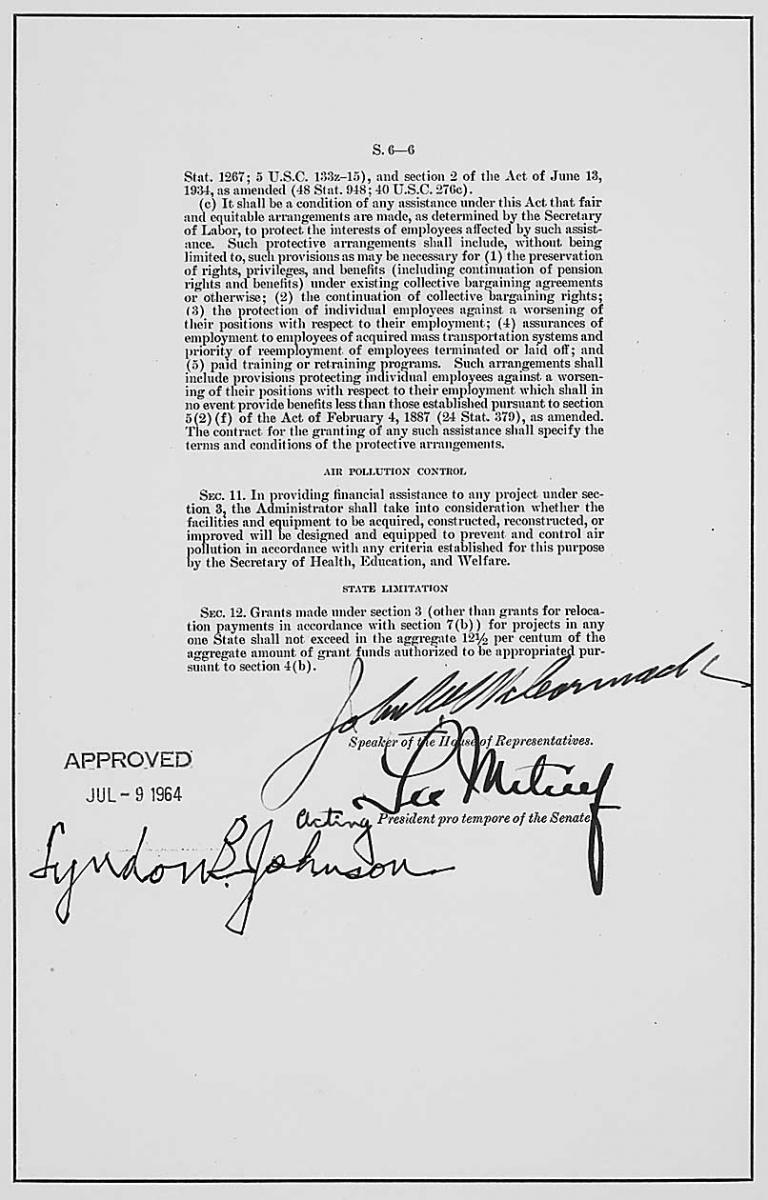
The entire process began when President Lyndon B. Johnson signed the Urban Mass Transportation Act of 1964 into law in response to the nation’s long-term transportation investment needs. The new law provided grant and loan money to local transportation systems and created an oversight agency, the Urban Mass Transportation Administration (UMTA), which would be renamed the Federal Transit Administration (FTA) in 1991. The Metropolitan Transportation Commission (MTC) then was put together by the California State Legislature in 1970 and tasked with reviewing transportation grant applications submitted by agencies in the state. 

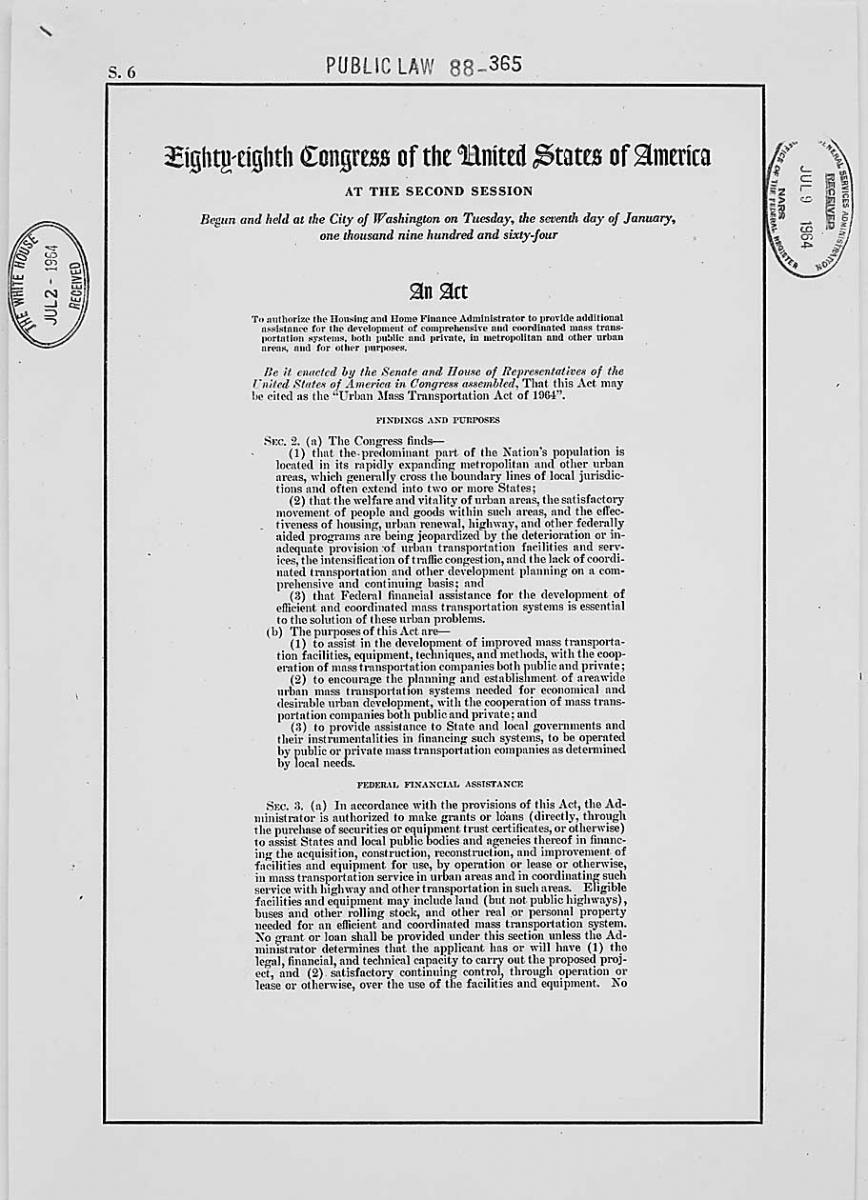
Text of documentation with signatures towards the bottom of the page with time stamped notation of 1964


Text of documentation with signatures towards the bottom of the page with time stamped notation of 1964

Urban Mass Transportation Act of 1964, Public Law 88-365, 78 STAT 302

An in-depth study of Muni was undertaken in 1974 by Wilbur Smith & Associates, a private consultant and author of the UMTA’s Characteristics of Urban Transportation Demand: A Handbook for Transportation Planners. The Municipal Railway Planning, Operations and Marketing (POM) Study was completed in 1977 and analyzed the Muni system and the travel needs of its riders and made recommendations for a 5-Year Plan. 

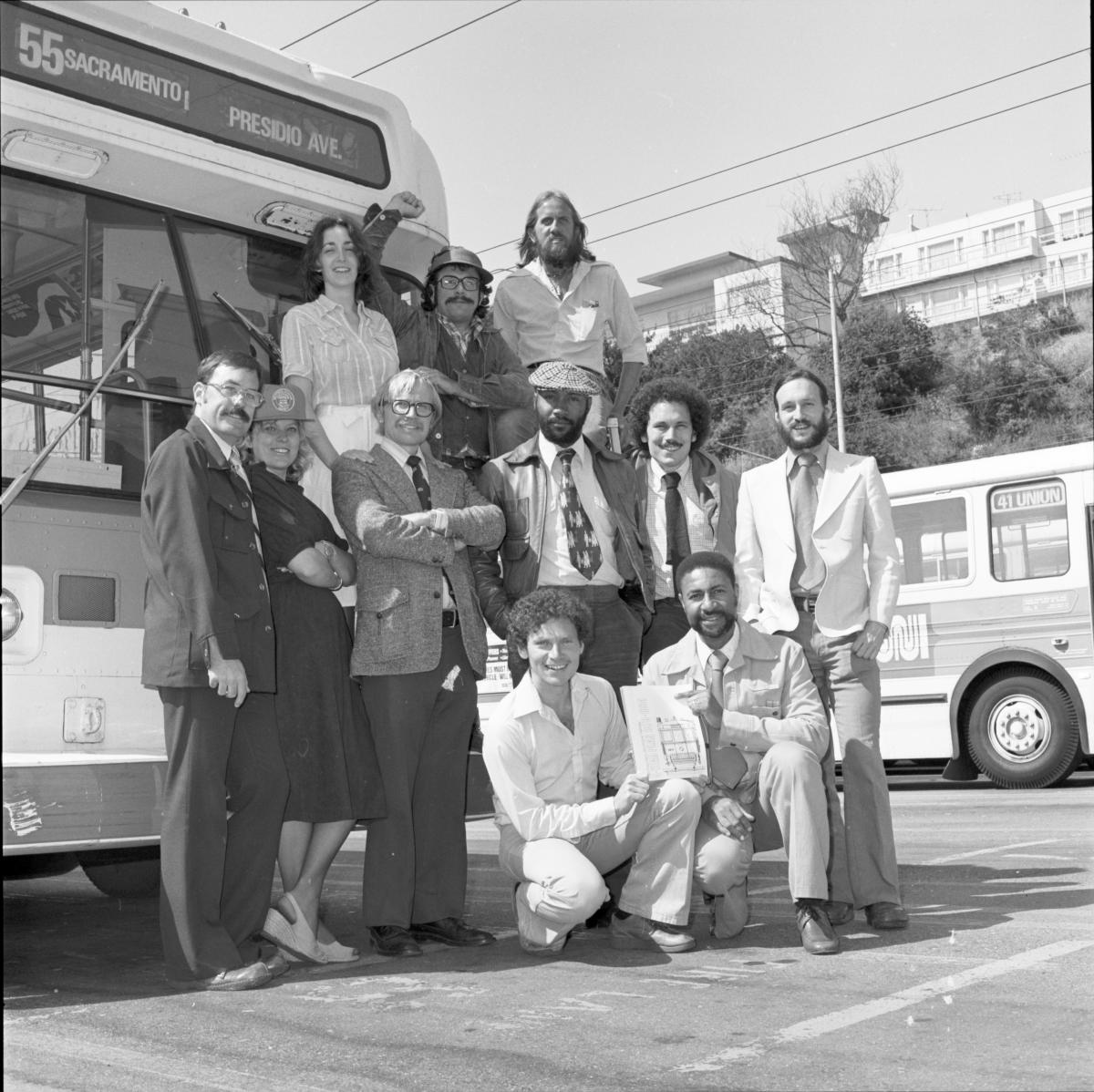
 A new in-house Muni Planning Division that had been created with UMTA funding in 1974 presented the POM Study at more than 70 community meetings, and after intense review and several revisions, The San Francisco Municipal Railway 5-Year Plan, 1979-1984 was drafted. 

A dozen people dressed in business casual posting for a group photo in front of a bus in what seems to be a bus yard. They are positioned in several different tiers.

Muni Planning Division Employees in Presidio Trolley Coach Yard, May 17, 1979

Since that first plan was written, transportation planning at the SFMTA has expanded to include capital projects, street design, bike lanes, paratransit, parking, historic streetcars and much more, while promoting safety, equity and sustainability. The SFMTA continues to publish an operating and service plan approximately every 10 years, now called the Short-Range Transit Plan (SRTP), which is based on the needs, goals and agency priorities to serve the people of San Francisco. 


Published March 30, 2023 at 11:26PM
https://ift.tt/5pIV6bQ

Tuesday, March 21, 2023

A Decade of Rolling out the Red Carpet for Riders

A Decade of Rolling out the Red Carpet for Riders
By Cassie Halls

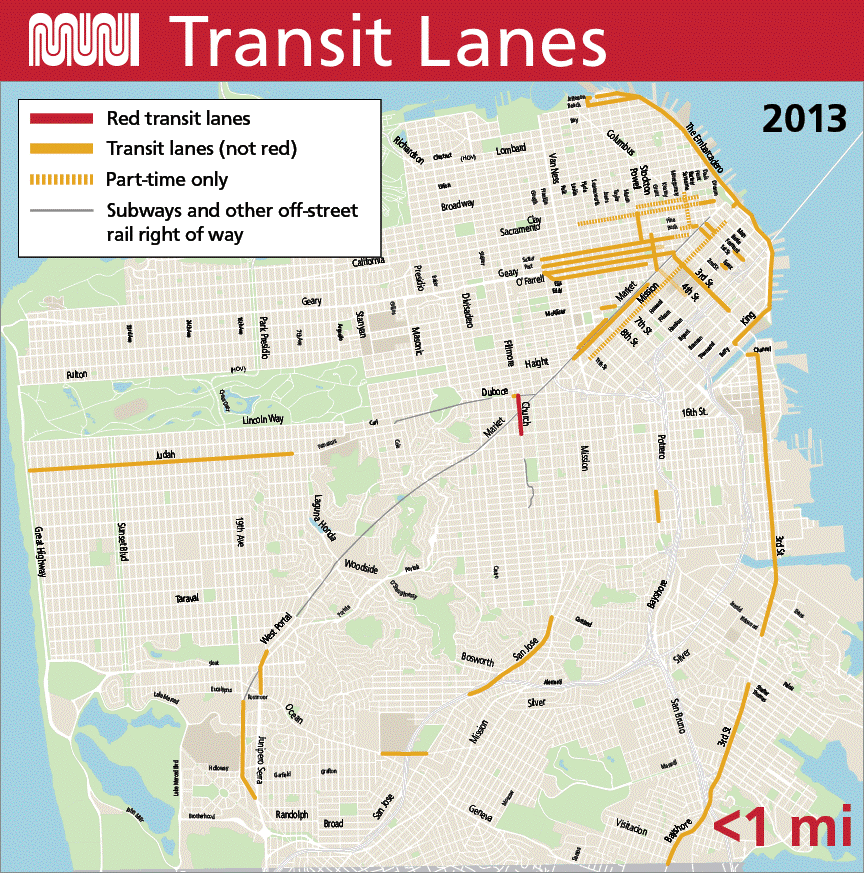
 A map showing the expansion of transit lanes in San Francisco from 2103 to 2023, as well as lanes that are coming soon. A summary of key highlights from the map is included in the following link.

An animated map showing the expansion of red transit lanes in San Francisco. View as a PDF. Accessible version of the expansion of red transit lanes: 

Red Transit Lanes Over Time in San Francisco from 2013 to 2023 

There is nothing quite like looking out the window at gridlock traffic while your bus coasts down a red transit lane. This may feel like an “only in San Francisco” pleasure – after all, San Francisco was one of the first U.S. cities to “roll out the red carpet” by painting bus lanes red. But red transit lanes have now become a popular way to keep buses out of traffic in more than 25 cities across the country. 

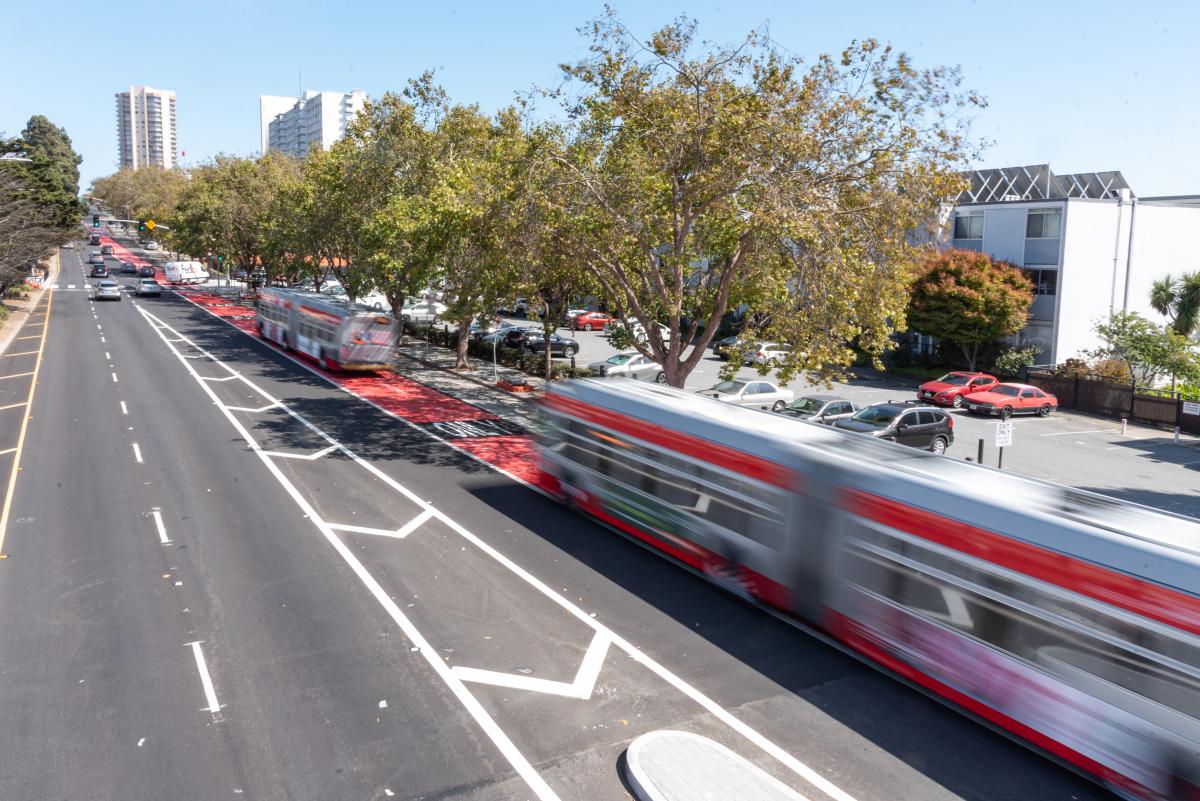
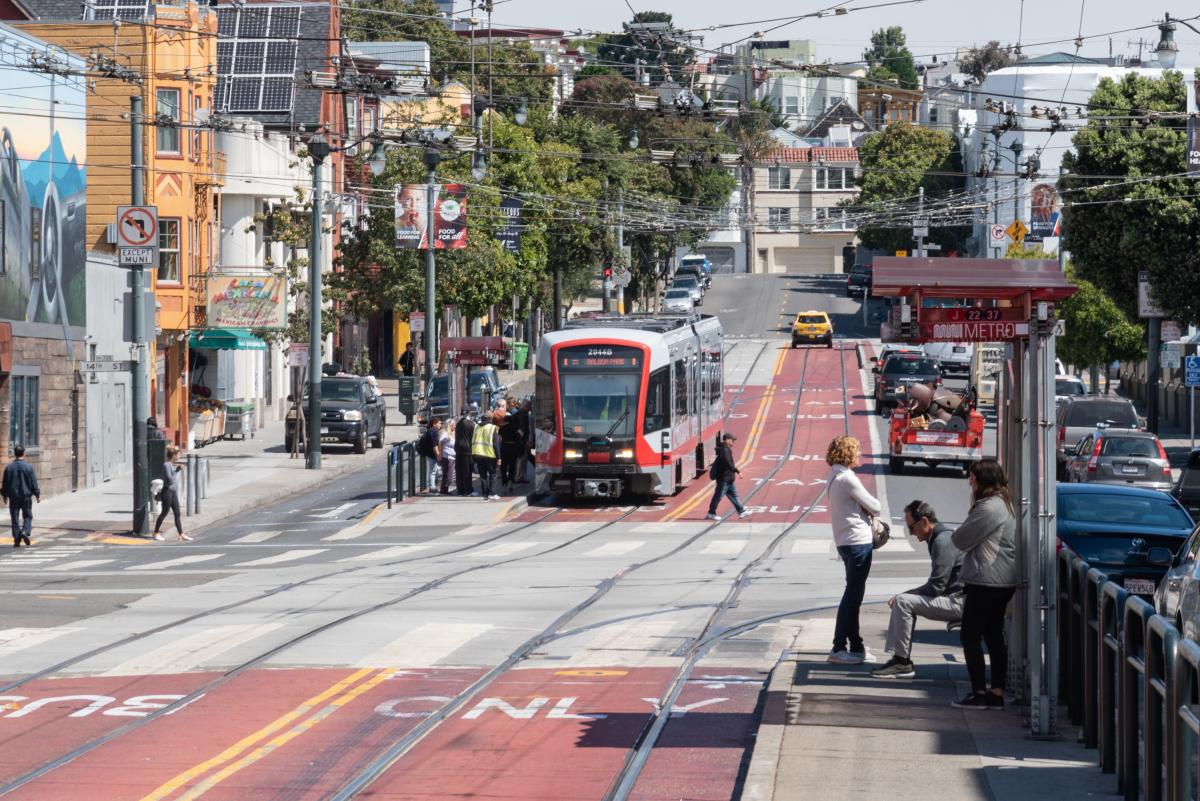
The SFMTA is celebrating a decade since the installation of San Francisco’s first red transit lane on Church Street on March 23, 2013. You can help us celebrate by riding that first red transit lane between Duboce and 16th Streets on Muni’s 22 Fillmore and J Church along with thousands of other weekday riders. As you whiz past traffic, you may feel the estimated 14% time savings afforded by the red color.  

If you drive, help us celebrate by keeping transit lanes clear. Remember, double parking in transit lanes is camera enforced. Transit lanes are an essential tool to keep Muni moving on San Francisco’s busy streets.  

Dedicated transit lanes started popping up in the city as early as the 1970s following the adoption of the city’s Transit-First Policy (which happens to be turning 50 this month). As of 2023, over 20 lane miles of transit lanes now also have the red treatment, in addition to 55 miles of transit and bus/HOV lanes without red paint.  

J Church using red transit lanes and picking up passengers on a boarding island on Church at Market Street.

J Church train using red transit lanes on Church at Market Street. 

Although often the most visible, transit lanes are one of more than 20 tools in our toolbox to improve transit reliability and reduce delays. With Muni Forward, we’ve built more than 80 miles of transit corridor reliability improvements to keep Muni moving — with upgrades like bus bulbs for faster boarding and traffic signals that stay green for transit.  

As an early adopter of red transit lanes, the SFMTA helped lay the groundwork to change federal guidelines to make it easier to paint lanes red. This is because red colorization has led to a 55% improvement in motorist compliance and is a cost-effective way to reduce delays. We have to say they’re looking great for their age! 

We know that despite our best efforts, Muni buses and trains are sometimes stuck in traffic and transit lanes are occasionally blocked. That is why we continue to innovate to bring improvements to our riders. Last year we colorized six miles of transit lanes in the Van Ness Improvement Project, Geary Boulevard Improvement Project, and along Mission Street in SoMa, 4th Street and Stockton Street. We also continue to install Muni Forward transit priority projects across the city and push for further compliance improvements through an education campaign for motorists. The SFMTA was also recently awarded a state grant to deploy new next-generation camera technology as a part of the transit lane enforcement program. 

Stay tuned for more red transit lanes and other reliability improvements in the year ahead.  


Published March 22, 2023 at 01:35AM
https://ift.tt/XmBt8wD

Friday, March 17, 2023

San Francisco’s Transit-First Policy Turns 50

San Francisco’s Transit-First Policy Turns 50
By Melissa Culross

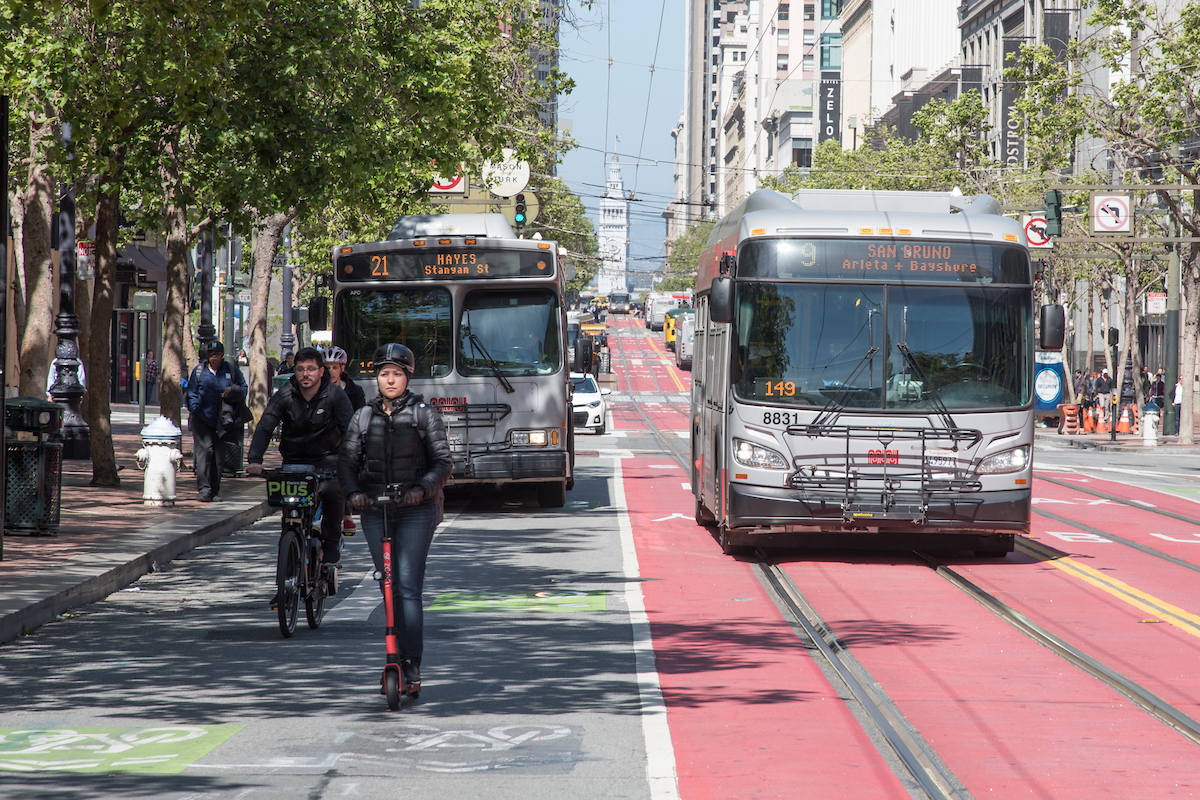
Two buses, a bicyclist, a pedestrian and person riding a scooter all on Market Street.

Transit on Market Street in downtown San Francisco, 2018

It’s been a half-century since the San Francisco Board of Supervisors put transit needs above all other traffic initiatives, and now, the city’s Transit-First policy is celebrating its golden anniversary. The policy guides the city’s work on major infrastructure projects and planning efforts. Its principles drive San Francisco officials to promote incentives that reduce traffic congestion and solo vehicle trips, support transit investments including the purchase of Muni buses and light rail vehicles, and regularly evaluate how well our transportation network functions. 

Adopted on March 19, 1973, the original Transit-First policy was born out of an effort to reshape the Municipal Railway so it could serve San Franciscans' needs more effectively. The goals were very specific: 

  • Create exclusive bus lanes and prohibit automobiles from streetcar and cable car tracks. 
  • Restrict turning movements of automobiles that conflicted with transit vehicles. 
  • Extend sidewalks at transit stops to allow boarding from the travel lane.  
  • Strictly enforce parking codes and tow-away regulations along major transit corridors. 
  • Consider the use of preemptive traffic signals for transit vehicles. 

By the early 70s, San Francisco streets had become increasingly crowded. The Freeway Revolt just over a decade earlier led to the cancellation of planned highway construction in the city, and an office boom downtown was bringing in thousands of commuters. Meanwhile, the San Francisco Bay Area Urban Renewal Association (SPUR) began a comprehensive review of Muni’s operations in 1972. The organization interviewed operators and management, conducted line checks and reviewed company properties and processes to identify areas for improvement. 

“The recurring theme was most Muni vehicles were operating in traffic. This was the source of many problems — schedule bunching, accidents, unhappy operators and riders,” said Jim Chappell, executive director of SPUR from 1994-2009. 

The recommendations in SPUR’s report, “Building a New Muni,” were well-received by the mayor and city supervisors, and the Transit-First policy was passed not long after its release. Transit-First also addressed concerns about increased air pollution and environmental damage by effectively putting the personal automobile on notice. 

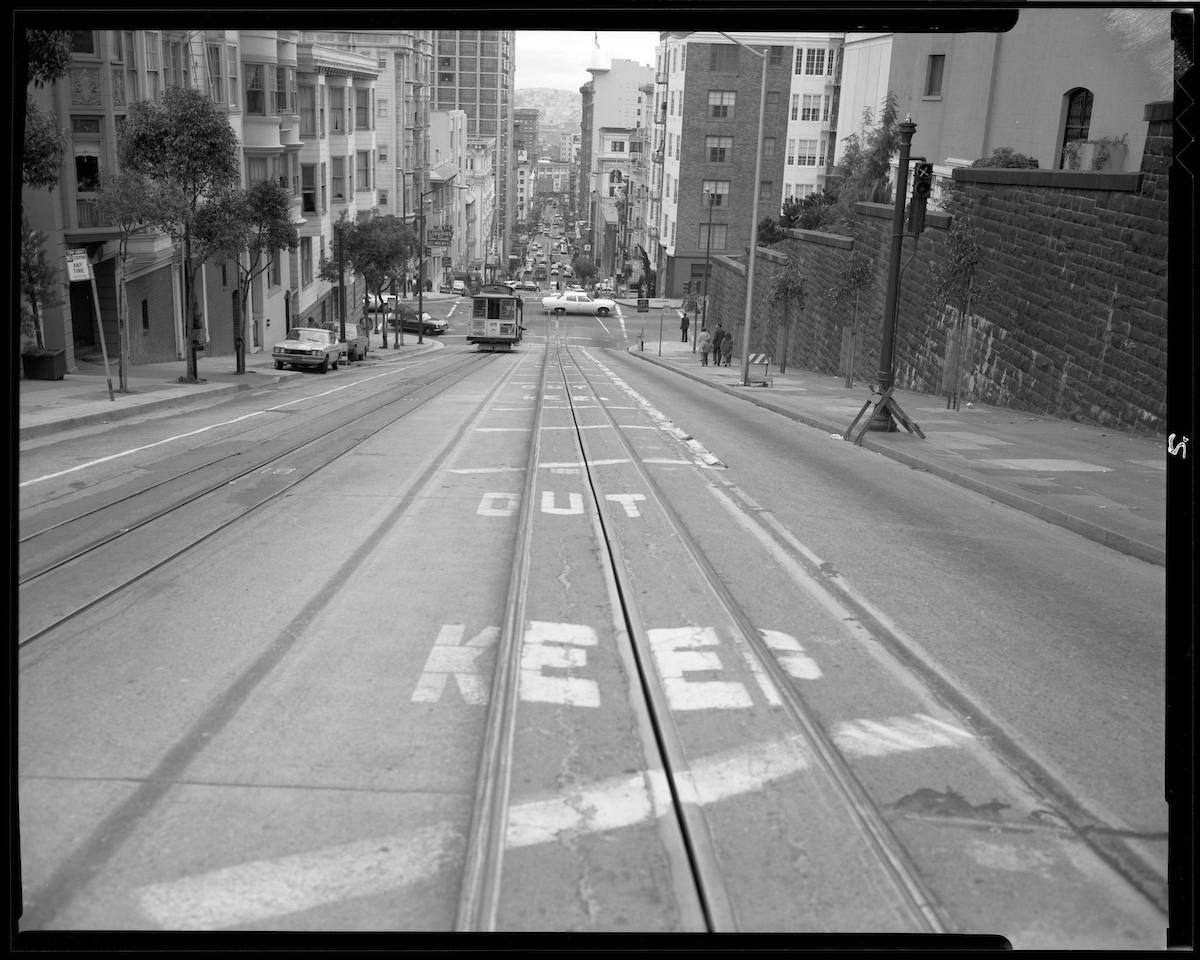
Cable car tracks with the words “keep out” painted over the street.

Transit-only lane along the Powell Street cable car tracks from California to Pine Street | November 27, 1973 

New equipment, transit priority and a focus on complete funding for Muni were initial hallmarks of the policy. The passage of Proposition E, a city charter amendment, in 1999 further enhanced Transit-First by including protections in the landmark legislation for people walking and bicycling. 

“San Francisco’s Board of Supervisors showed remarkable foresight in adopting the Transit-First resolution, and it no doubt helped San Francisco remain one of the strongest public transit cities in the nation,” said Jason Henderson, San Francisco State University Geography and Environment professor and author of Street Fight: The Politics of Mobility in San Francisco.  

In addition to making transit, walking and biking more attractive, Transit-First also promotes equity. When residents have options beyond cars, employment and economic opportunity can grow, as does the opportunity to reduce greenhouse gases. 

Professor Henderson believes San Francisco was the first city in the country to adopt a policy to prioritize public transit, but that doesn’t mean the work is done. “Transit-First must no longer be advisory,” he said. “[New policies are] needed so that public transit, cycling and walking are more than aspirational.”   

In recent years, the “Muni Forward” program has reflected the Transit-First policy with 80 miles of transit priority street improvements. Among those improvements, diamond-marked transit lanes have evolved to become the present-day “Red Carpet” lanes reserved exclusively for buses and taxis to reduce travel times and the impact of traffic congestion on Muni schedules. Meanwhile, Market Street has gone through various redesigns in the downtown area over the years. Following boarding island and lane improvements, San Francisco’s busiest thoroughfare received its first red transit lanes in 2014 and was declared “Car Free” in a monumental celebration on January 29, 2020. 

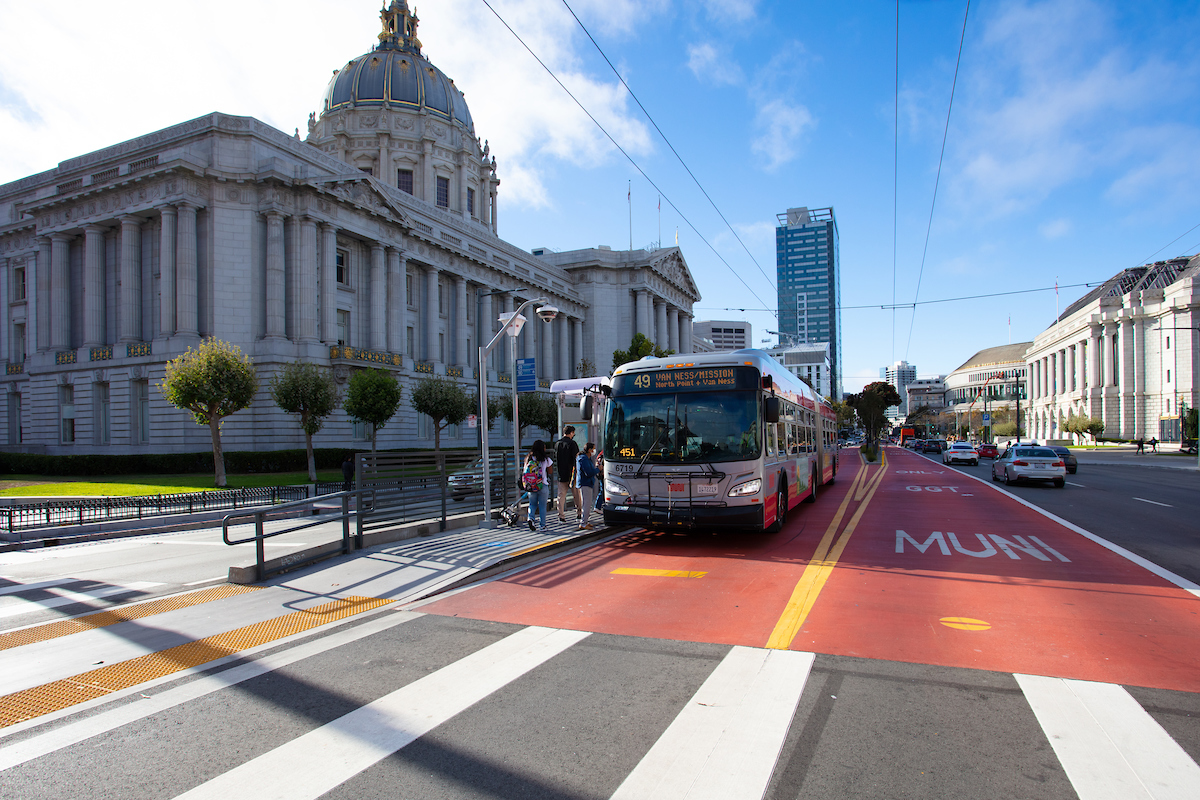
Three people board a Muni bus on Van Ness Avenue in front of City Hall.

Riders board a 49 Van Ness/Mission bus near City Hall 

Today we can see the Transit-First policy in action in the now open Central Subway and projects such as the Van Ness Bus Rapid Transit (BRT) corridor and the Muni Forward L Taraval Improvement Project that is now under construction to add transit lanes, make the route more accessible and improve pedestrian safety and visibility. With Transit-First entering its 51st year, there are new challenges as the COVID-19 pandemic has driven many people back into private cars. However, the SFMTA’s improvement projects continue with a focus on proven strategies that make transit, walking and bicycling the city’s preferred modes of travel. 


Published March 17, 2023 at 11:12PM
https://ift.tt/fIF8Kj2

June 10 Muni Service Changes Adds Service on Connector Routes

June 10 Muni Service Changes Adds Service on Connector Routes By Clive Tsuma The 38R Geary Rapid will run every 6 minutes starting June 1...