Friday, July 30, 2021

Creating Sustainable Change in Downtown San Francisco

Creating Sustainable Change in Downtown San Francisco
By Shayda Haghgoo

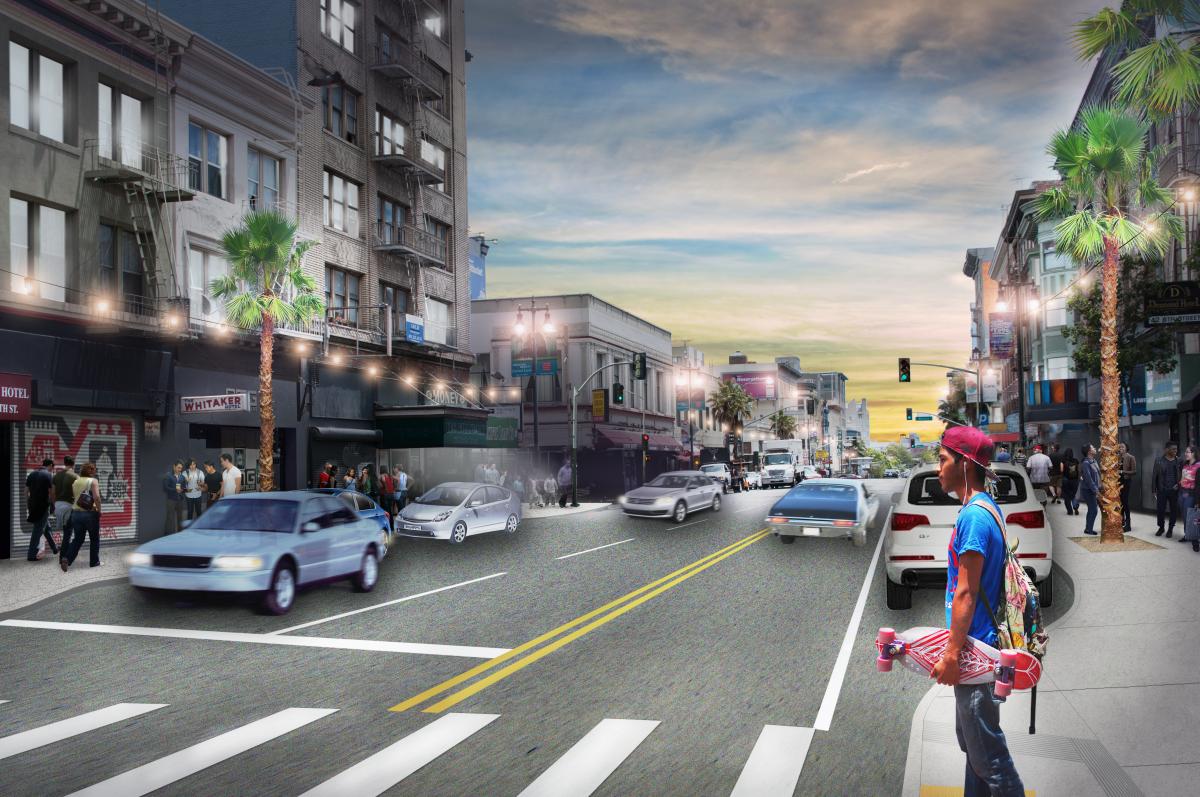
Rendering showing completed improvements on 6th Street between Market and Howard Streets

Rendering of 6th Street between Market and Howard Streets

When planning for new projects in Downtown San Francisco, the SFMTA must look at potential sites through multiple lenses:  

  • How did previous planning decisions that funnel traffic through the Tenderloin to freeway onramps in SoMa influence existing street conditions?  

  • How can we leverage quick-builds and capital streetscape projects now to make the streets safer not only today, but far into the future as well? 

This dual-pronged approach allowed the SFMTA to address immediate safety issues along 6th and Taylor streets while collaborating with San Francisco Public Works to bring capital improvements to these corridors. 

6th and Taylor streets are among the 13%  of city streets that account for 75% of severe traffic injuries and fatalities known as the Vision Zero high-injury network. The communities that live along these corridors largely consist of seniors, children, people with disabilities, limited English proficient people, and lower-income families—all of whom face higher risks of traffic collisions resulting in injury and/or death.  

Both the 6th Street Pedestrian Safety and Safer Taylor Street projects were legislated in the fall of 2018. Within a year, the SFMTA constructed its first quick-build improvements along 6th and Taylor streets to address critical pedestrian safety needs. These included: 

  • Travel lane reconfigurations to calm traffic and limit last minute lane changes 

  • Signal changes and left-turn restrictions to manage traffic flow and reduce collisions 

  • Curb management and buffered parking lanes to prioritize passenger and commercial loading zones 

  • Painted safety zones and daylighting to slow fast turning vehicles and improve visibility of people walking  

These changes reduced opportunities for conflict between motorists and sidewalk users while accommodating the community’s various street usages. After implementation, evaluation showed a 21% decrease in vehicle speeds on average along 6th Street, and a 100% reduction in double parking along Taylor Street. Larger capital projects take time to design and bid, but the SFMTA did not have to compromise on street safety. The quick-build improvements were installed while the projects’ construction-heavy streetscape elements were still being refined. 
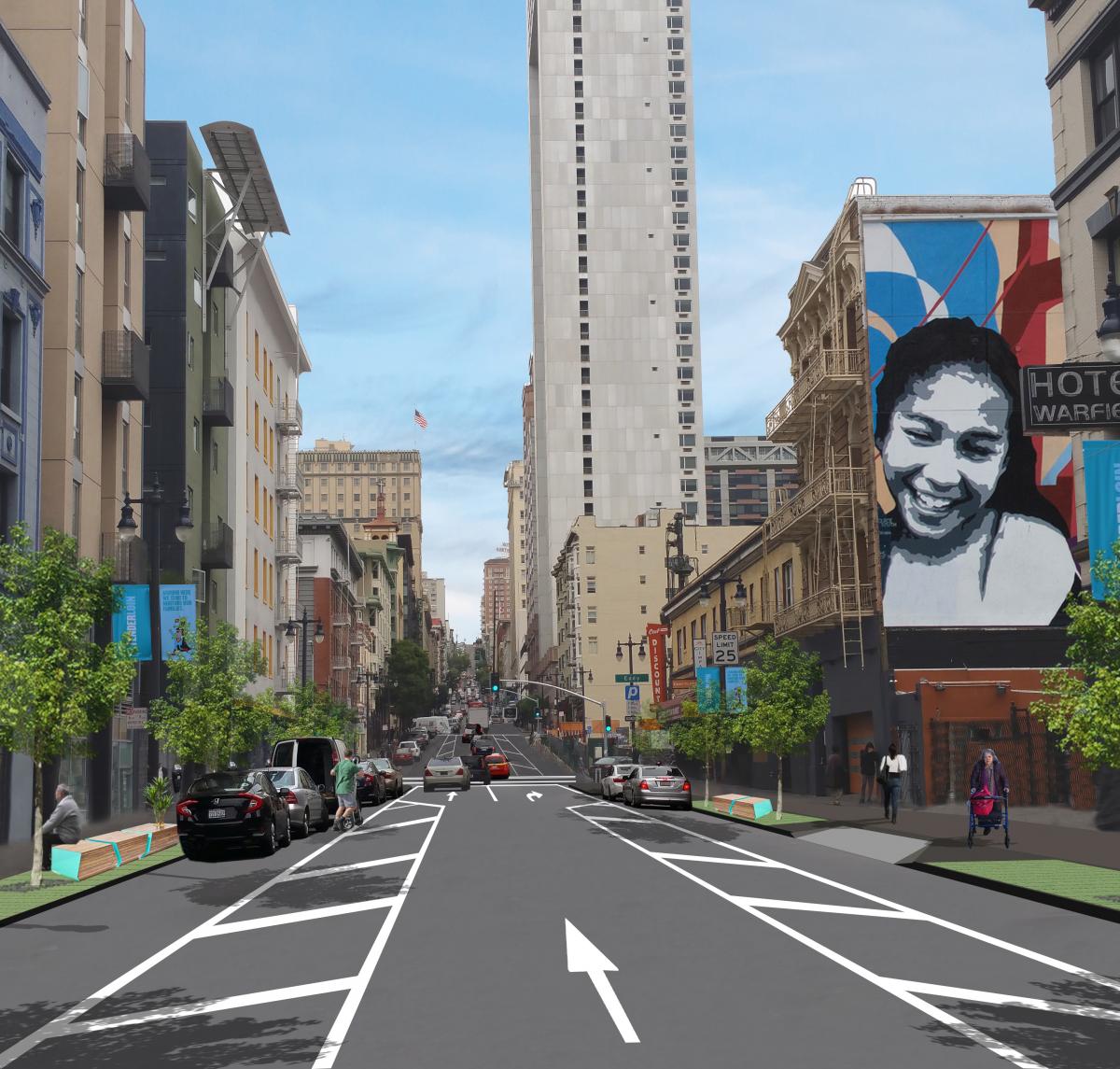
Photo rendering showing completed improvements on Taylor Street between Turk and Ellis StreetsRendering of Taylor Street between Turk and Ellis Streets 

While quick-builds address many of the immediate traffic safety needs, capital streetscape improvements like signal upgrades and landscape amenities will improve the quality of life by allowing protected and dedicated crossing times for people walking and creating inviting spaces. Many downtown residents live in small quarters like single-resident occupancy (SRO) properties, often with little to no outdoor space. The sidewalks along these corridors often function as an extension of people’s homes. Widening the sidewalks will enhance the space and allow a clear path of travel, especially for those using mobility devices, like wheelchairs.  

Capital improvements also allow for more possibilities to incorporate community elements and identity. 6th Street is part of the Filipino Cultural District, and both 6th and Taylor streets are part of the Transgender District, the first legally recognized transgender district in the world. Throughout the detailed design phase, we have been working closely with local groups such as SOMA Pilipinas and The Transgender District to implement community-identifying decorative crosswalks. These improvements will build off the previous quick-build work to further enhance safety and livability for people walking along these corridors.  

Since fall 2018, the SFMTA and Public Works teams have been diligently designing construction plans that include sidewalk widening with corner bulb-outs to shorten crossing distances and reduce speeds of turning vehicles, new and upgraded utilities and traffic signals and streetscape amenities such as new trees, benches, and decorative crosswalks. 

These project elements will continue to enhance the walking, biking, shopping, and living experiences of the 6th and Taylor Street communities. Due to unique issues below street level involving utilities and sub-sidewalk basements along the project corridors, these projects will require extensive construction.  

While the SFMTA led the planning and legislation processes of these projects, we will be handing the baton to San Francisco Public Works to manage implementation and construction communication. As construction begins, both agencies will continue to reach out to the community to minimize disruption to merchants, residents, and visitors along 6th and Taylor streets. For more information, please visit SFMTA.com/6thSt and SFMTA.com/Taylor


Published July 31, 2021 at 05:23AM
https://ift.tt/3rNZt6L

Creating Sustainable Change in Downtown San Francisco

Creating Sustainable Change in Downtown San Francisco
By Samantha Serafica

Rendering showing completed improvements on 6th Street between Market and Howard Streets

Rendering of 6th Street between Market and Howard Streets

When planning for new projects in Downtown San Francisco, the SFMTA must look at potential sites through multiple lenses:  

  • How did previous planning decisions that funnel traffic through the Tenderloin to freeway onramps in SoMa influence existing street conditions?  

  • How can we leverage quick-builds and capital streetscape projects now to make the streets safer not only today, but far into the future as well? 

This dual-pronged approach allowed the SFMTA to address immediate safety issues along 6th and Taylor streets while collaborating with San Francisco Public Works to bring capital improvements to these corridors. 

6th and Taylor streets are among the 13%  of city streets that account for 75% of severe traffic injuries and fatalities known as the Vision Zero high-injury network. The communities that live along these corridors largely consist of seniors, children, people with disabilities, limited English proficient people, and lower-income families—all of whom face higher risks of traffic collisions resulting in injury and/or death.  

Both the 6th Street Pedestrian Safety and Safer Taylor Street projects were legislated in the fall of 2018. Within a year, the SFMTA constructed its first quick-build improvements along 6th and Taylor streets to address critical pedestrian safety needs. These included: 

  • Travel lane reconfigurations to calm traffic and limit last minute lane changes 

  • Signal changes and left-turn restrictions to manage traffic flow and reduce collisions 

  • Curb management and buffered parking lanes to prioritize passenger and commercial loading zones 

  • Painted safety zones and daylighting to slow fast turning vehicles and improve visibility of people walking  

These changes reduced opportunities for conflict between motorists and sidewalk users while accommodating the community’s various street usages. After implementation, evaluation showed a 21% decrease in vehicle speeds on average along 6th Street, and a 100% reduction in double parking along Taylor Street. Larger capital projects take time to design and bid, but the SFMTA did not have to compromise on street safety. The quick-build improvements were installed while the projects’ construction-heavy streetscape elements were still being refined. 

Photo rendering showing completed improvements on Taylor Street between Turk and Ellis StreetsRendering of Taylor Street between Turk and Ellis Streets 

While quick-builds address many of the immediate traffic safety needs, capital streetscape improvements like signal upgrades and landscape amenities will improve the quality of life by allowing protected and dedicated crossing times for people walking and creating inviting spaces. Many downtown residents live in small quarters like single-resident occupancy (SRO) properties, often with little to no outdoor space. The sidewalks along these corridors often function as an extension of people’s homes. Widening the sidewalks will enhance the space and allow a clear path of travel, especially for those using mobility devices, like wheelchairs.  

Capital improvements also allow for more possibilities to incorporate community elements and identity. 6th Street is part of the Filipino Cultural District, and both 6th and Taylor streets are part of the Transgender District, the first legally recognized transgender district in the world. Throughout the detailed design phase, we have been working closely with local groups such as SOMA Pilipinas and The Transgender District to implement community-identifying decorative crosswalks. These improvements will build off the previous quick-build work to further enhance safety and livability for people walking along these corridors.  

Since fall 2018, the SFMTA and Public Works teams have been diligently designing construction plans that include sidewalk widening with corner bulb-outs to shorten crossing distances and reduce speeds of turning vehicles, new and upgraded utilities and traffic signals and streetscape amenities such as new trees, benches, and decorative crosswalks. 

These project elements will continue to enhance the walking, biking, shopping, and living experiences of the 6th and Taylor Street communities. Due to unique issues below street level involving utilities and sub-sidewalk basements along the project corridors, these projects will require extensive construction.  

While the SFMTA led the planning and legislation processes of these projects, we will be handing the baton to San Francisco Public Works to manage implementation and construction communication. As construction begins, both agencies will continue to reach out to the community to minimize disruption to merchants, residents, and visitors along 6th and Taylor streets. For more information, please visit SFMTA.com/6thSt and SFMTA.com/Taylor


Published July 31, 2021 at 05:23AM
https://ift.tt/3rNZt6L
Thursday, July 29, 2021

History in Motion: New Photos from the 1960s to 1980s Now Online

History in Motion: New Photos from the 1960s to 1980s Now Online
By Jeremy Menzies

We’ve been hard at work in the SFMTA Photo Archive and recently uploaded two large collections of photos from the early 1960s to the 1980s to our website. These photos, both color and black and white, give a glimpse into the day-to-day operations of Muni and the streets of San Francisco. Here’s a selection of shots from this brand-new batch of photos, many of which have not been seen outside the Photo Archive in years. 

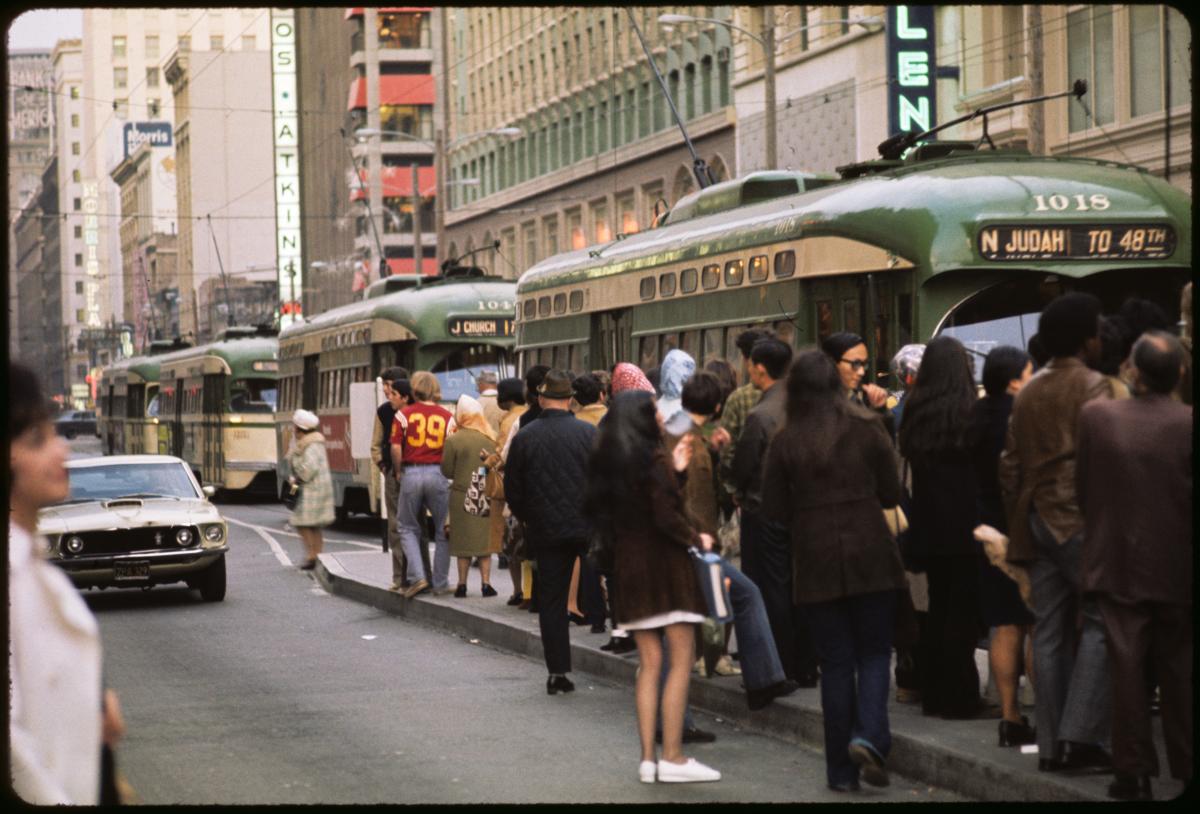
Muni platform overflowing with people as three streetcars approach and a car passes

This shot shows a typical evening rush hour scene from the mid-1970s taken at Market and Powell Streets. 

The color photos from this era are all part of a collection that was most likely used for presentations, studies and as general “stock” type photos of San Francisco, streets and Muni facilities and operations. Subjects include project documentation, copies of maps and charts, street scenes and “before and after” type photos showing Muni improvement projects being implemented. 

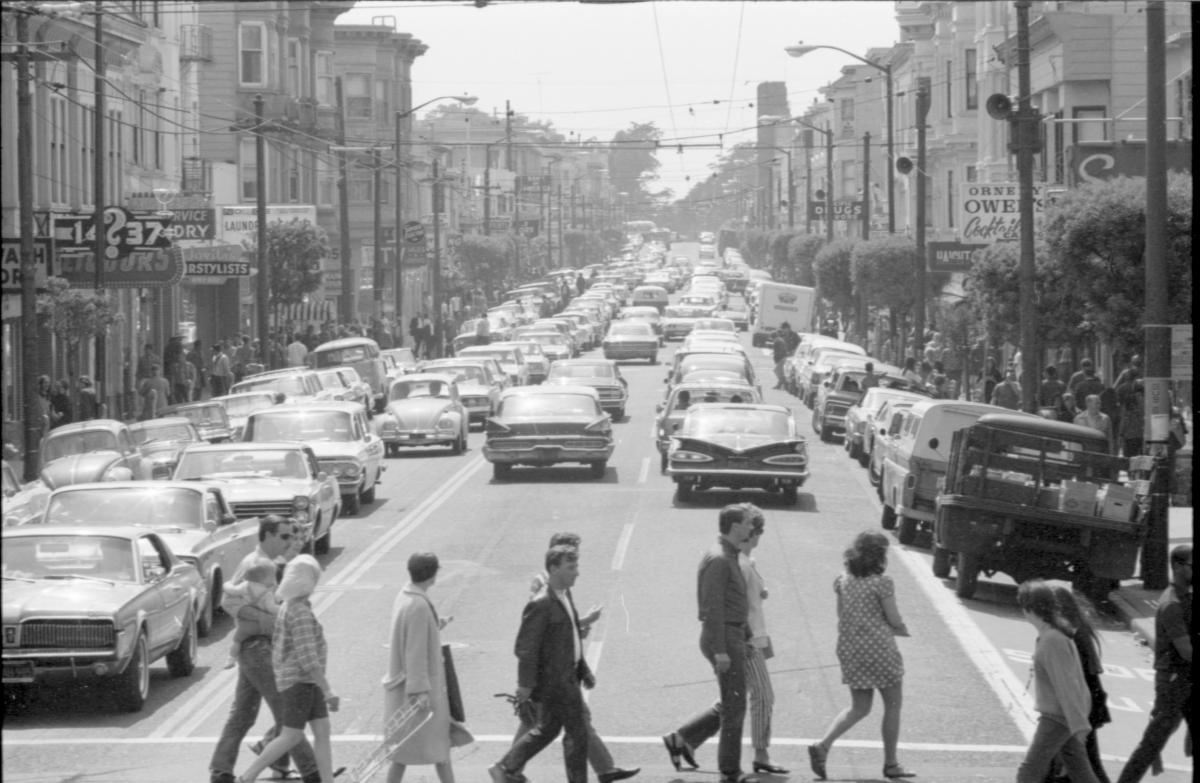
Photo of people crossing street in crosswalk. Street is full of classic cars.

This photo was taken on Haight Street during the 1967 “Summer of Love” to document the huge increase in traffic congestion along the corridor during that summer. 

The black and white photos from this new set of images were shot between 1962 and 1979 and cover a wide range of subjects from project documentation to typical street scenes, employee awards and public events. 

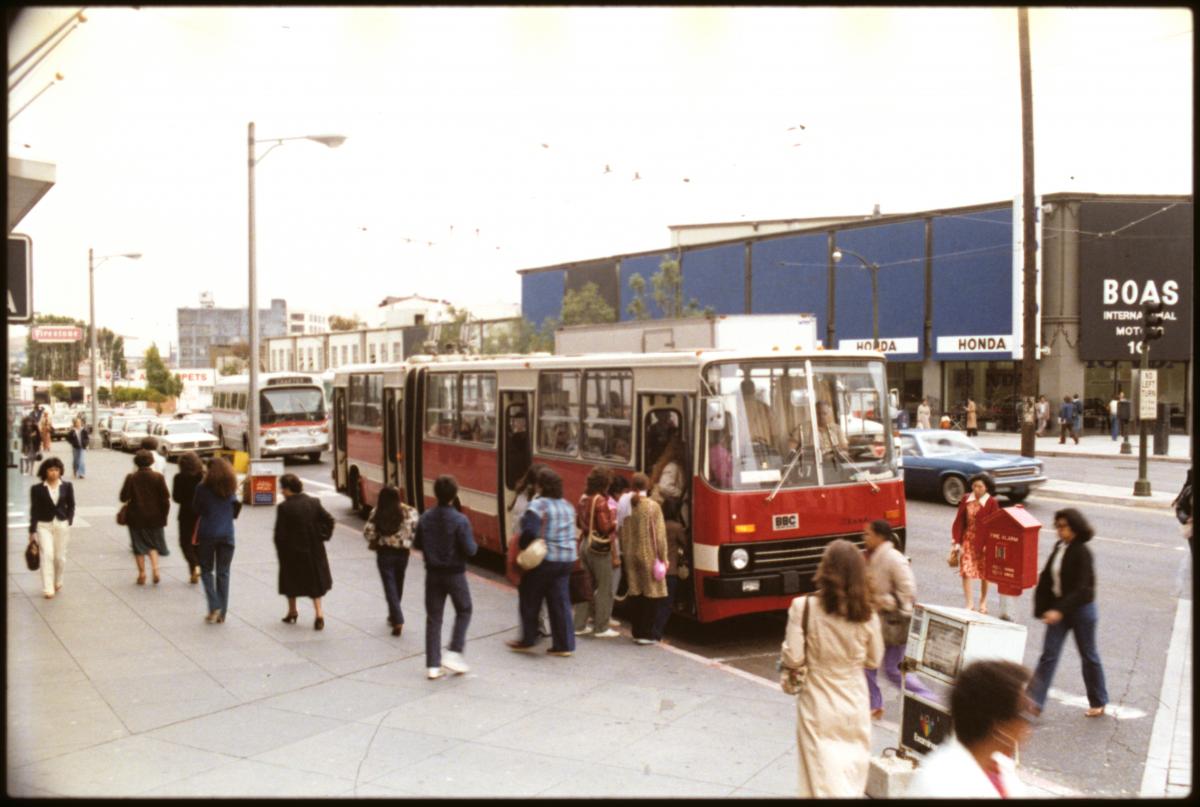
People boarding a Ikarus Articulating Bus on South Van Ness Avenue at Market Street

This articulated trolley bus was tested by Muni in the late 1970s-early 1980s, here it’s seen picking up passengers at Van Ness and Market.  Shots like this would have been used to show off the bus testing program at meetings. 

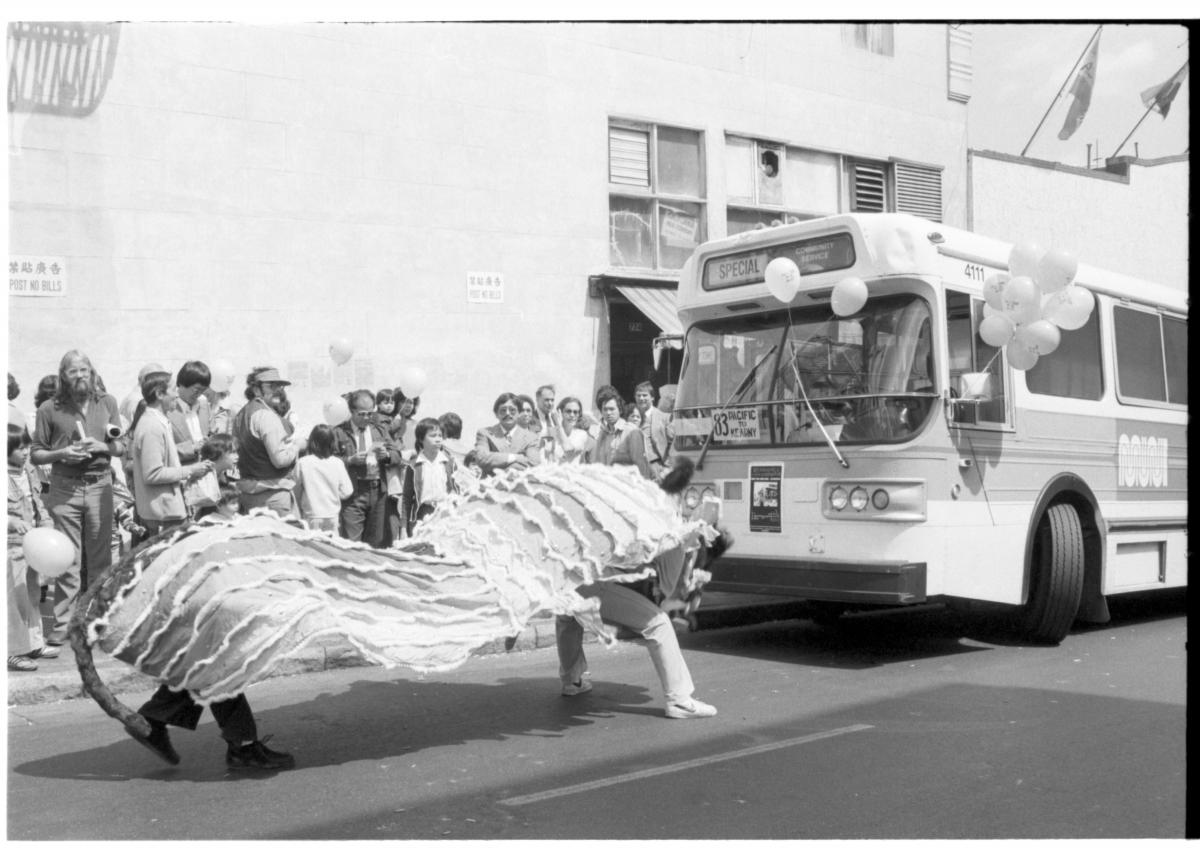
Lion dancers performing in front of a Muni bus

This shot from August 1979 was taken at an event to celebrate the launch of a new bus route, the 83-Pacific Avenue.  The 83 was part of Muni’s efforts to expand service to neighborhoods and create more transit connections outside of downtown.

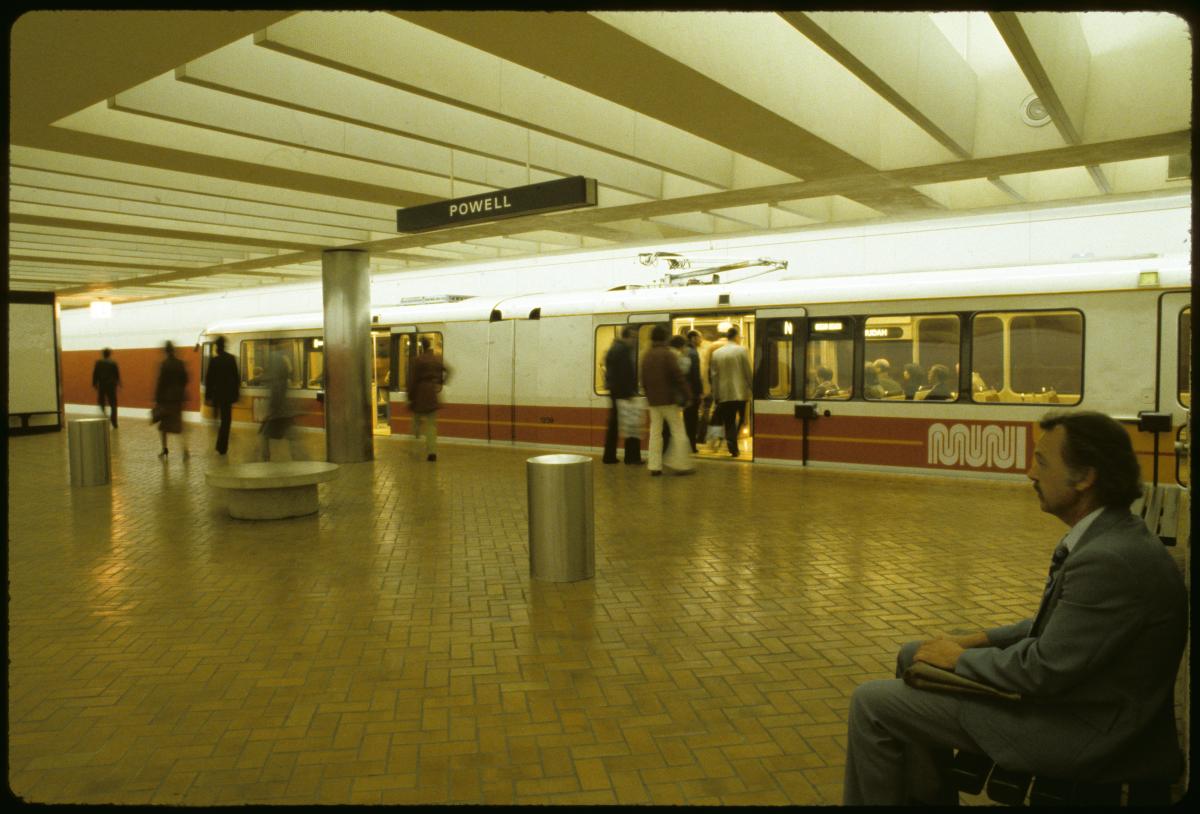
Man sitting in Powell Station as people board a Muni Metro

In the early 1980s, the Muni Metro subway system opened.  This shot inside Powell Station shows passengers boarding one of San Francisco’s first light rail vehicles, which were designed to operate above and below ground in the new system. 

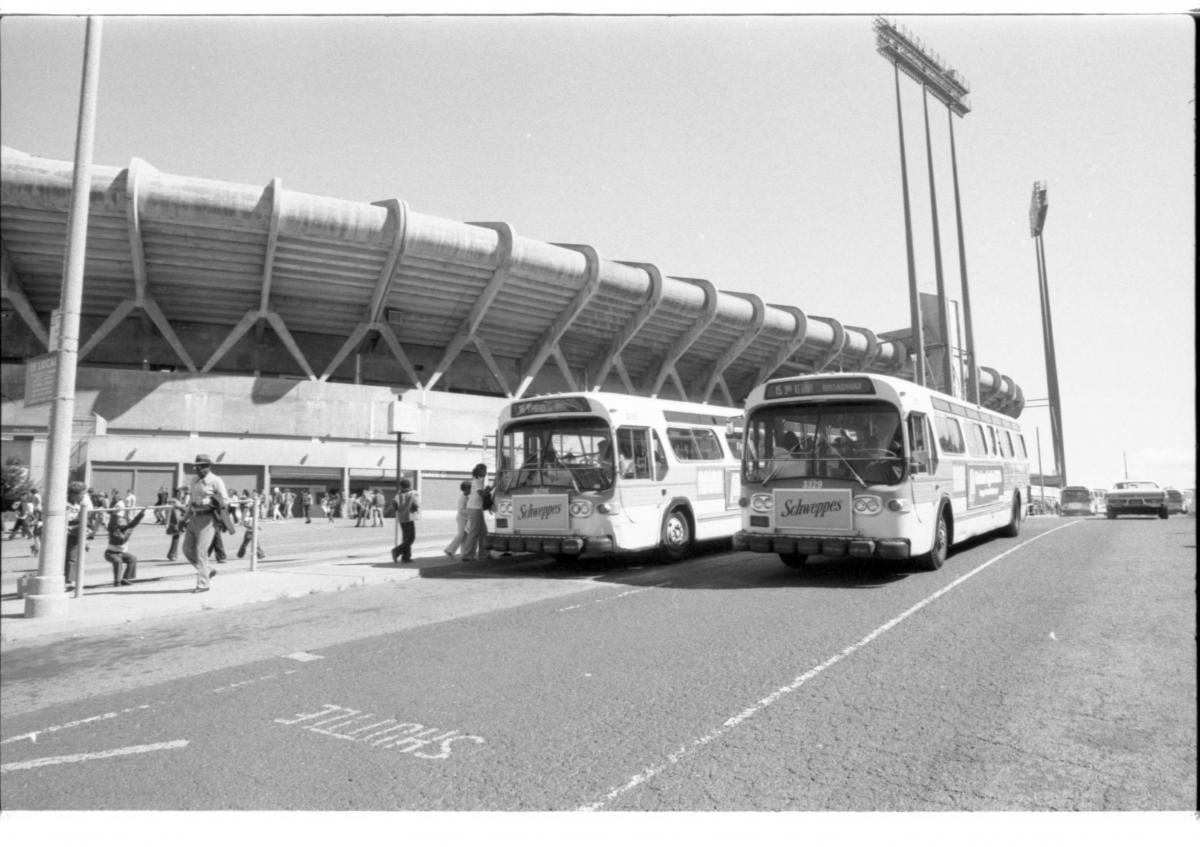
Muni buses outside Candlestick Park

Many long-time San Francisco sports fans will recognize this scene of Muni buses outside Candlestick Park in this late-1970s photo. Muni would operate special bus service to the park on game days to help get people to and from the arena. 

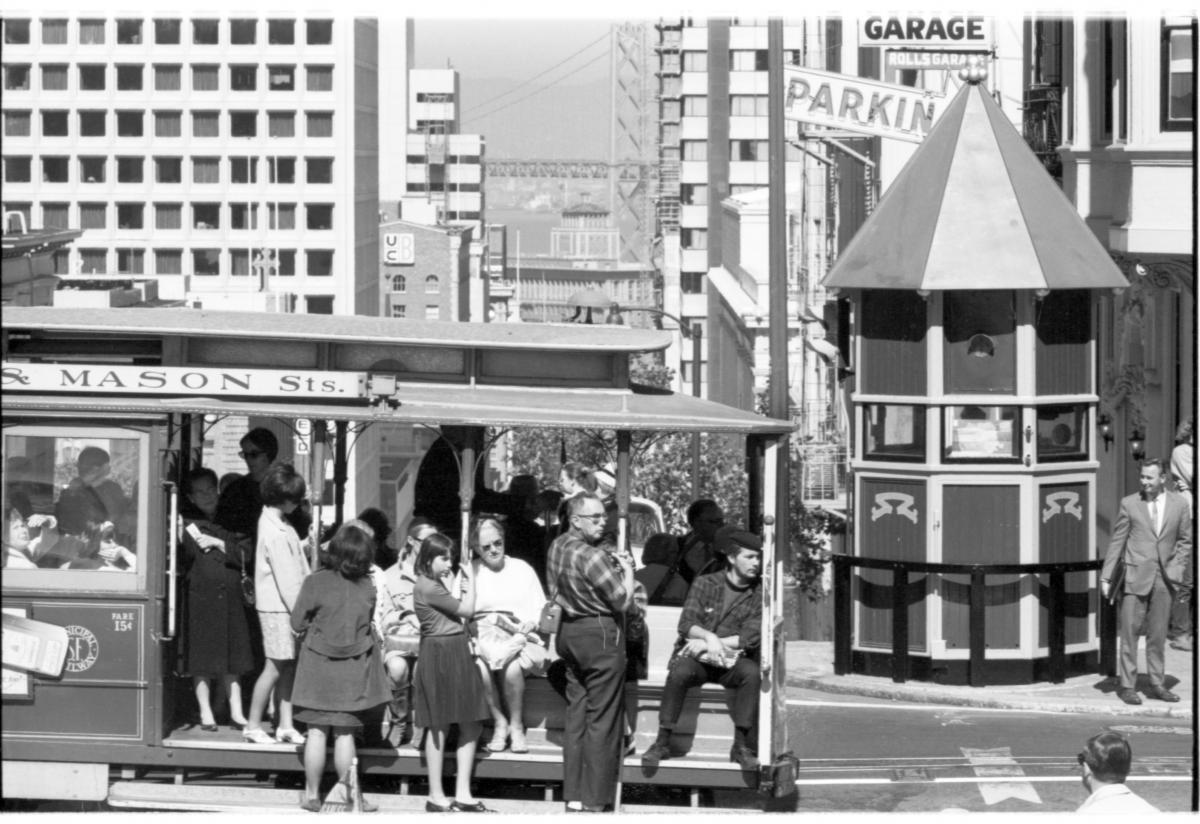
Cable car passes over top of Nob Hill

This classic cable car scene on Nob Hill shows a cable car crossing California Street on Powell with downtown and the Bay Bridge in the background. 

Altogether, there are over 1,700 photos now online that show Muni and San Francisco during an era of transition for the city and our transit system. Check them all out at SFMTA.com/photo


Published July 30, 2021 at 06:15AM
https://ift.tt/3idZduU

Tuesday, July 27, 2021

Destination San Francisco: Muni Gets You to All the Sights

Destination San Francisco: Muni Gets You to All the Sights
By

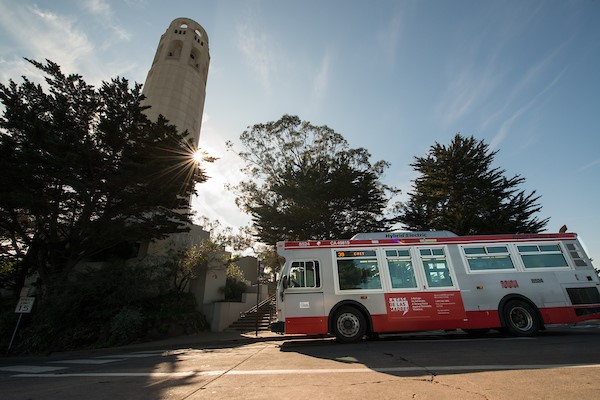
Photo depicting a Muni bus next to Coit Tower.

39 Coit servicing Coit Tower at Telegraph Hill – one of the routes that will be returning in August 2021 as part of Muni’s next service changes.

San Francisco is reopening and the SFMTA is supporting economic recovery by providing Muni access to 98% of the city. By August 2021, a majority of our pre-COVID routes will be back in service connecting residents and visitors with world-class shopping and dining experiences, off-the-beaten-path local flare, diverse neighborhoods and almost boundless outdoor activities. 

Shops, Markets & Dining in Diverse Neighborhoods 

Virtually every neighborhood in San Francisco has its own boutique shopping and dining experiences, as well as unique farmers markets showcasing local shops and amenities.  

With service to 24th Street in the city’s Latino Cultural District, the 67 Bernal Heights (restored August 2020) will take you to Alemany’s Saturday Farmers Market and Sunday Flea Market.  

Or groove on the 22 Fillmore (original Core Service route) through the Fillmore District – once known as the Harlem of the West – through the heart of the Mission for one of San Francisco’s world-famous burritos. Beginning August 14, 2021, late-night service will be extended to midnight on the 22 Fillmore and several other routes. 

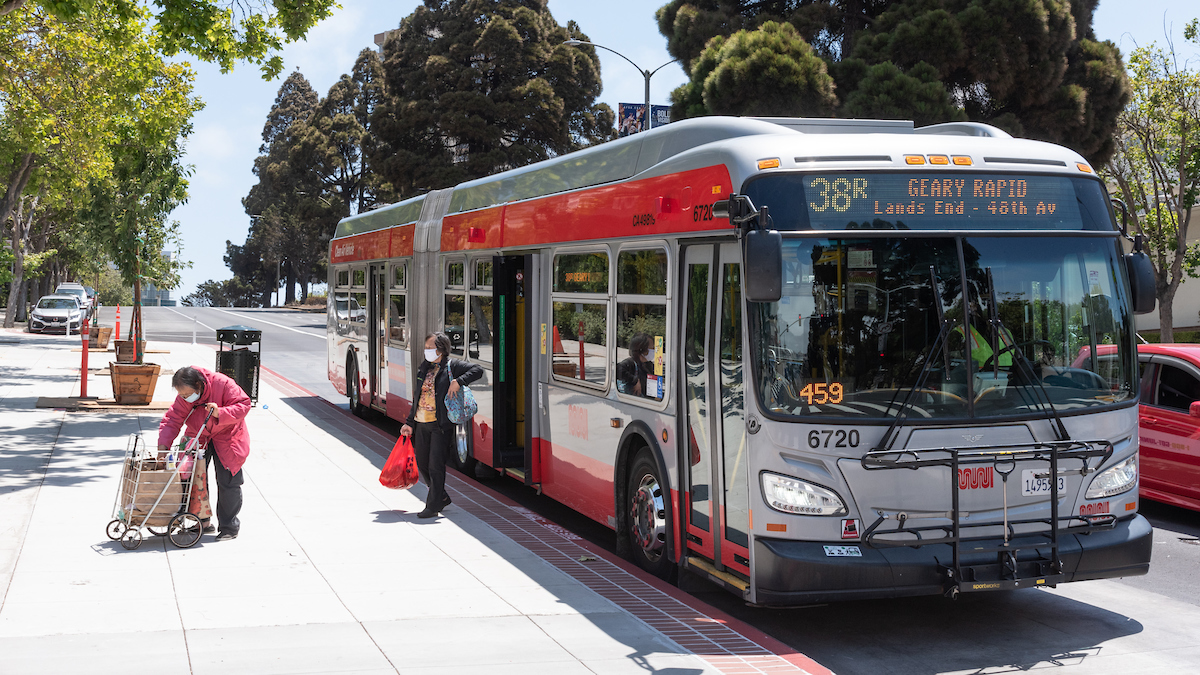
Take the 1 California (original Core Service route) from Embarcadero Center to the Richmond District, where you’ll find boutiques, quaint cafes, cozy restaurants, bakeries and a vibrant weekend farmers market. Then ride the 38 Geary or 38R Geary Rapid (original Core Service routes) to Japantown for a crepe and take home a bonsai tree to cultivate your COVID-19 green thumb. 

The KT Ingleside-Third Street (restored May 2021) connects Ingleside to Mission Bay and several Hunter’s Point-Bayview markets, passing through the Dogpatch where customers can find classic beignets and new sports bars. With proximity to the ballpark, Chase Center and waterfront, experience food, culture and local artistry in San Francisco’s historic African American neighborhoods.  

Want to explore the culinary heart of Chinatown? Catch the 45 Union (restored August 2020) or 8 Bayshore (modified May 2021) to Chinatown’s fresh produce and seafood markets. 

You can get an authentic taste of Italy in North Beach – one of San Francisco’s oldest neighborhoods and historic home of the city’s Italian American and Greek communities. Catch the 30 Stockton (modified August 2020) to Joe DiMaggio Park, or all the way to the restored Crissy Field marshlands.  

Get Outdoors 

Choose one of eight routes – soon to be nine on August 14 – to Golden Gate Park. See the list below. 

Take the 24 Divisadero to Sanchez Street, or the 55 Dogpatch to Arkansas Street, and enjoy the city’s most popular Slow Streets for some fun in the fog (or sun). Ride the 5 Fulton (original COVID-19 Core Service route) to a picnic in historic Alamo Square. 

The 9 San Bruno or 9R San Bruno Rapid (restored June 2020) will take you to Portola –known for its plentiful community gardens. Transfer to the 29 Sunset (original Core Service route) to visit McLaren Park, or the 44 O’Shaughnessy (original Core Service route) to explore picturesque Forest Hill.  

For a swing on Billy Goat Hill, take the 24 Divisadero (original Core Service route) then ride to the Castro and catch the F Market & Wharves (restored May 2021) historic streetcar to the bocce courts at Justin Herman Plaza. 

If a day by the ocean is what you seek, the N Judah (restored May 2021) takes customers out to La Playa for a stroll on the Great Highway temporary promenade. Stop by the Sunset Farmers Market and Mercantile first or grab a bite along Judah Street. 

More Connections Coming in August  

In August, with the return of the 39 Coit and the 35 Eureka, you can almost touch the stars from one of San Francisco’s renowned hills and connect to neighborhoods like West Portal, the Outer Sunset, Bernal Heights and Merced Manor. Read our blog to learn more. 

Looking for help with homework as schools reopen? Every San Francisco public library is within steps of a Muni stop. Plan your tips to school with our Back-to-School resources and sign up for the Free Muni for Youth Program

We also plan to ring in the fall by reintroducing the historic Powell-Hyde Cable Car line in September. Enjoy the night lights of Union Square to the hot chocolate of Ghirardelli’s. 

Whether you’re coming from out of town, getting kids back to school or planning your “staycation,” let Muni be your guide on one of our many great routes! 

Muni routes to Golden Gate Park: 

  • N Judah - serves Tenderloin, Chinatown and SoMa 

  • 5 Fulton - serves Western Addition, Tenderloin, Chinatown and SoMa 

  • 7 Haight 

  • 18 46th Avenue - returning August 14 

  • 28 19th Avenue 

  • 29 Sunset - serving Oceanview/Ingleside, Excelsior/Outer Mission and Visitacion Valley 

  • 33 Ashbury - serving the Mission 

  • 43 Masonic - serving Oceanview/Ingleside 

  • 44 O'Shaughnessy -  serving Excelsior/Outer Mission and the Bayview 


Published July 28, 2021 at 12:34AM
https://ift.tt/3x94ub5

Thursday, July 22, 2021

Muni Metro Debuts New International Wayfinding Standards

Muni Metro Debuts New International Wayfinding Standards
By Mariana Maguire

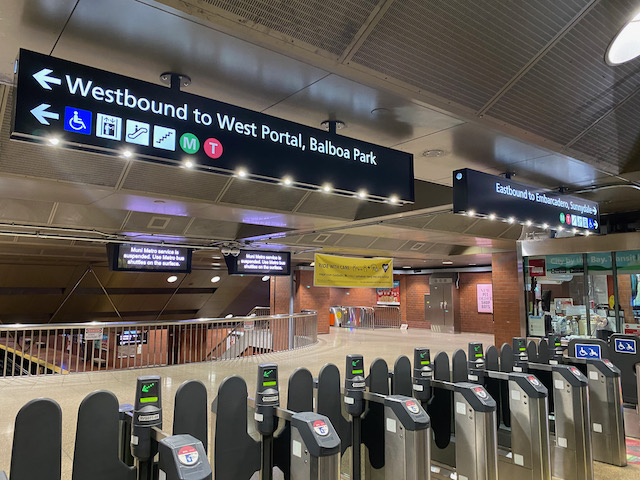
Photo of subway station fare gates with new overhead wayfinding signs depicting east, west directions and destinations for trains, and modes of accessing the platform such as elevators, stairs and escalators

New subway signage showing new directional wayfinding and accessible exists. 

When the Muni Metro subway reopened on May 15, 2021, customers noticed some changes at the Castro and Church stations: new overhead wayfinding signage more clearly identifying station exits and indicating where those exits lead, and new cardinal (north, south, east, west) directions, which now indicate where trains are headed instead of the former “inbound/outbound” directions.  

These stations – along with Powell Station, which will be updated soon – are part of the Metro Enhancement Project to improve the customer experience by providing better travel information, clearer wayfinding, cleaner stations and safety improvements. Treatments depend on the station, but enhancement elements include paint, lighting and accessibility improvements. The project began with the Castro and Church stations because those are easier to update than the shared BART stations. Powell is next in line in preparation for the opening of Central Subway. Looking forward, the aim is to improve all Muni Metro stations once additional funding can be identified. 

Customers may also see cardinal directions on digital signs in other subway stations. This is a separate effort that is part of Muni Customer Service upgrades. 

The Need for Change 

When the Muni Metro subway system was built in the 1980s, all rail routes funneled downtown along Market Street, making the “inbound” (generally towards downtown) and “outbound” (generally away from downtown) directions easy to navigate. In 2006, when the T Third Muni Metro line combined with the K Ingleside, the new combined route traveled into downtown from two different directions, making Muni Metro’s traditional “inbound/outbound” orientations less effective. 

In 2012, the Metropolitan Transportation Commission (MTC) – the transportation planning, financing and coordinating agency for the nine-county San Francisco Bay Area – adopted regional transit wayfinding guidelines and standards, and the SFMTA began working with other transportation agencies on a long-term plan for regional wayfinding integration and standardization, so that customers can navigate different systems in similar ways using route end destinations (last stops), station exit signage and accessibility information. 

The development of Central Subway also pushed SFMTA to think critically about wayfinding and directional improvements to the Muni subway system, including the use of cardinal directions (north, south, east, west). Once the Central Subway is complete, the T Third Street route will realign to run north-south between two major job, population and commercial activity centers within the city, calling into question the concept of what is “inbound” and what is “outbound.” 

For San Franciscans who are accustomed to Muni, wayfinding may not pose much of a challenge. The inbound/outbound directions may even hold a nostalgic charm, including for this author, having grown up in the Sunset District riding the N Judah. 

But with the growth of Muni and other regional transit systems, it’s important to make navigating the Muni Metro subway more efficient and effective with proven best practices for wayfinding, route directions and accessibility. 

Next Steps 

There are still many steps to fully update the Muni Metro subway that tie together with SFMTA’s new, soon-to-be-rolled-out Muni Customer Information System, long-term Metro map and permanent signage updates and more. The SFMTA also needs support to identify additional funding to continue implementing this project in all Metro stations. 

Tell us what you think about SFMTA’s efforts to update and upgrade our wayfinding to regional and international standards, and let us know if you support the completion of these efforts throughout the Muni Metro system. Write to TellMuni@SFMTA.com with the subject “Metro wayfinding enhancements.” 


Published July 23, 2021 at 04:59AM
https://ift.tt/3xZ8iwJ

Wednesday, July 21, 2021

South Van Ness and Mission Intersection Closure August 4-9

South Van Ness and Mission Intersection Closure August 4-9
By John Gravener

With the recent completion of the new red transit lanes along Van Ness Avenue, the Van Ness Improvement Project is now focused on its upcoming Mission Street closure as the project works to complete construction later this year. 

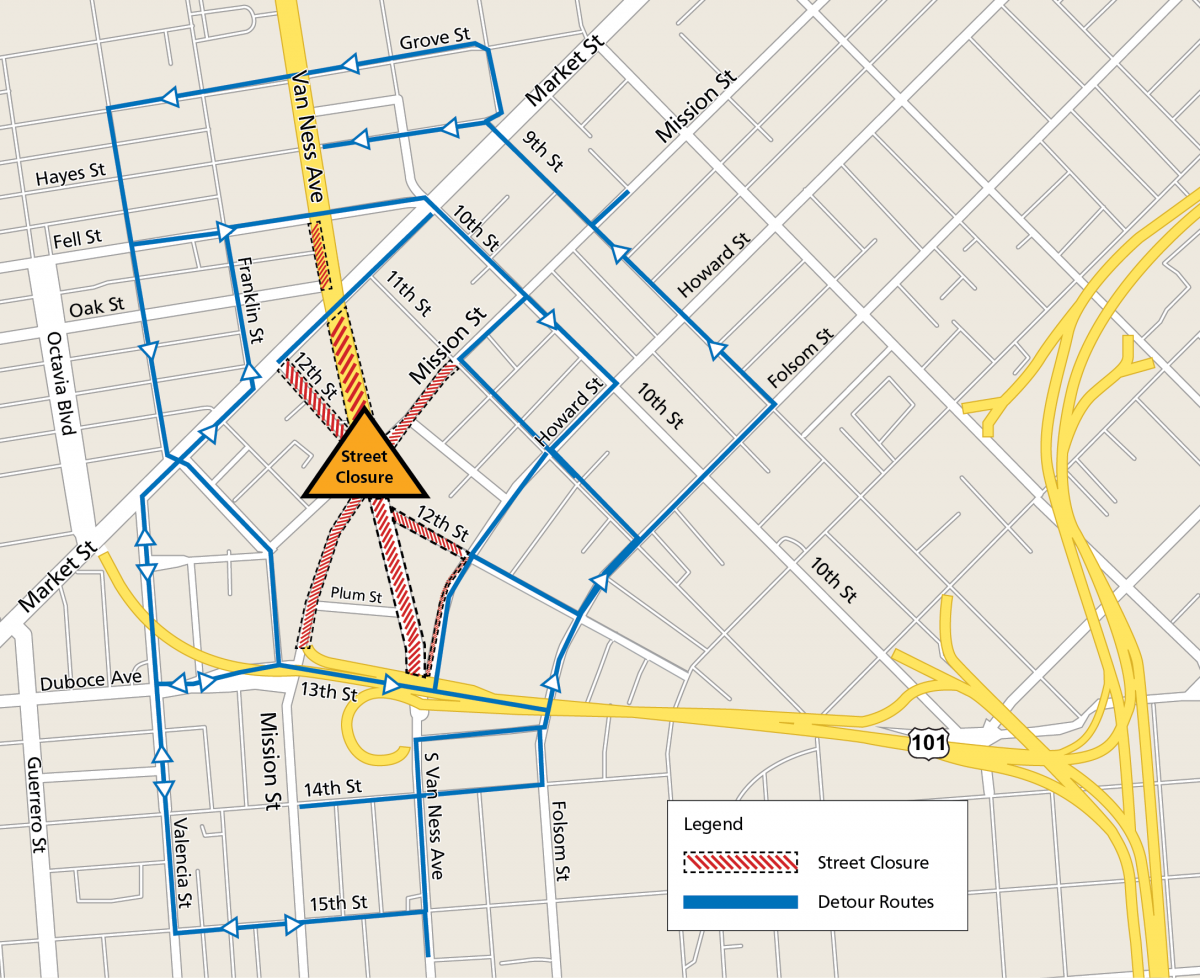
The major intersection closure, scheduled for August 4-9, is planned to reduce the duration of the work there. By closing the full intersection for five days, the team can complete work in the intersection that would normally require two months of work completed one segment at a time. The goal is to minimize inconvenience for the public.

Map of Van Ness Avenue and Mission Street intersection showing detours and street closures. Streets closed to traffic include South Van Ness Avenue south of Market, Mission Street one block west of 11th Street, 12th Street north of Howard, South Van Ness north of Highway 101, Highway 101/Mission Street highway exit, and 12th Street south of Market will all be closed to traffic. Detour streets include Howard Street, Folsom Street, 10th Street, 9th Street, 13th Street, Duboce Avenue, Gough Street, Franklin Street, Fell Street, Hayes Street and Grove Street can all help you avoid the closed intersection.Map of Van Ness Avenue and Mission Street intersection with reroutes.

Once the construction during the intersection closure has been completed, there will be just a few more milestones left for the Van Ness Improvement Project before construction wraps up later this year. New overhead powerlines for transit lines will be installed. Additionally, crews will begin installing landscaping and irrigation systems, as well as pedestrian bulb-outs on sidewalks to aid in safer crossings for people walking.  

The project website details the available reroutes and provides additional information for motorists. While pedestrian access will be maintained at all times, people walking should consider bypassing the area. Transit will be rerouted, with Muni and AC Transit bus stops relocated and highly visible signage posted. Muni Metro and BART service will not be affected.

Once construction is complete, San Francisco’s first Bus Rapid Transit (BRT) system, a much needed and globally proven solution to improve transit service and address traffic congestion on Van Ness, is expected to begin operation in early 2022.   

In addition to the building of the BRT, the multi-agency Van Ness Improvement Project has also included the replacement of 1800s-era water main to better withstand a major earthquake, new streetlights that are more power-efficient and brighter, installation of the overhead contact system that provides 100% emissions-free hydroelectric power from Hetch Hetchy—the city's municipal power source—to power the buses, new landscape to beautify the corridor, and new pavement on Van Ness for smoother travel and sidewalk extensions for a safer experience for people walking. Completion of the project is in sight, with construction projected to finish by the end of the year.

The August 4-9 closure will impact people driving, biking, taking transit and walking in SoMa, Tenderloin, Civic Center, Hayes Valley, Downtown and Inner Mission. The South Van Ness and Mission Street intersection will be closed at all times, as well as the roads leading to the intersection. People who travel in the area are encouraged to “Scout Your Route” before the shutdown and plan their travel accordingly.

Thank you to all the residents and travelers who have remained patient through the traffic reroutes, dust and noise! We appreciate your support and are excited to welcome you on to the new BRT in early 2022. 


Published July 22, 2021 at 08:32AM
https://ift.tt/3wUq8j9

Tuesday, July 20, 2021

Going Back to School with Muni

Going Back to School with Muni
By Shalon Rogers

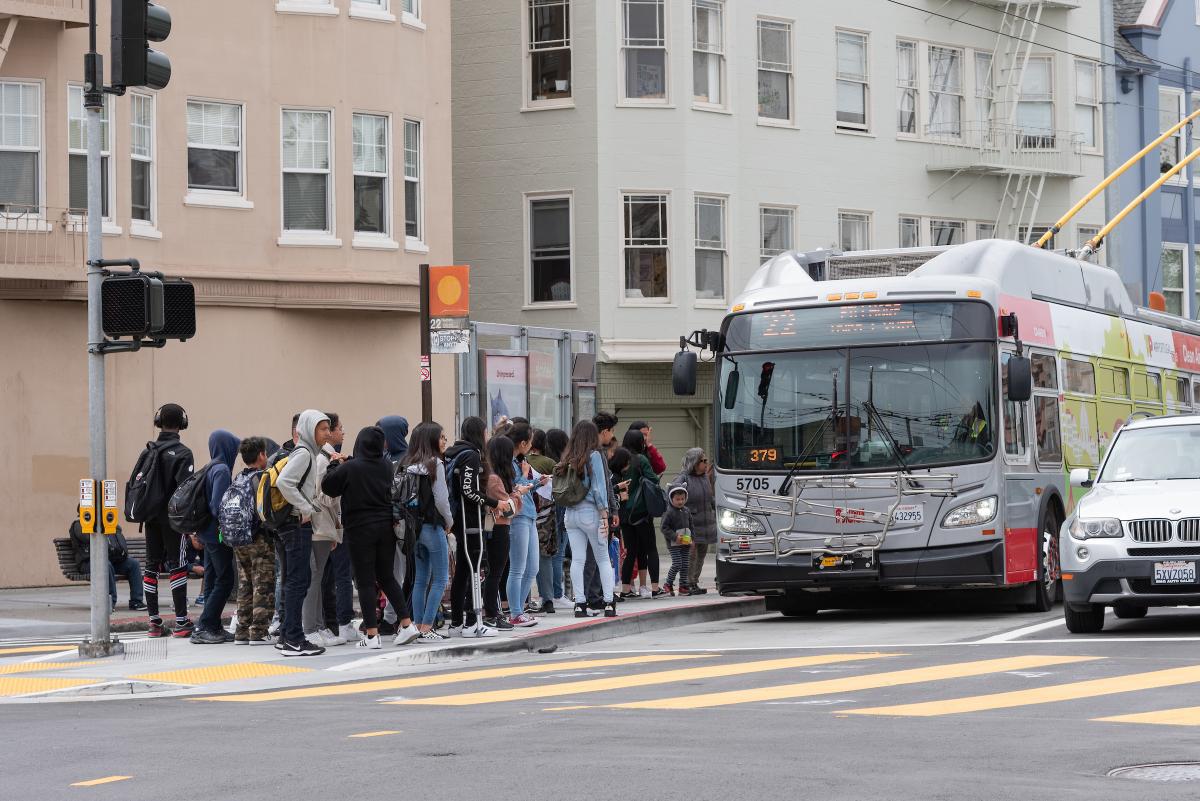
Students board at transit boarding island on 22 Fillmore route near Marina Middle School

Schools are returning to in-person instruction in August. If you have school-aged children at home, then you likely have a back-to-school checklist that includes reliable, efficient transportation. 

Many parents and guardians rely heavily on Muni to get their children to and from school which is why households will see Muni service restoration continue in August, so that 98% of San Francisco residents will be within two to three blocks of a Muni stop by the start of the new school year.  

To help take the guesswork out of what bus your child can take to school, the SFMTA has put together a list of Muni routes that serve SFUSD schools. This resource shows the closest transit options for all San Francisco public elementary, middle and high schools. 

With additional lines returning in August, including the 18 46th Avenue35 Eureka36 Teresita and 56 Rutland, you can rest assured that at least one or more Muni lines will provide transportation to the area of your child’s school.  

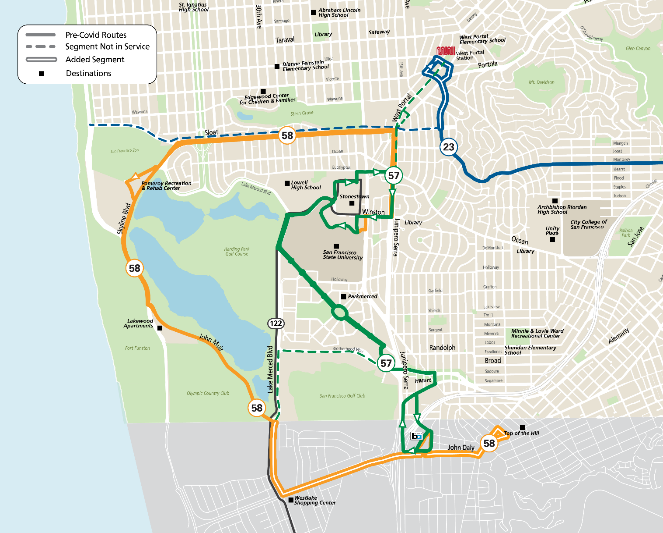
Before hitting the road to school though, it’s important for families to know that some of Muni’s routes have been modified. For example, beginning in August, the returning 52 Excelsior and 66 Quintara will both provide service for route segments of the 6 Parnassus, and the returning 23 Monterey will terminate at West Portal station and no longer serve Sloat Boulevard as the new 58 Lake Merced (the new route page will be added to our website soon!) route will now cover Sloat.  

Map showing 57 Parkmerced service between Eucalyptus Drive & Junipero Serra Boulevard and Daly City BART Station, providing direct connections from Stonestown and Parkmerced to BART and KT Ingleside-Third Street and the new 58 Lake Merced route along John Muir Drive

Route map showing the new routing for the 57 Parkmerced and the 58 Lake Merced. 

Some Muni school trippers will also return in August. School trippers are extra buses on existing routes that meet students after school at some of the city’s largest middle and high schools. They begin their route near a school site to help prevent crowding and pass ups on busy Muni lines after school, and then continue along their regular route. Schools served by a school tripper can be found on the Muni Routes to City Schools page. 

Once you’ve mapped out the best route to school, you’ll want to know the fare. And we have great news! Beginning August 15—the day before the first day of school--SFMTA’s Free Muni for Youth program will extend to all children under the age of 19. While no proof of age or Clipper Card is required for buses and trains, if your child is planning to ride the cable cars when they reopen later this year, make sure they have applied for that option.  

If riding prior to August 15th, you’ll want to make sure that your child’s Clipper card is full. Cash is always accepted as fare payment when boarding a bus, but by using a Clipper card, the single ride fare for youth will only be $1.25 versus $1.50 if using cash. Additionally, if you use an iPhone, you can now add the Clipper Card to your Apple Wallet.  

Though physical distancing requirements between passengers on Muni have ended, we do require passengers to maintain 6 feet of distance from the operator. Federal law requires properly worn masks while riding transit and at Muni facilities, regardless of vaccination status. You’ll want to make sure that a mask is packed in backpacks and remind your child that masks are required while riding Muni, with limited exceptions.  

With transportation to school now crossed off your checklist, enjoy the remaining days of summer with your kids. Ride the N Judah or KT Ingleside-Third to the ballpark for a Giants game, or one of our eight – soon to be nine – routes to Golden Gate Park to visit the Academy of Sciences, or take a historic trip on the F Market & Wharves. However you spend the remaining days of summer, know that Muni will help  get you and your family there. 

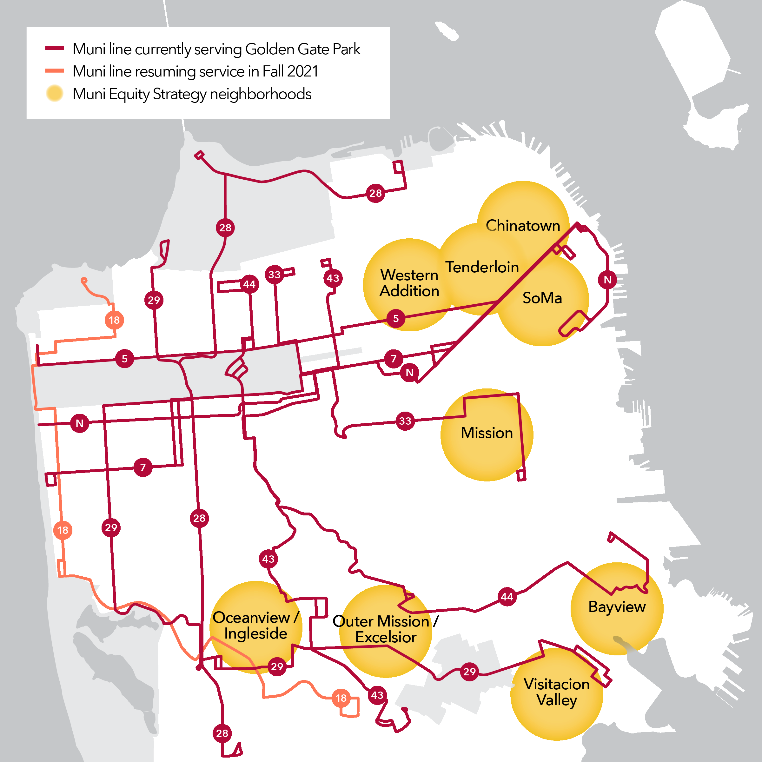
Map showing the Muni routes that serve Golden Gate Park (N, 5, 7, 28, 29, 33,43, 44), the 18 line resuming service in fall 2021 and the location of the Muni Equity Strategy neighborhoods (Bayview, Chinatown, Mission, Oceanview/Ingleside, Outer Mission/Excelsior, SoMa, Tenderloin, Western Addition).

Map showing city-wide Muni routes to Golden Gate Park. 


Published July 21, 2021 at 05:40AM
https://ift.tt/3xUMR01

Friday, July 16, 2021

Rolling Out the Red on Geary

Rolling Out the Red on Geary
By Liz Brisson

Transit lanes on Geary Boulevard east of Stanyan Street are about to receive the red carpet treatment. And with Geary Rapid Project construction nearing the finish line on time and on budget, it’s the perfect occasion for the corridor to be getting the ruby rollout.

But what’s so magical about the color red? In general, painting transit lanes red has been shown to improve compliance by about 50%. Studies of three downtown San Francisco streets found that red paint led to fewer violations by private vehicles, which reduces the number of collisions and makes Muni service more reliable.

And it makes sense: coloring transit lanes red makes it easier for drivers to know where they’re allowed to drive. By making transit lanes extra clear, you’re less likely to get a citation for unintentionally driving in a transit lane.

Learn about when it’s okay for drivers to access a transit lane.

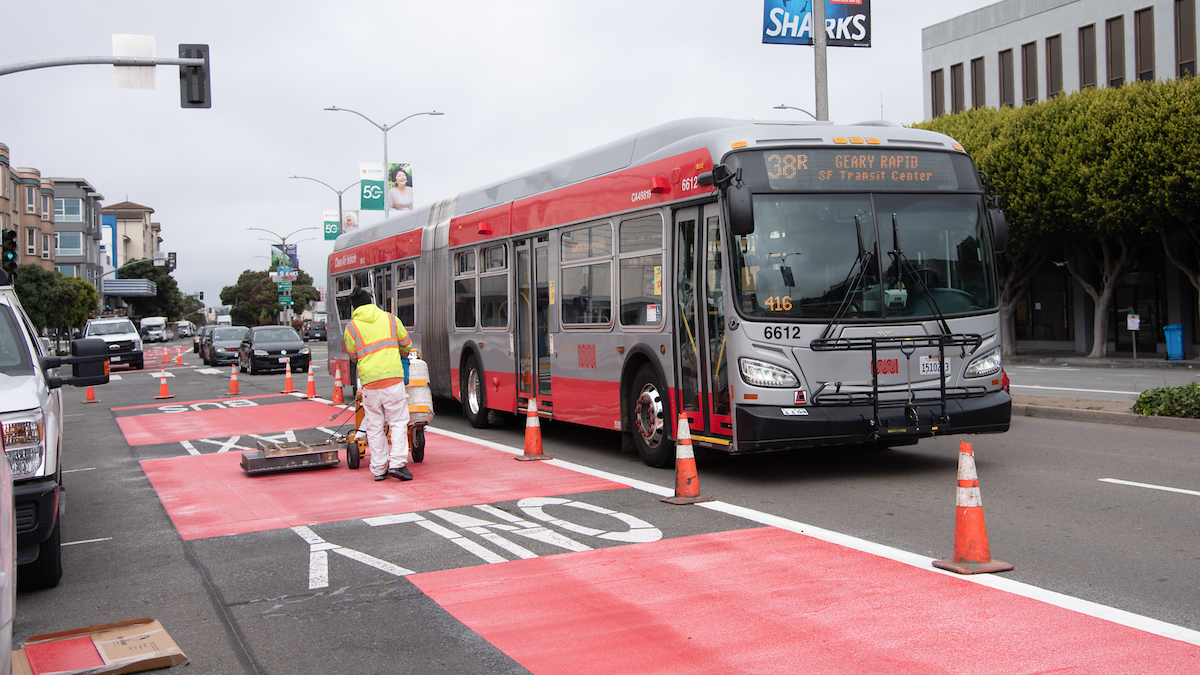
Photo of crew striping street with red paint on Geary
Red transit lanes mark the final step of the transit, safety and utility improvements that are being installed along the Geary corridor between Stanyan and Market streets as part of the Geary Rapid Project.

San Francisco is a leader in using red transit lanes to give buses and trains priority on the street. Following San Francisco’s success, many cities are now using this approach, including New York, Washington, DC, Portland, Seattle, Boston and more.

In the coming months you will start to see new red lanes installed along Geary Boulevard between Stanyan Street and Van Ness Avenue. Then later this fall, after utility and repaving work is completed, existing red lanes will be refreshed and new red lanes will be installed on Geary and O’Farrell streets east of Van Ness.

When the red treatments are completed, Geary will have gained almost 3.5 miles of red lanes along the corridor, bringing the citywide red transit lanes total to 22 miles, or about a 20% increase in red transit line mileage. 

Red lanes along Geary will add to the transit benefits that were realized when quick-build improvements—such as non-colored transit lanes, bus stop changes and traffic signal retiming—were made at the beginning of the Geary Rapid Project in late 2018. Those changes helped to speed up 38R Geary Rapid trips by up to 20% and improved reliability by 20%. In the coming months we’ll be crunching the numbers to understand the additional benefits of the red-colored transit lanes and other recently completed transit improvements like bus bulbs (sidewalk extensions at bus stops).


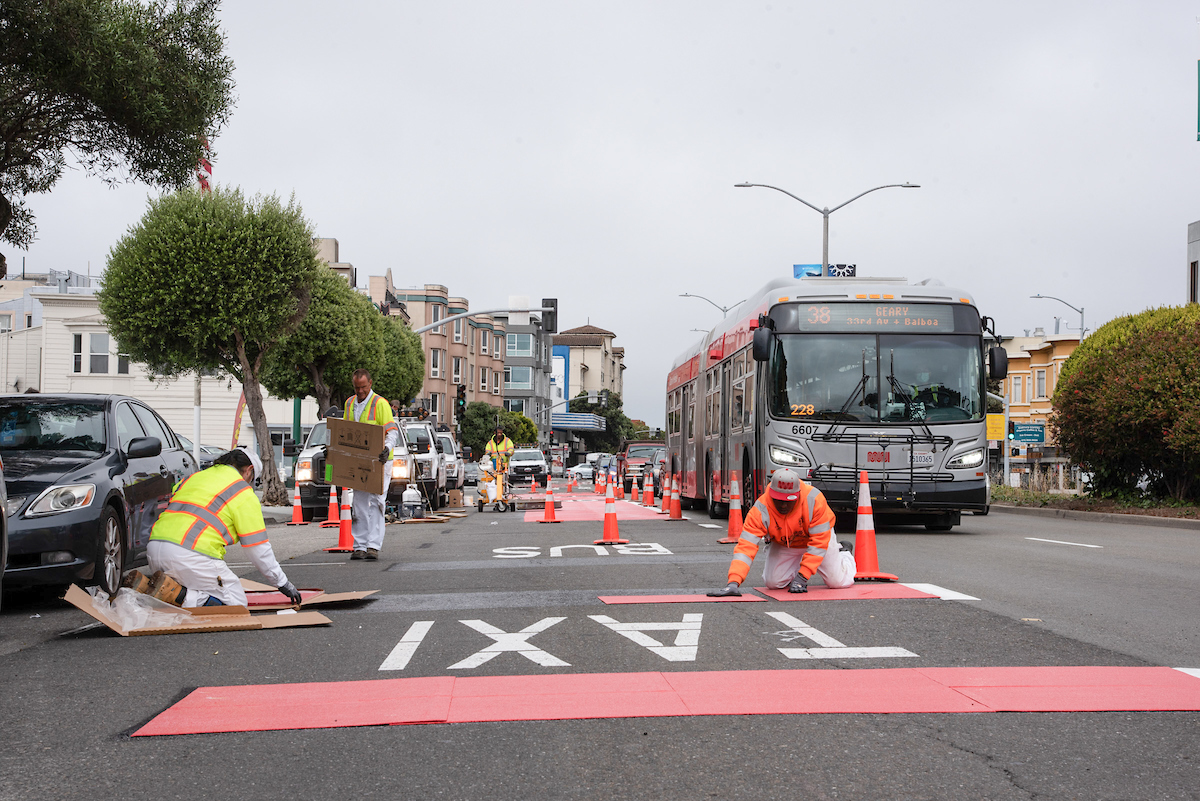
Photo of crew finishing red striping of Geary transit lane

Crews put the finishing touches on Geary Boulevard red lanes

Based on the success of San Francisco and other cities’ experiments, the Manual of Uniform Traffic Control Devices (MUTCD)—the national standards governing all traffic control devices—issued Interim Approval to use red transit lane treatments in late 2019. Now the 11th edition of the MUTCD is under development and is expected to include the treatment.


Published July 17, 2021 at 01:04AM
https://ift.tt/3z4ss8S

Rolling Out the Red on Geary

Rolling Out the Red on Geary
By Amy Fowler

Transit lanes on Geary Boulevard east of Stanyan Street are about to receive the red carpet treatment. And with Geary Rapid Project construction nearing the finish line on time and on budget, it’s the perfect occasion for the corridor to be getting the ruby rollout.

But what’s so magical about the color red? In general, painting transit lanes red has been shown to improve compliance by about 50%. Studies of three downtown San Francisco streets found that red paint led to fewer violations by private vehicles, which reduces the number of collisions and makes Muni service more reliable.

And it makes sense: coloring transit lanes red makes it easier for drivers to know where they’re allowed to drive. By making transit lanes extra clear, you’re less likely to get a citation for unintentionally driving in a transit lane.

Learn about when it’s okay for drivers to access a transit lane.

Photo of crew striping street with red paint on Geary
Red transit lanes mark the final step of the transit, safety and utility improvements that are being installed along the Geary corridor between Stanyan and Market streets as part of the Geary Rapid Project.

San Francisco is a leader in using red transit lanes to give buses and trains priority on the street. Following San Francisco’s success, many cities are now using this approach, including New York, Washington, DC, Portland, Seattle, Boston and more.

In the coming months you will start to see new red lanes installed along Geary Boulevard between Stanyan Street and Van Ness Avenue. Then later this fall, after utility and repaving work is completed, existing red lanes will be refreshed and new red lanes will be installed on Geary and O’Farrell streets east of Van Ness.

When the red treatments are completed, Geary will have gained almost 3.5 miles of red lanes along the corridor, bringing the citywide red transit lanes total to 22 miles, or about a 20% increase in red transit line mileage. 

Red lanes along Geary will add to the transit benefits that were realized when quick-build improvements—such as non-colored transit lanes, bus stop changes and traffic signal retiming—were made at the beginning of the Geary Rapid Project in late 2018. Those changes helped to speed up 38R Geary Rapid trips by up to 20% and improved reliability by 20%. In the coming months we’ll be crunching the numbers to understand the additional benefits of the red-colored transit lanes and other recently completed transit improvements like bus bulbs (sidewalk extensions at bus stops).


Photo of crew finishing red striping of Geary transit lane

Crews put the finishing touches on Geary Boulevard red lanes

Based on the success of San Francisco and other cities’ experiments, the Manual of Uniform Traffic Control Devices (MUTCD)—the national standards governing all traffic control devices—issued Interim Approval to use red transit lane treatments in late 2019. Now the 11th edition of the MUTCD is under development and is expected to include the treatment.


Published July 17, 2021 at 01:04AM
https://ift.tt/3z4ss8S

Thursday, July 15, 2021

Guest Blog: What's the Best Way to Restore Muni Service?

Guest Blog: What's the Best Way to Restore Muni Service?
By Jarrett Walker
Today Moving SF welcomes guest-blogger Jarrett Walker, an international public transit planning consultant and the author of the book Human Transit and the blog humantransit.org. The SFMTA contracted with Jarrett and his firm to provide an independent perspective on how to best help Muni service recover from the COVID-19 pandemic. His team has been tasked with evaluating different approaches for each of the next phases of Muni service expansion developed by the SFMTA’s transit planning team. 

Photo of the 31 Balboa

Starting this summer, the SFMTA will be sharing three alternatives for how Muni service should be restored and inviting the public to provide feedback.

When a transit agency comes back from the COVID-19 crisis, should it aim to put service back the way it was, or try to put back something better? 

Muni started out as a service that took people downtown, and even today, most of the service is oriented that way. Meanwhile the pandemic accelerated ongoing trends that have shifted travel patterns away from a single focus on downtown and towards many locations across the city. At the same time, more people need to travel in all directions all over the city. So are we sure we want the network to be exactly as it was?

Later this summer, the SFMTA will be sharing three alternatives for how service might be restored in winter and inviting the public to provide feedback on those alternatives. The input received from the public will help the SFMTA Board determine the pattern of Muni service to be implemented in early 2022. The three scenarios the SFMTA will be laying out for the public to consider are: 

  1. Return the Familiar Network​
  2. Build a High-Access Network
  3. Develop a Hybrid Network, balancing the best features of the first two.

The Familiar Network alternative would put back the routes people are used to from prior to the pandemic. But the service that people are used to isn’t always the service that helps the most people get where they need to go. 

The High-Access approach would shift some patterns of service to expand people’s ability to get to more destinations sooner. (See here for a full explanation of how access works.)

 When we plan for high access, we aren’t just thinking about trips people are making, or the trips they made before the pandemic. We’re also thinking about all the trips they could make. Better access can mean more opportunities in your life. Right now, many people’s lives are changing as they find new jobs, get their kids started at new schools and explore new types of recreation. A high-access network tries to give people as many options as possible.

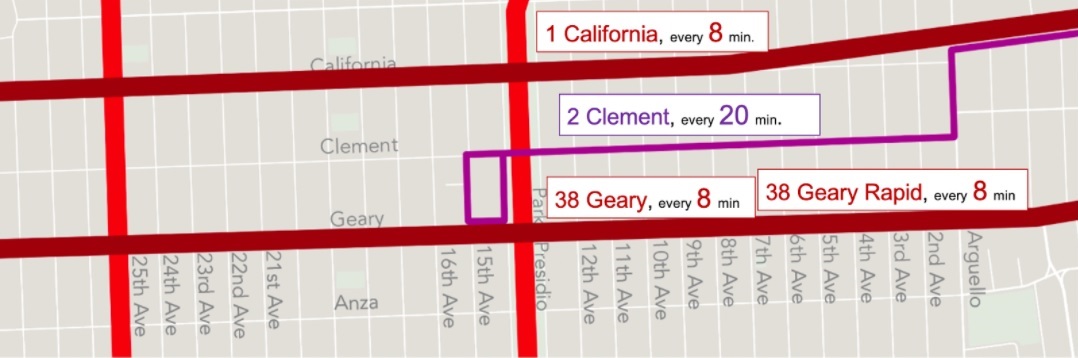
 What does a high-access alternative mean in practice? Here’s an example:  Once the 31 Balboa comes back in August, the Richmond district will have frequent east-west lines spaced every quarter mile. But Muni’s 2 Clement runs just one-eighth mile (a long Richmond block) from the frequent lines on California and Geary. 

 Pre-pandemic frequency and route spacing in the north part of the Richmond district showing 1 California every 8 minutes, 2 Clement every 20 minutes, 38 Geary every 8 minutes and 38 Geary Rapid every 8 minutes

Caption: Pre-pandemic frequency and route spacing in the north part of the Richmond district.

To measure the total access for people in a particular place, we look at all the trips to all the places they might be going, and calculate how long those trips take on the network. This travel time includes walking time, waiting time and riding time. In other words, we measure travel time starting from when you want to go, not when the bus comes.  

 When we calculate access from points along Clement, we find that the 2 Clement doesn’t add much, because the nearby service on Geary is so much faster and frequent.  Even if you walk (or roll) slowly at 2 miles per hour, it would take you 8 minutes to get from Clement to Geary.  But your wait would be 5 minutes shorter, on average, because the 38 Geary is so frequent. You may save even more time if you get a 38R Geary Rapid, which is faster. At most, the 2 Clement service only saves riders a minute or two. And if you walk at a more average pace, 3 miles per hour, it’s almost always faster to walk to Geary than wait for the bus on Clement.

Such close spacing of parallel routes is not something the SFMTA provides in most parts of the city, so does it make sense to dedicate Muni’s scarce resources to provide it here? Should those resources go where they can measurably expand access to opportunity, such as by moving toward five-minute frequency on many lines?

I’ve talked at length about this high-access approach because it’s less familiar and therefore requires more explanation, but that doesn’t mean the SFMTA has already decided to do it. The choices between familiar and high-access approaches is a genuine question, and we’ll want to know what you think.

Finally, all of these choices are harder because the SFMTA faces severe resource constraints. It still faces a labor shortage and has lost much of its income from fares and parking revenues, not to mention the structural deficit that existed even before the pandemic.  So the agency can’t afford to restore all of the service it ran before the pandemic.  Even if the labor shortage were resolved (and the SFMTA is working on it), restoring 100% of the previously scheduled service would run the risk that just a year or two later, when one-time federal funding runs out, drastic service cuts would be needed that could leave us with even less service than we have now. 

Instead, it makes sense to offer only a level of Muni service that the SFMTA is sure they can sustain, at least until they find new resources to replace funds that have eroded over the last decade and fallen dramatically during the COVID-19 pandemic.

Next, we and the SFMTA will lay out exact plans for each alternative, showing the exact routes and frequencies that each alternative would provide. We’ll then analyze how each alternative affects access to opportunity.  We’ll look at this for the whole population, but we’ll also calculate the benefits and impacts for specific neighborhoods, for people of color, for low-income people, and for people who walk or roll relatively slowly.  

The SFMTA will bring this information to the community, so that everyone can think about the choices and express their view.  This will help the SFMTA Board reach a decision that reflects the values of San Francisco. 


Published July 15, 2021 at 07:15PM
https://ift.tt/3hIdeR4

June 10 Muni Service Changes Adds Service on Connector Routes

June 10 Muni Service Changes Adds Service on Connector Routes By Clive Tsuma The 38R Geary Rapid will run every 6 minutes starting June 1...