Tuesday, March 30, 2021

Muni’s Equity Toolkit Helps Essential Employees Get to Work

Muni’s Equity Toolkit Helps Essential Employees Get to Work
By Mariana Maguire

The latest data from SFMTA’s new Equity Toolkit shows that Muni service changes are helping people in neighborhoods identified by our Muni Service Equity Strategy access more jobs and support the city’s recovery.  

In winter 2020, we launched the SFMTA Equity Toolkit to understand how service decisions are affecting neighborhoods where there is likely a high prevalence of essential workers who rely predominantly on Muni to get to their essential jobs. Our goal is to make better service decisions based on the trends and impacts we see in the Equity Toolkit.  

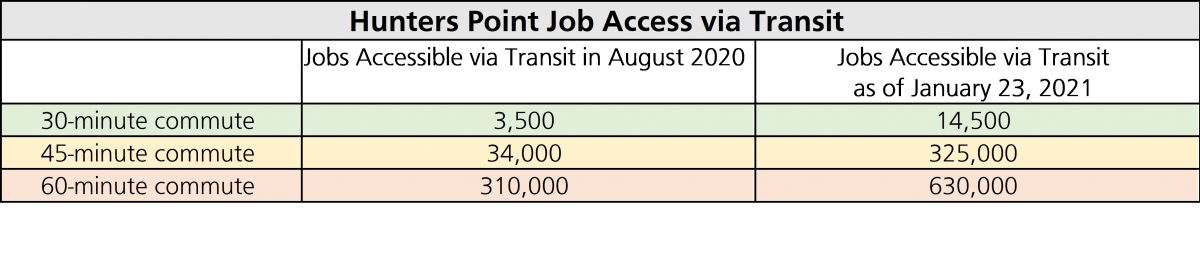
Recently, the greatest increases in access to jobs via Muni have been in Hunters Point and Western Addition. The Hunters Point neighborhood saw the largest gains from the addition of the 15 Bayview-Hunters Point Express, as demonstrated in the table below. Thanks to the return of key Muni lines and increased frequencies on connector routes, Inner Mission, Tenderloin, Oceanview-Ingleside and Treasure Island have also seen increased access to jobs via Muni.  
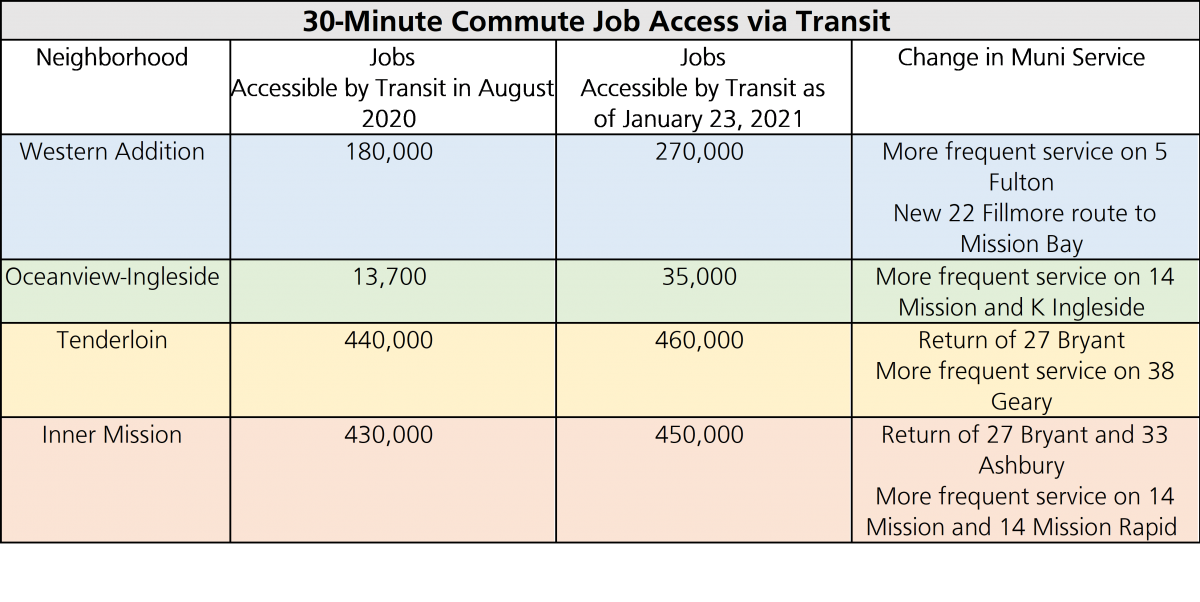
Table title: "30-Minute Commute Job Access via Transit" First row, left to right: column 1 is "Neighborhood", column 2 is "Jobs Accessible by Transit in August 2020", column 3 is "Jobs Accessible by Transit as of January 23, 2021", column 4 is "Change in Muni Service" Second row, left to right: column 1 is "Western Addition", column 2 is "180,000", column 3 is "270,000", column 4 is "More frequent service on 5 Fulton, New 22 Fillmore route to Mission Bay" Third row, left to right: column 1 is "Oceanview-Ingleside", column 2 is "13,700", column 3 is "35,000", column 4 is "More frequent service on 14 Mission and K Ingleside" Fourth row, left to right: column 1 is "Tenderloin", column 2 is "440,000", column 3 is "460,000", column 4 is "Return of 27 Bryant, More frequent service on 38 Geary" Fifth row, left to right: column 1 is "Inner Mission" column 2 is "430,000", column 3 is "450,000", column 4 is "Return of 27 Bryant and 33 Ashbury, More frequent service on 14 Mission and 14 Mission Rapid"

Table title: Hunters Point Job Access via Transit First row, left to right: column 1 is blank, column 2 is "Jobs Accessible via Transit in August 2020", column 3 is "Jobs Accessible via Transit as of January 23, 2021" Second row, left to right: column 1 is "30-minute commute", column 2 is "3,500", column 3 is "14,50o" Third row, left to right: column 1 is "45-minute commute", column 2 is "34,000", column 3 is "325,000" Fourth row, left to right: column 1 is "60-minute commute", column 2 is "310,000", column 3 is "630,000"

Lessons Learned 

The Equity Toolkit also shows some decreases in job access via transit in other neighborhoods identified by the Muni Service Equity Strategy. This reflects the Toolkit’s methodology and/or the impacts of service changes and helps us to understand where we need to make improvements in our data collection, transit service or both. 

Bayview job access increased for commutes of 45 and 60-minutes, but decreased 11% for 30-minute commutes. How can that be? The answer is that the T Third bus substitution was replaced with rail service in December 2020, which makes different and fewer stops than the bus within a 30-minute time period. Overall, Bayview residents are still able to access more jobs now than in August 2020 – roughly 644,500 now compared to 624,000 then, a 3% increase. 

In addition, we rely on fixed points of reference, such as the Bayview Opera House, to gather data and Bayview is a large neighborhood. We learned that using one community landmark for this area is not enough, so we will be adding additional landmarks in future analyses to more accurately capture service change impacts. 

In Visitacion Valley we see decreases in job access via transit across the board. Like in the Bayview, we determined that the issue is both methodology and service. When we redistributed buses from the 8 Bayshore to 8AX to respond to changes in ridership, the community landmark (John King Senior Community) we were using to track the data only showed us the decrease from the 8 Bayshore, not the increase from the 8AX. 

By comparison, more affluent areas show very low to no increases in job access via transit. This reflects our decision to prioritize resources on Muni service for essential workers and essential travel, especially for communities with the fewest options during this unprecedented pandemic. More affluent neighborhoods have more transportation alternatives readily available and more people who are able to work from home. 

These findings give us insights we didn’t have before and help us think about service in new ways. As we learn from the Equity Toolkit we will continue to refine it and make it more detailed by adding more reference points for our data analysis.  

As San Francisco gradually reopens and we continue to add back Muni service, we will also continue to evaluate the impacts through our Equity Toolkit and work to use these insights to inform service adjustments that support our city’s economic recovery. 

Read more about changes to our network on the SFMTA’s Transportation Recovery Plan webpage


Published March 30, 2021 at 10:33PM
https://ift.tt/2PkupwH

Monday, March 29, 2021

SFMTA’s Cable Car Signal Tower Gets a Refresh

SFMTA’s Cable Car Signal Tower Gets a Refresh
By Jeremy Menzies

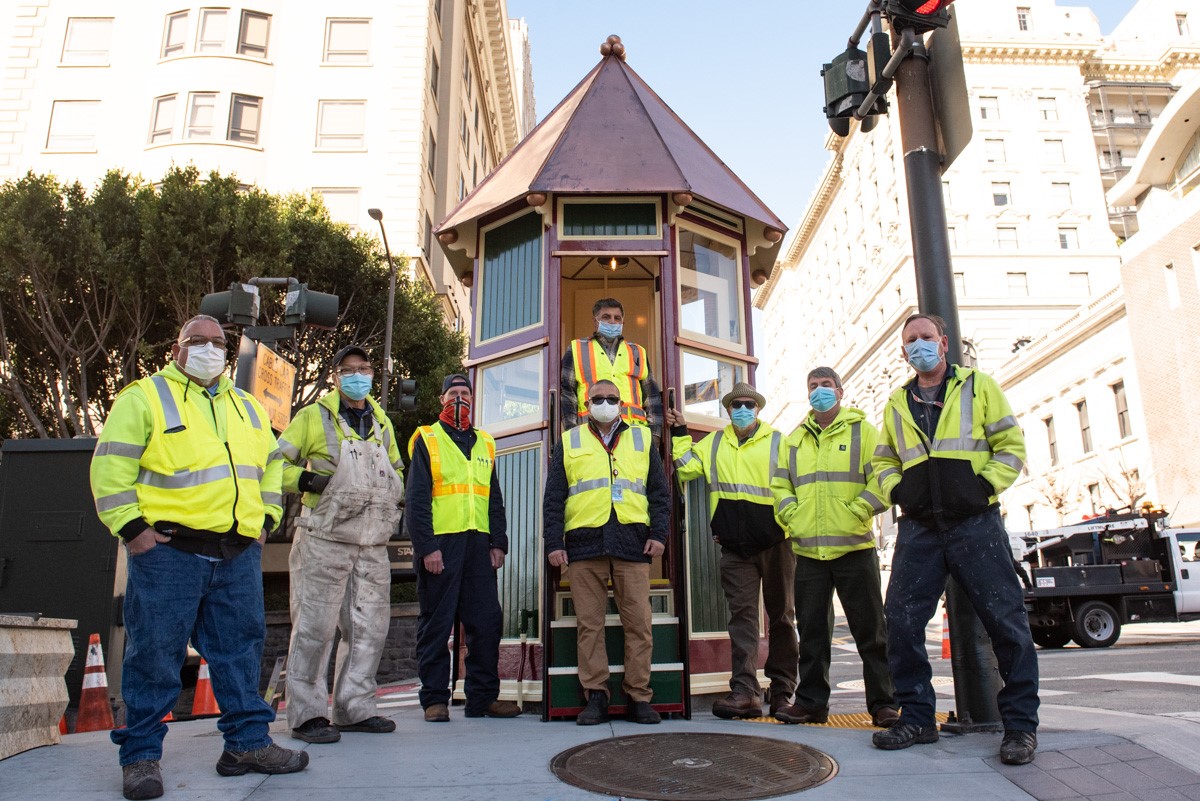
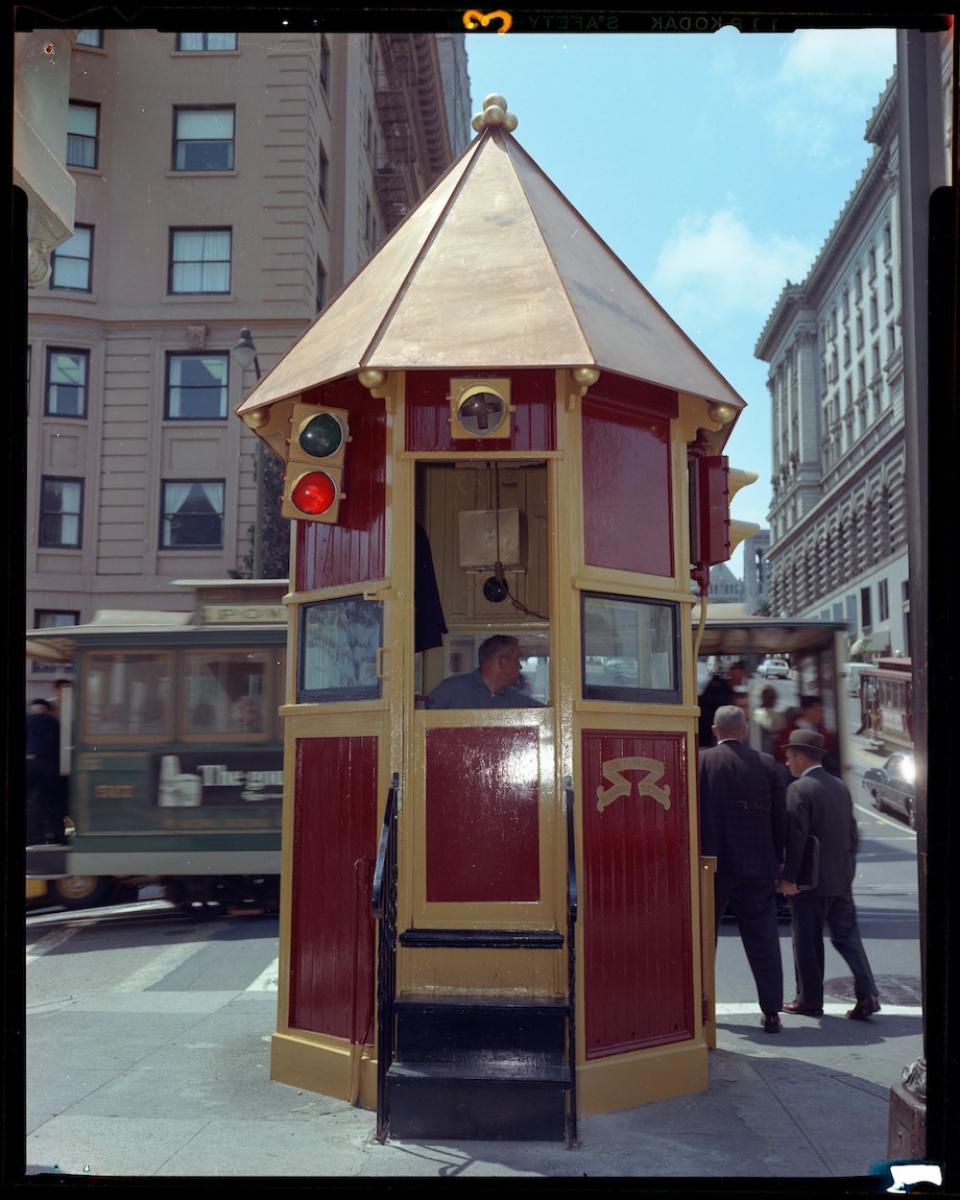
At the corner of California and Powell Streets stands a diminutive but important building that has been in use for well over 100 years. This octagonal signal tower controls the crossing of the Powell and California Street cable car lines, and recently underwent a full restoration thanks to the skilled craftspeople at the Cable Car Division.

A group photo of Muni craftspeople and shop management who worked to restore the signal tower in 2020-2021.

A group photo of Muni craftspeople and shop management who worked to restore the signal tower in 2020-2021.

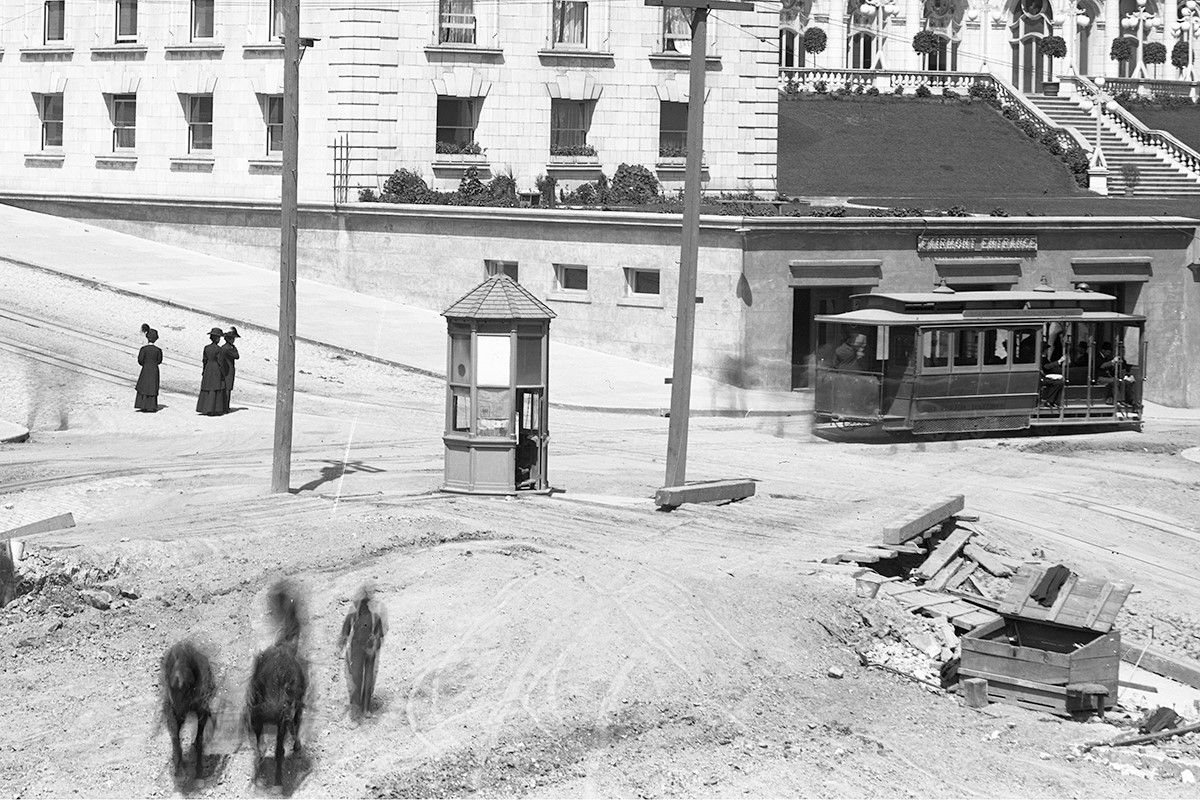
The tower’s history dates to 1888 when the original was built by the Ferries and Cliff House Railroad, which operated cable cars on Powell Street at the time. That tower was destroyed in the 1906 earthquake and fires that ravaged Nob Hill. In March 1907, it was rebuilt by then-owner United Railroads of San Francisco (URR) and went back into operation.

Photo showing signal tower in 1908 with the Fairmont Hotel and passengers waiting for a cable car in the background. Photo courtesy OpenSFHistory.org.

Photo showing signal tower in 1908 with the Fairmont Hotel and passengers waiting for a cable car in the background. Photo courtesy OpenSFHistory.org.

In 1935, a runaway automobile on California Street struck the tower, causing severe damage and tragically killing the signal operator inside. The tower was subsequently rebuilt, and a heavy metal barrier was installed on its west side.

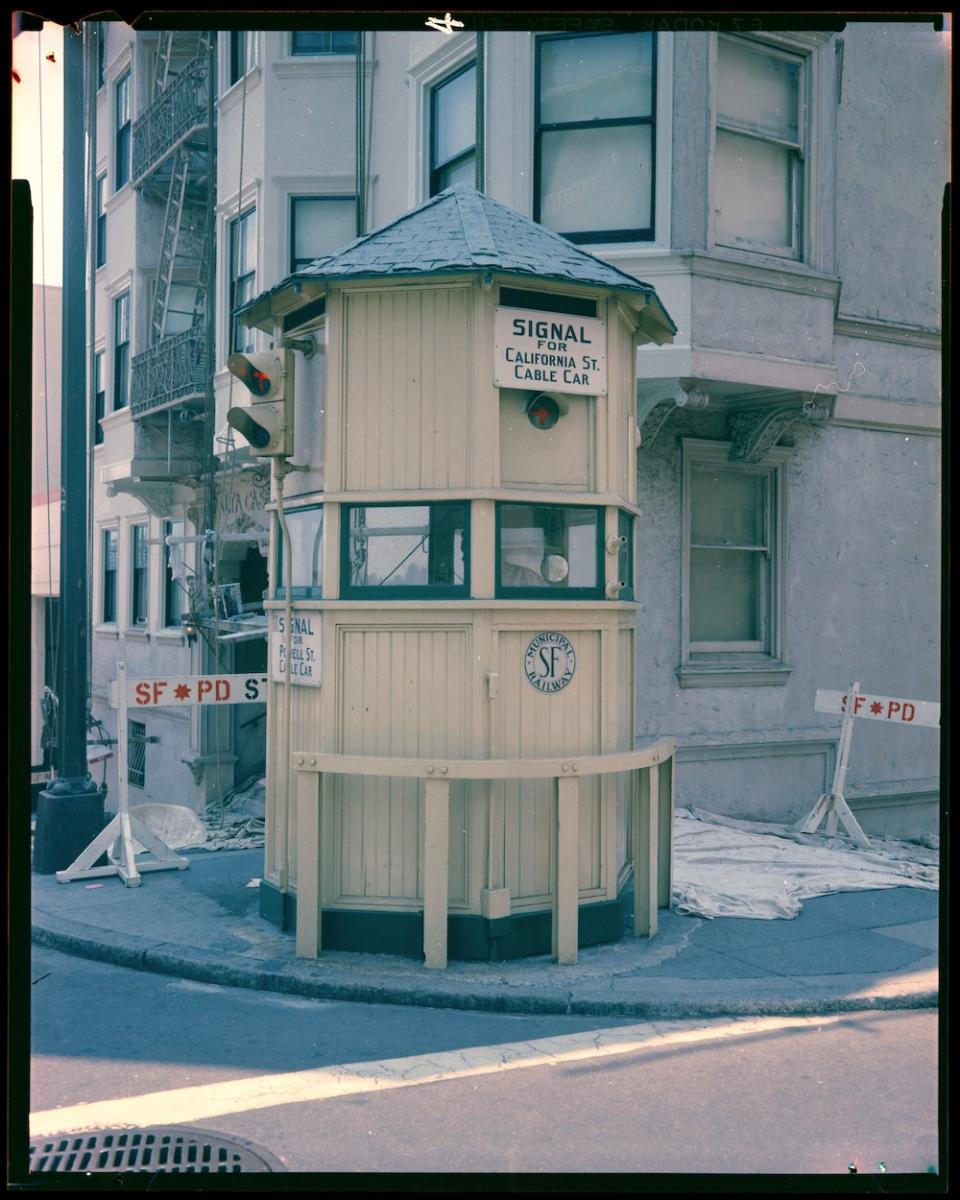
This 1966 photo shows the west-facing side of the tower, painted in green and cream, shortly before paint and repairs were done on the building.

This 1966 photo shows the west-facing side of the tower, painted in green and cream, shortly before paint and repairs were done on the building.

The next major change came in 1967 when the tower was renovated and a new copper roof was installed. The structure was also repainted to reflect the maroon and tan color scheme of the California Street cable cars. Until 1982, the tower retained its manually-operated kerosene lantern signals originally installed in 1907.

A 1967 photo showing the newly repainted and copper-roofed signal tower.

A 1967 photo showing the newly repainted and copper-roofed signal tower.

The suspension of cable car service during the Covid-19 pandemic proved an opportune time to give the little signal tower some much needed T-L-C.  During 2020 and early 2021, SFMTA carpenters, painters, metal workers and mechanics undertook a complete overhaul of the building. A new floor, roof, ceiling, door, windows, steps, heating, lighting and electrical system were all built and installed.

As with our world-renowned cable cars, no detail was overlooked during the tower rebuild. Muni carpenters repaired woodwork throughout, custom-building both the octagonal ceiling and split Dutch door. Paint crews highlighted each element of the tower with colors that enhance the structure’s overall visual appeal. Our expert mechanics installed new electrical systems. Even the grab handles and handrails for the steps were custom built from materials that are also used on Powell Street cable cars by skilled metalworkers at the SFMTA’s Special Machine Shop. A final step in this rebuild will be the installation of new signals before the tower goes back into operation later this year.

Check out the gallery below showing photos of the tower through the years and the recent restoration.


Published March 30, 2021 at 02:10AM
https://ift.tt/3m39I4d

Friday, March 26, 2021

Better Connections from Bayview and Hunters Point to Downtown

Better Connections from Bayview and Hunters Point to Downtown
By Enrique Aguilar

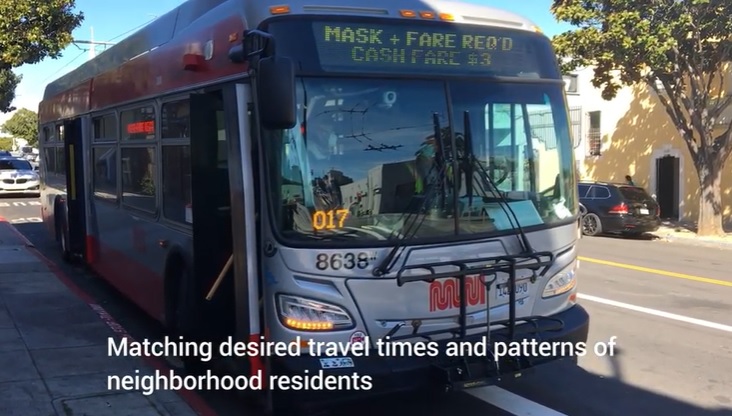
To better connect southeast San Franciscans with downtown, the SFMTA debuted the 15 Bayview Hunters-Point Express in late January, coinciding with the return of T Third train service. Within weeks, average daily boardings reached 1,000 customers on this new service.

Photo of 15 Bayview Hunters Point Express bus

The 15 Bayview Hunters Point Express 

We added this route based on community feedback from the Southeast Muni Expansion Project in 2018, which prioritized a more direct trip to downtown from the Bayview. With the sudden rise of the COVID-19 pandemic and its disproportionate impacts on communities in the Bayview and Hunters Point, fast-tracking the project became critical to our transit planning. Adding service capacity and a direct connection between these neighborhoods and downtown is a crucial step in supporting the City’s economic recovery and increasing job access for essential workers using transit.

Using data from the SFMTA Equity Toolkit, staff determined that the addition of the 15 Bayview Hunters Point Express in the January 23 service changes resulted in the largest increase in job access for 45- and 60-minute commutes of any San Francisco neighborhood.

The SFMTA convened the Bayview Hunters-Point Express Working Group, comprised of community leaders who helped shaped the conversation on route options. Then, at a time when pandemic precautions precluded in-person community outreach, we invited all area residents to vote for their preferred route through both an online and text-based survey.

After months of planning and continuous support from the Bayview Hunters-Point Express Working Group, we were able to implement a route that offers service closer to residents’ homes and make trips shorter for community members.

“We appreciate the community process and approach SFMTA took to reinstate the 15 Bayview Hunters Point Express,” said Lyslynn Lacoste, Executive Director at Bayview Hunters Point Mobilization for Adolescent Growth in our Communities (BMAGIC) and working group member. “Particularly identifying and prioritizing those that are most isolated in the Bayview community and ensuring that they have efficient access to the public transportation line extending to downtown. I look forward to personally utilizing [it] myself as I travel from the downtown area to my office in the Bayview.”

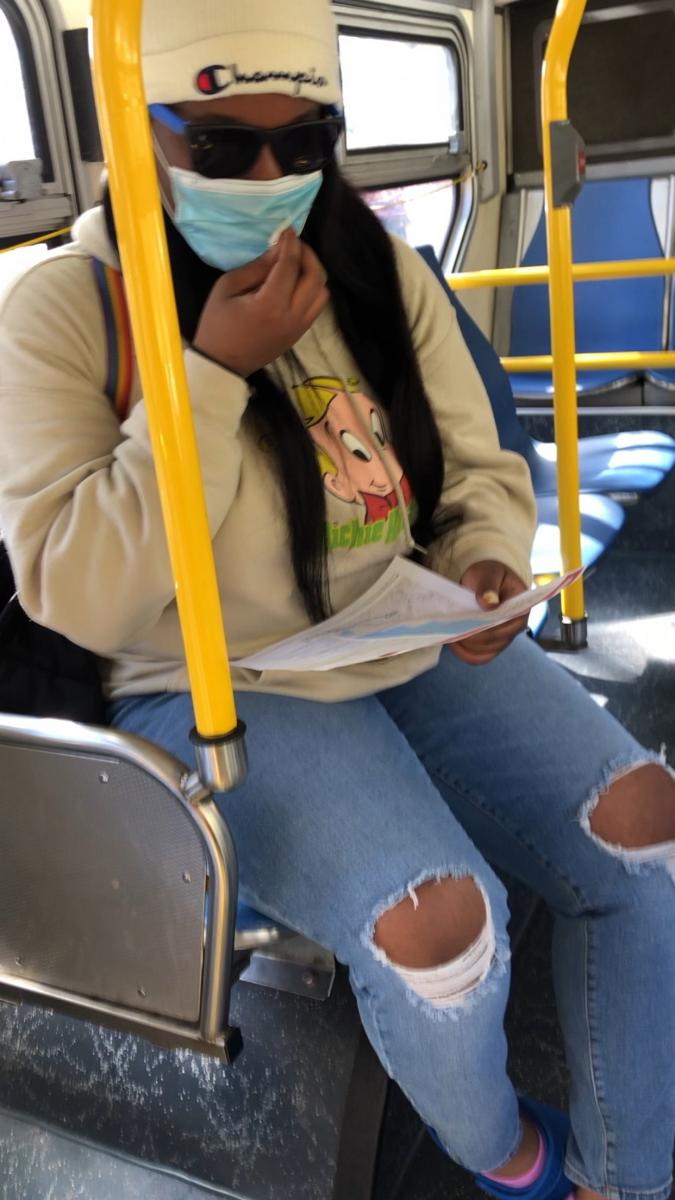
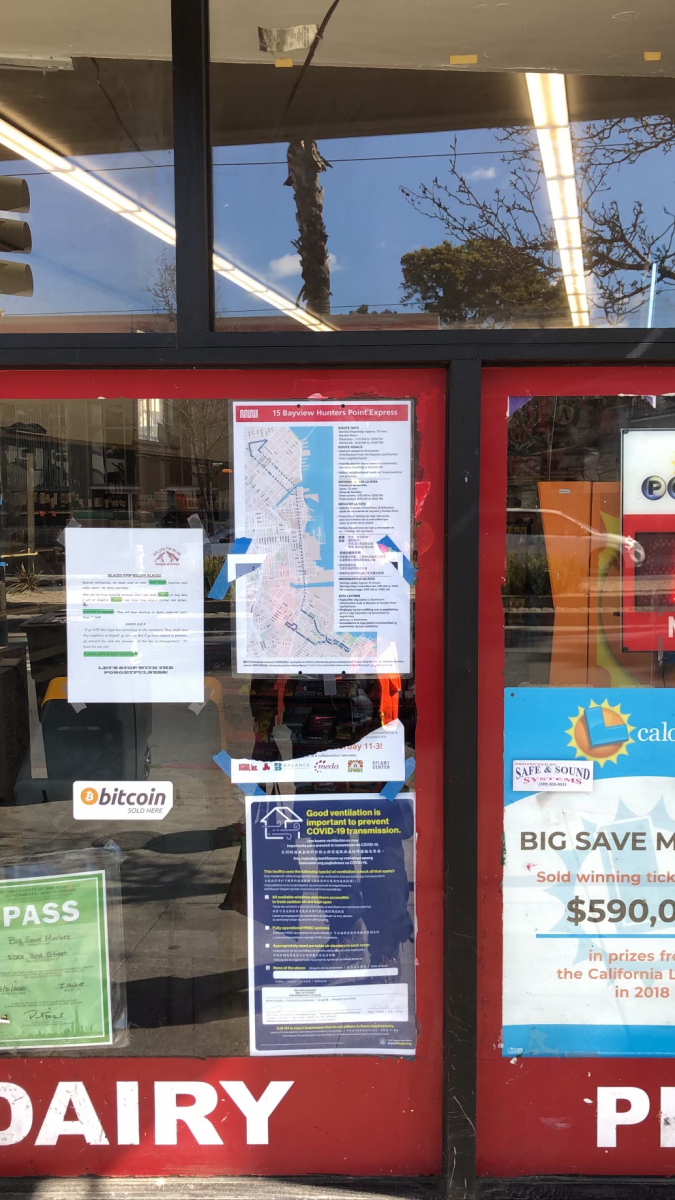
While in-person outreach remains limited due to COVID-19 physical distancing guidelines, SFMTA staff continue to engage community residents and leaders in order to evaluate the service and gather feedback. Discussions with the working group on the initial impact of the service began earlier this week. In mid-March, project staff also distributed handouts to customers of the 15 Bayview Hunters Point Express waiting at bus stops and onboard when riding between downtown and the Bayview. Posters were also placed in businesses along Third Street in the Bayview.

Muni customer reading handout provided by SFMTA staff

Muni customer reading handout provided by SFMTA staff

15 Bayview Hunters Point Express signs were posted at businesses along Third Street

15 Bayview Hunters Point Express signs were posted at businesses along Third Street

Community members are encouraged to provide comments on the 15 Bayview Hunters-Point Express by completing the online Muni feedback form.


Published March 26, 2021 at 08:27PM
https://ift.tt/3svsJig

Thursday, March 25, 2021

Hate is a Virus

Hate is a Virus
By Jonathan Streeter

As a city we stand united against racism. While violence resulting from racism has been more visible in recent years, many of our colleagues and community members have been surviving the violence resulting from racism for generations. This is especially true for many Black, Indigenous, Latinx, Asian, and Pacific Islander communities that have often grappled with the effects of racism in silence or without widespread acknowledgement and support.

Hate against Asian American Pacific Islander communities has risen at an alarming rate during the COVID-19 pandemic.

Anti-Asian violence has been fueled by rhetoric baselessly blaming people of Asian descent for the outbreak and spread of COVID-19.  We condemn all forms of racism and xenophobia and stand in support of any marginalized groups who are being targeted.

Let’s continue coming together to stop racism in all its forms, including Asian discrimination. We can all do our part to stop bias, hate, and violence by educating ourselves and taking action. 

One action to take today is enrolling in Hollaback’s online training, Anti-Asian/American and xenophobic harassment.  The organization has partnered with Asian Americans Advancing Justice to launch a free bystander intervention training to meet this moment.  

As this year has shown, San Franciscans excel at connecting with each other in order to create the change we want to see in our city and the world. And we can do it again.


Published March 26, 2021 at 03:16AM
https://ift.tt/3sAHCzG

Tuesday, March 23, 2021

SFMTA Supports San Francisco Small Businesses Through Construction and COVID-19

SFMTA Supports San Francisco Small Businesses Through Construction and COVID-19
By Sophia Scherr

Local small businesses are what give San Francisco its eclectic and unique charm. Running a small business in San Francisco isn’t an easy feat either, especially over the past year. Therefore, it’s imperative that SFMTA’s projects not only provide resources to businesses that are impacted by construction but are also responsive to COVID-19 concerns as well.

Through our partnership with the Office of Economic and Workforce Development (OEWD), we have been able to provide an additional layer of support to businesses along project corridors including the Geary Rapid Project, Van Ness Improvement Project and L Taraval Improvement Project.  The SFMTA project teams have made it a standard practice to include dedicated support as part of every major capital project. OEWD staff undertake door-to-door outreach and provide information and assistance with grant applications and other city resources that are available to impacted business owners. This partnership with OEWD is just one of many tools in SFMTA’s toolbox to ensure that our small businesses can thrive.

Projects like the Geary Rapid Project span diverse neighborhoods, each with differing needs. Project staff therefore customized outreach and engagement with small business owners and merchant groups for each of the unique business corridors along the corridor: Union Square, the Tenderloin, Japantown and the Fillmore.

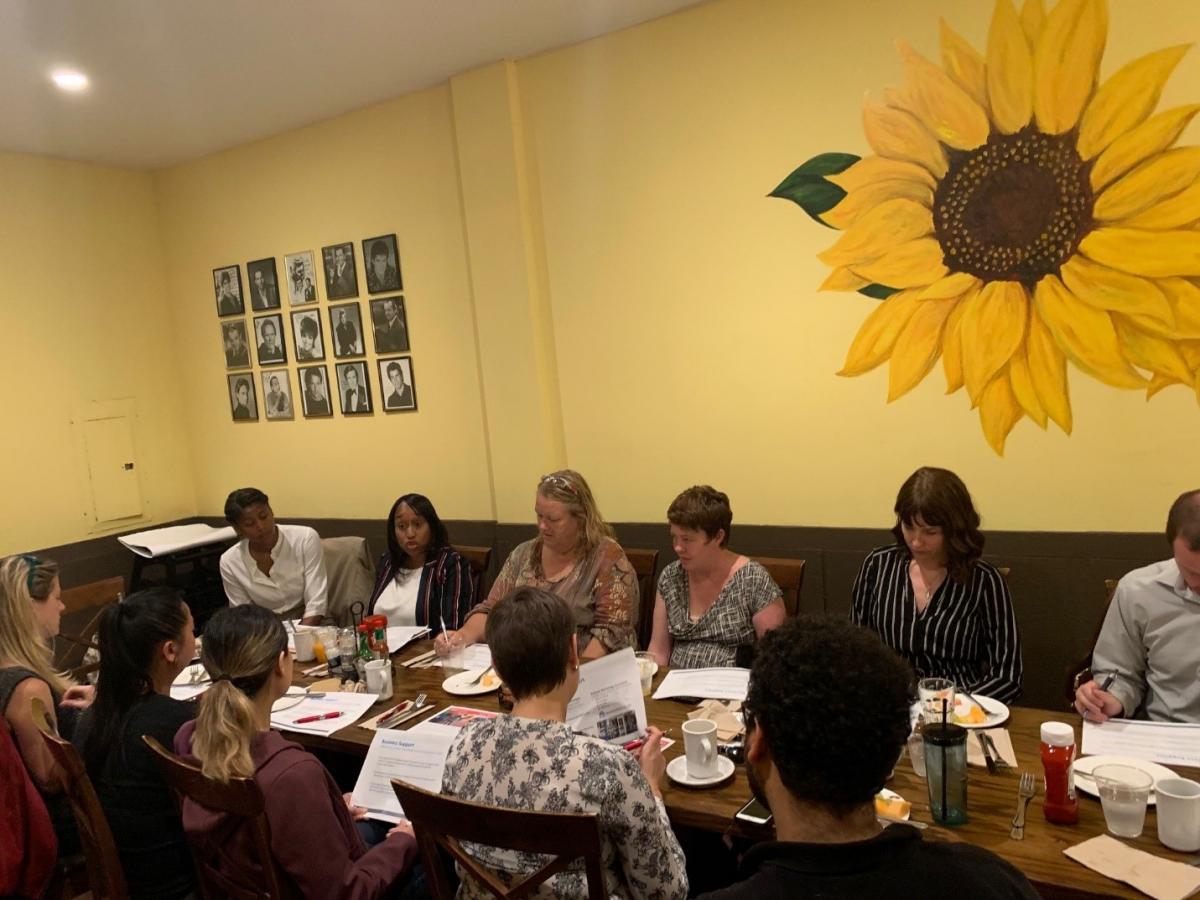
photo of Geary Rapid Project and OEWD staff meeting prior to COVID-19 with Fillmore Merchants to discuss upcoming construction

Geary Rapid Project and OEWD staff meet prior to COVID-19 with Fillmore Merchants to discuss upcoming construction

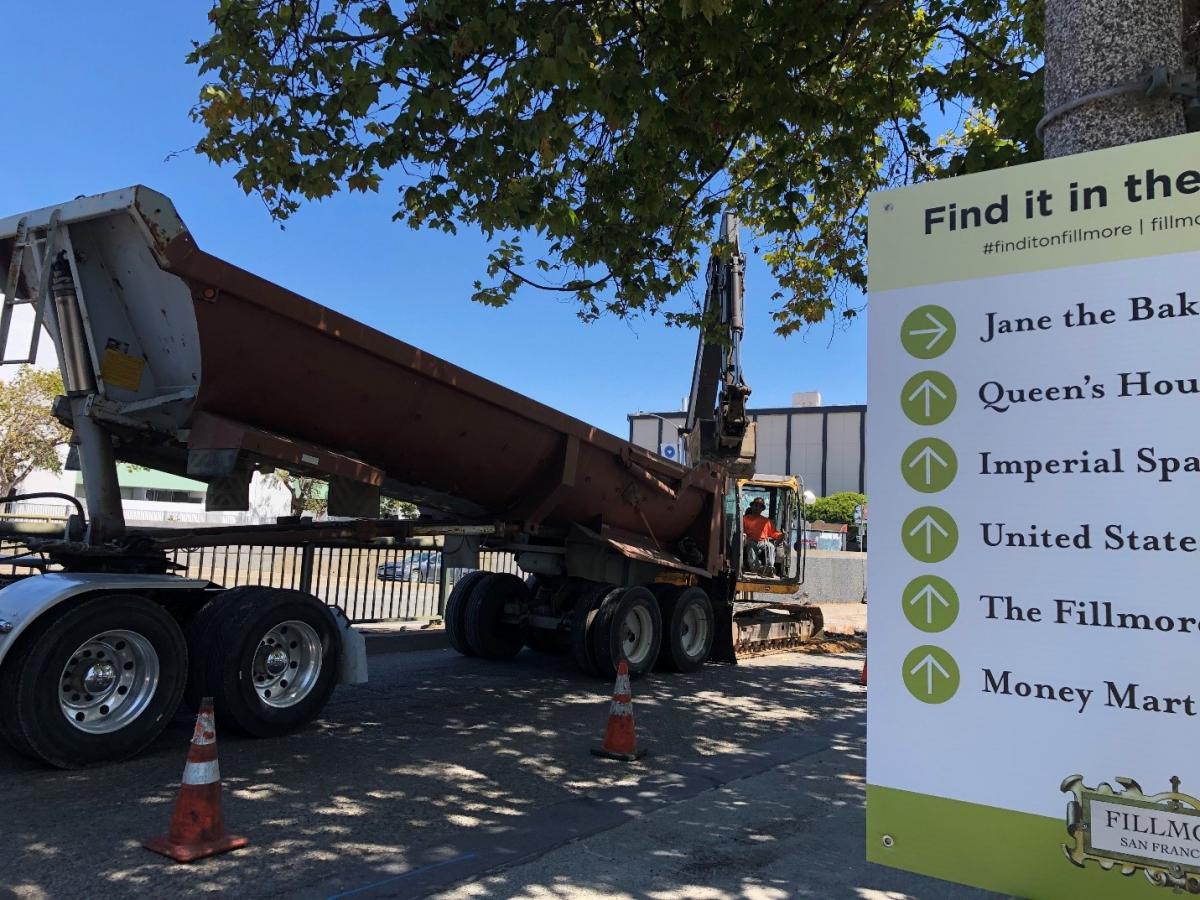
Prior to construction starting in a neighborhood, SFMTA and OEWD staff held frequent meetings with merchant groups and business owners to describe the anticipated impacts of construction and determine which support-resources best fit their needs. Once construction began, each merchant corridor was provided business wayfinding signage in line with their branding, as well as to fit the look and feel of the neighborhood. This wayfinding signage helps to raise the visibility of businesses, so that patrons can still find and access their favorite stores throughout construction.

Photo of wayfinding signage next to Construction Crews working in the Fillmore

Wayfinding signage next to Construction Crews working in the Fillmore

COVID-19 and shelter-in-place orders only compounded pressure on small businesses already feeling the effects of construction. In response, SFMTA staff and merchant groups worked together to develop new ideas on how to keep customers coming during this challenging time. Small businesses, local events, and COVID-19 resources were featured within the project’s weekly construction forecast, which is sent to over 3,000 subscribers.

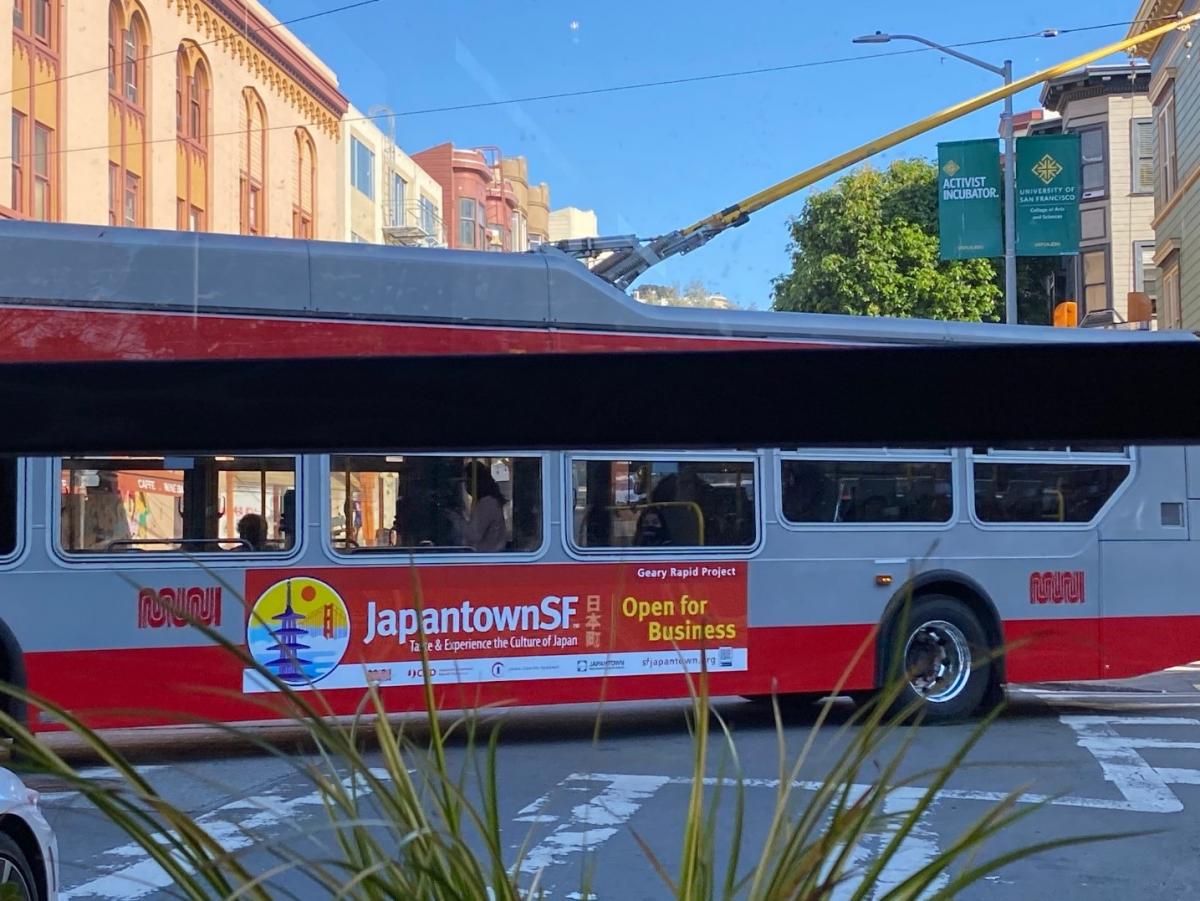
Each group also collaborated with staff to determine what type of marketing support would best suit them, and when was the best timing given the changing nature of shelter-in-place restrictions. The results were a mix of traditional and new approaches of promoting local merchants. For example, the Japantown Merchants Group chose an advertising campaign to promote visiting Japantown, featured inside and outside of buses throughout the Muni network. The Tenderloin Community Benefit District took a social media approach and promoted visiting restaurants and stores via targeted Facebook ads.

No matter the chosen method, providing targeted support is a proactive way for the SFMTA to help small business during these trying times, so they are able to remain open as our city begins the re-opening process.     

Photo of bus with ad produced for Japantown as part of the Geary Rapid Project Business Support Program

Bus ad produced for Japantown as part of the Geary Rapid Project Business Support Program

Of course, we recognize that in the past not every SFMTA project has been smooth sailing when it comes to construction. However, we have built upon our experience as a lesson for projects currently underway, and for those being planned. We have learned that consistent, personalized outreach and having project staff dedicated to addressing issues directly and quickly are essential to building and fostering meaningful relationships that maximize opportunities, and minimize the impact of construction.


Published March 23, 2021 at 09:30PM
https://ift.tt/2QtB1ZP

Monday, March 22, 2021

Creating a Better Market Street: Car-free Enforcement to Resume

Creating a Better Market Street: Car-free Enforcement to Resume
By Mariana Maguire

It’s been over a year since Market Street went “car-free” on January 29, 2020, but shortly afterwards, the COVID-19 pandemic shut down our city and changed how people move through San Francisco. As the city begins to reopen and vehicle traffic is increasing, we are by stepping up compliance and enforcement efforts to keep Market Street car-free starting March 29, with the help of SFMTA’s Parking Control Officers (PCOs) and the San Francisco Police Department (SFPD).

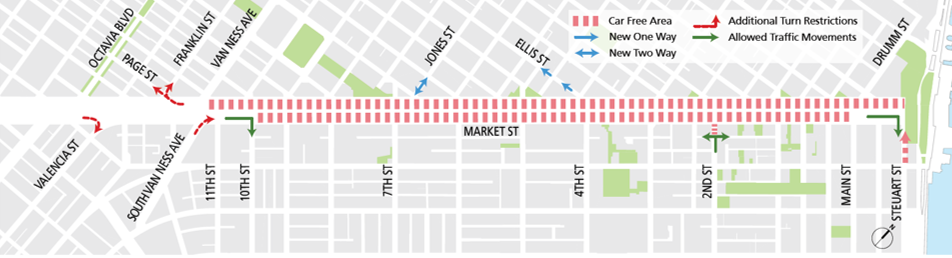
Under the year-old car-free rules established as a part of Better Market Street, no private vehicles are allowed to travel along Market Street eastbound from 10th to Main streets or westbound from Steuart Street to Van Ness Avenue. Traffic is still allowed to cross Market Street, but there are no turns allowed onto the street in the car-free area. These restrictions apply to all private vehicles, including Uber, Lyft, Postmates, DoorDash, and other services whose drivers use personal vehicles without a commercial license plate.

Map of Market Street showing car-free zone from Van Ness Avenue to Main Street eastbountd and from Van Ness Avenue to Steuart Street westbound. New one-way restrictions on Ellis from Market to ____, new two way traffic on Jones from Market to _____, and additional turn restrictions from Market to Valencia street, from Market to Page and Franklin Streets, from South Van Ness onto Market Street and northbound from Steuart to Market. New traffic movements will occur from 2nd Street northbound onto ___ and ____ and on Market Street to Steuart Street.

 Map: Car-free area on Market Street, implemented January 2020.

Enforcement of compliance will increase starting March 29 and will continue for about a month to help remind drivers of the restrictions. PCOs and police officers will monitor the street at various locations. PCOs will wave on vehicles attempting to turn onto Market Street within the restricted area. During the first week of the campaign the SFPD will issue warnings to drivers as we ramp up education efforts. Thereafter, they will issue citations to vehicles in violation of the car-free restrictions.

These efforts are in direct response to violations and concerns we’re heard from people that private vehicles are still driving in the car-free area. We also understand and appreciate concerns around police enforcement and we’re working hand in hand with SFPD to address those concerns.

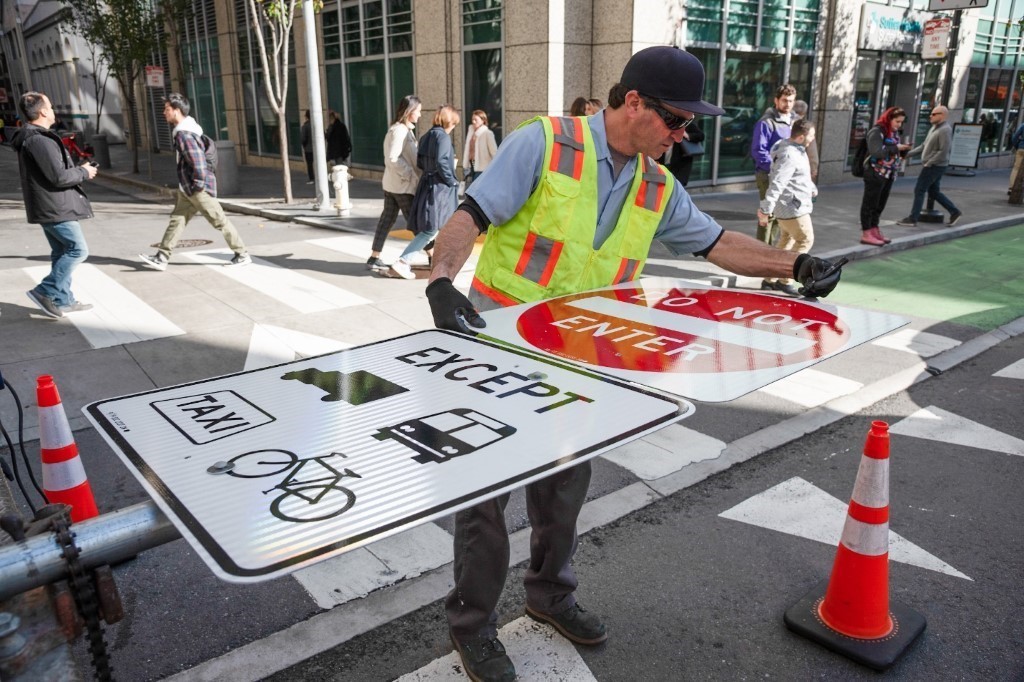
Photo of worker getting ready to put up a pole with new signs indicating that Market Street is restricted to non-private vehicles only.

Photo: Crew member installing new signage on Market Street in January 2020

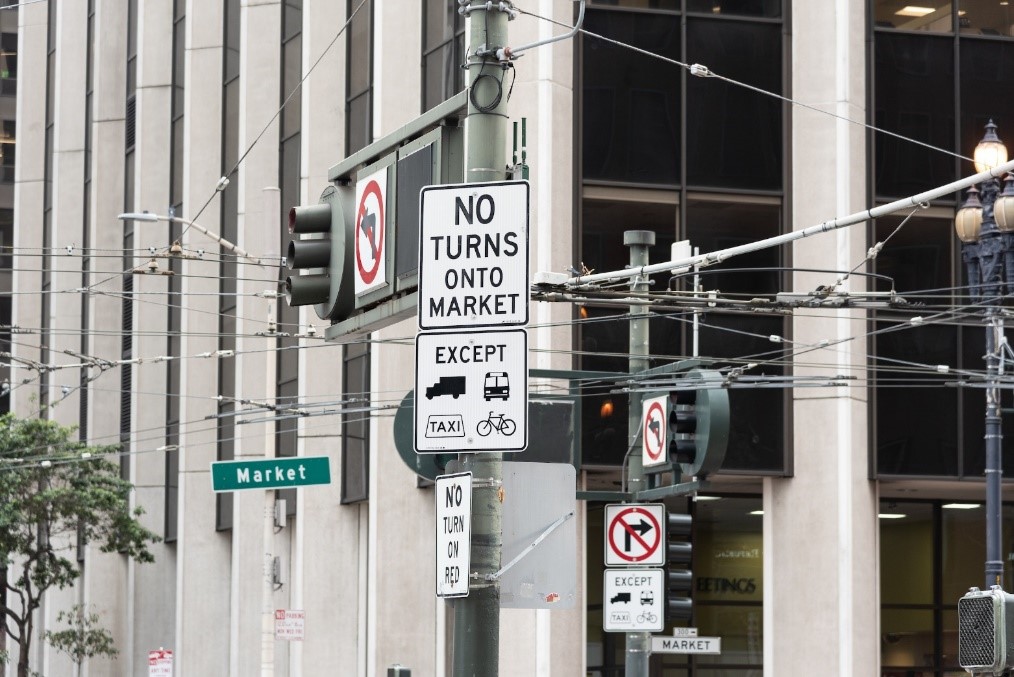
Photo of signs on Market Street indicating restrictions to private vehicles.

Photo: Car-free Market Street signs limiting private vehicles from driving on Market Street east of Van Ness Avenue.

Vehicles that are still allowed to use Market Street:

  • Muni and other transit service vehicles
  • Taxis
  • Paratransit
  • Licensed commercial vehicles
  • Emergency service vehicles
  • Bicycles
  • Scooters

Don’t get ticketed! If you’re not one of the vehicles above, don’t drive on Market Street east of Van Ness Avenue. Pay close attention to signage like those shown in the photos. If you’re using a navigation app it will route you around the car-free area.

Please help us spread the word to family, friends, neighbors and coworkers. Plan your trips accordingly. Consider alternate modes of travel if you’re going downtown. If you need to use your personal vehicle to reach destinations along Market Street, take alternate streets – they’re open!

Keep checking the COVID-19 Muni Core Service Plan website for the latest Muni service as we continue to expand and restore additional Muni rail routes which will improve transit service along Market Street.


Published March 23, 2021 at 04:38AM
https://ift.tt/3f75iIe

Thursday, March 18, 2021

Get On Board for Your Driver

Get On Board for Your Driver
By Lori Phelan

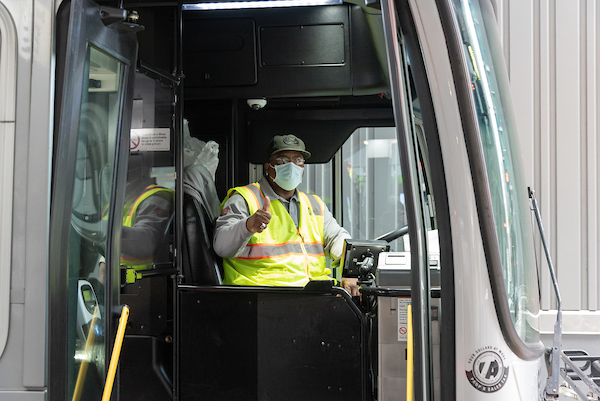
Photo of Muni bus operator wearing mask

Today is Transit Worker Appreciation Day, a national day of recognition to thank and celebrate the public service of transit vehicle operators and support staff who keep our cities moving. Operating any vehicle in a city like San Francisco is not easy, yet our operators strive to provide a comfortable ride while navigating large-capacity buses with precision through city streets and traffic. We recently celebrated hundreds of Muni Operators with years –even decades-- of “safe driver” experience, having had no avoidable collisions. We also celebrate the hundreds of mechanics, car cleaners, and other critical personnel who keep vehicles safe and operational.

Muni’s transit operators and support teams have been on the job in San Francisco throughout the COVID-19 pandemic, providing essential service at a time of unprecedented challenge and uncertainty. In addition to keeping our Muni Core Service Plan rolling during shelter-in-place, many of our Cable Car and rail operators have served as ambassadors while rail service was suspended, distributing masks, assisting customers while waiting for Muni and keeping the public informed about how to get to where they want to go.

In addition to our 2,500 Muni operators, there are nearly 3,000 taxi and 100 paratransit drivers in San Francisco, all of whom have had to manage the unique constraints the pandemic has imposed. This workforce has proven more than equal to the challenge of the past year.

Badge station: I'm on board for my operator

If you’d like to get on board with supporting an operator or other worker who made your day just a little bit brighter this past year, please consider participating in Transit Worker Appreciation Day and saying thank you by:

  • Posting thank you messages, photos or videos to social media with the hashtag #TWAD (Transit Worker Appreciation Day) or #ILoveMyMuniDriver.
  • Submitting an official commendation online through Muni Feedback -- provide details about your experience so that we can identify the employee and ensure that they receive kudos.
  • Giving a thumbs-up on MuniMobile app's RateMyRide.

And remember, a simple smile or thank you works any day – for which there are 365 opportunities each year.


Published March 18, 2021 at 07:10PM
https://ift.tt/3vDWOOE

Wednesday, March 17, 2021

4th Street Bridge Transit Lanes Ease T-Third Bottleneck

4th Street Bridge Transit Lanes Ease T-Third Bottleneck
By Erin McMillan

In January, along with other proposed and planned key locations across the city, the SFMTA Board of Directors approved temporary emergency transit lanes for the 4th Street Bridge.  These temporary lanes address a key bottleneck that delays the T Third line on 4th Street northbound and southbound between Berry and Channel Streets.

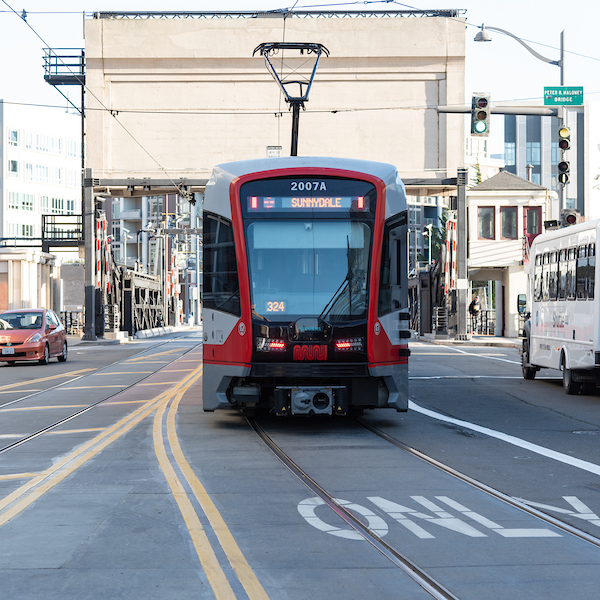
Photo of a Sunnydale-bound T Third approaching the 4th Street Bridge

A Sunnydale-bound T Third train approaches the 4th Street Bridge

As a response to community feedback, the project team developed a two-phase implementation of the temporary transit lanes to allow for an evaluation of their effectiveness before fully restricting northbound bridge traffic.

The initial evaluation of the first phase has been completed, and data shows that partial implementation was effective in allowing Muni trains to travel across the bridge with little delay.

Currently, northbound left turns are restricted from 4th Street onto Berry Street. The previous left turn pocket at that location was converted to a temporary transit lane, while northbound through-traffic continues to be allowed on the bridge. As the city emerges from the public health order to less restrictive tiers, we will perform an additional evaluation of the existing Phase 1 implementation. If that analysis determines that northbound private vehicle traffic on the bridge has begun to cause delays to the T Third, the single northbound lane will be restricted temporarily to transit only between Berry and Channel Streets as a second phase of the project.

A summary of this phased approach is provided below.

Phase 1: Complete. Evaluation of this phase began after the T Third resumed service in late January:

  • A southbound temporary emergency transit lane was installed in one of the two southbound lanes on the 4th Street Bridge
  • Northbound left turns are now temporarily prohibited from 4th Street onto Berry Street
  • The left turn pocket in the northbound direction from 4th onto Berry Street was converted to a temporary transit lane

Phase 2: If a change in emergency order tiers shows that traffic is causing transit delay on the 4th Street Bridge:

  • A northbound temporary transit-only lane will be installed in the sole northbound lane on the 4th Street Bridge
  • Northbound traffic will not be permitted on the 4th Street Bridge, with these additional temporary restrictions:
    • Heading north on 4th Street at Channel, no through traffic onto the 4th Street Bridge (right or left turn required)
    • Heading east on Channel, no left turn onto the 4th Street Bridge
    • Heading west on Channel, no right turn onto the 4th Street Bridge
  • Southbound general traffic will continue to be permitted

Evaluation of the phased approach

Our Phase 1 evaluation included site visits and several weeks of monitoring traffic on and around the 4th Street Bridge. Our chief metric was whether general traffic blocked trains on the shared northbound lane across the 4th Street Bridge.  If northbound traffic blocked trains more than 5% of the time, our plan was to implement Phase 2. Periods of evaluation included morning, mid-day, and afternoon/evening peak.

We also monitored train travel times using location data from T Third train tracking devices to identify when trains experienced the longest travel times on the 4th Street Bridge. Because this data showed few instances when trains were blocked by northbound traffic, we paused implementation of the second phase.

Initial Phase 1 Evaluation Results

Our data demonstrated that Phase 1 was successful in decreasing transit delays and protecting trains from traffic congestion. With the temporary emergency transit lanes in place:

  • On average, overall transit delay decreased by 63% at the of 4th and Berry streets.
  • T Third trains are now 2.5 times more likely to travel through the 4th and Berry street intersection without having to stop for a red light. 
  • When trains do encounter a red light, the average wait time for a green signal is 70% shorter
  • With Phase 1 in place, T Third trains were delayed by traffic congestion less than 1% of the time

Next steps

Our ongoing evaluation of the project will include a community survey in mid-March as well as continued technical evaluation of the effectiveness of these temporary transit lanes.  A renewed technical evaluation will take place with the changing of tiers in the city’s emergency public heath order.

For additional information on this project, and to sign up for updates, check out the 4th Street Bridge Temporary Emergency Transit Lanes webpage.


Published March 18, 2021 at 02:18AM
https://ift.tt/3vzBjP1

Tuesday, March 16, 2021

Muni and SamTrans Partner on Lake Merced Bus Service

Muni and SamTrans Partner on Lake Merced Bus Service
By Enrique Aguilar

Starting March 22, a new program will provide free access to SamTrans Route 122 within San Francisco between Lake Merced Boulevard and Lake Merced Hill. The SFMTA has teamed up with SamTrans to launch this pilot program, which allows residents to sign up to use the 122 while Muni service is limited due to COVID-19.

After applying to the program, customers will be sent an email with a MuniMobile pass link that will be valid for six months. There will be an opportunity to extend the pass if the program is still needed after that, pending the return of Muni’s 57 Parkmerced.

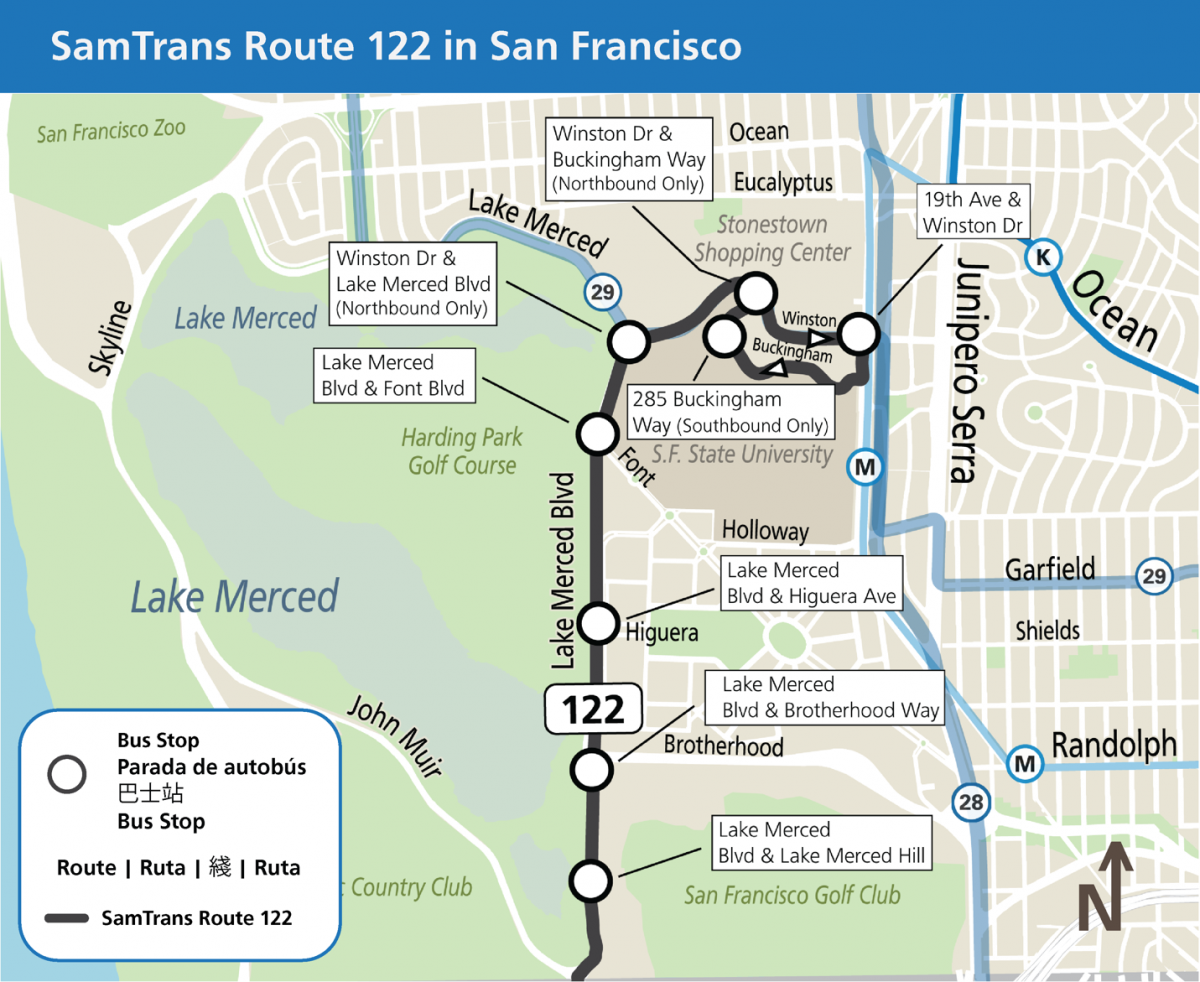
Map entitled SamTrans Route 122 in San Francisco. Eight bus stops are identified: Lake Merced & Lake Merced Hill, Lake Merced Boulevard and Brotherhood Way, Lake Merced Boulevard and Higuera Avenue, Lake Merced Boulevard and Font Boulevard, Winston Drive and Lake Merced Boulevard (northbound only), Winston Drive and Buckingham Way (Northbound only), 19th Avenue and Winston Drive, 285 Buckingham Way (southbound only)

Map of new SamTrans stops in the Lake Merced neighborhood

The SFMTA will post signs at the new bus stop locations and at essential destinations including grocery stores near Stonestown Galleria Shopping Center in order to inform community members about this free pilot program. For more information and to apply, visit the Samtrans Route 122 application page.


Published March 17, 2021 at 04:23AM
https://ift.tt/3cAsfAG

By The Numbers: The SFMTA’s COVID-19 Response

By The Numbers: The SFMTA’s COVID-19 Response
By Erica Kato

The COVID-19 pandemic has brought about unforeseen changes to San Francisco’s transportation network. And the impact of the crisis will continue to be felt city-wide long beyond the end of the public health emergency. On March 13, 2020, when it became clear that San Francisco needed immediate adjustments to the transportation system, Director of Transportation Jeff Tumlin launched SFMTA’s Department Operations Center (DOC) team. Since then, the DOC has served as a centralized hub to ensure that we are minimizing health risks to employees and the public as we keep transportation running, both by coordinating internally within the agency and by collaborating closely with our city, state, and federal partners to deploy resources and information in the most effective way possible.

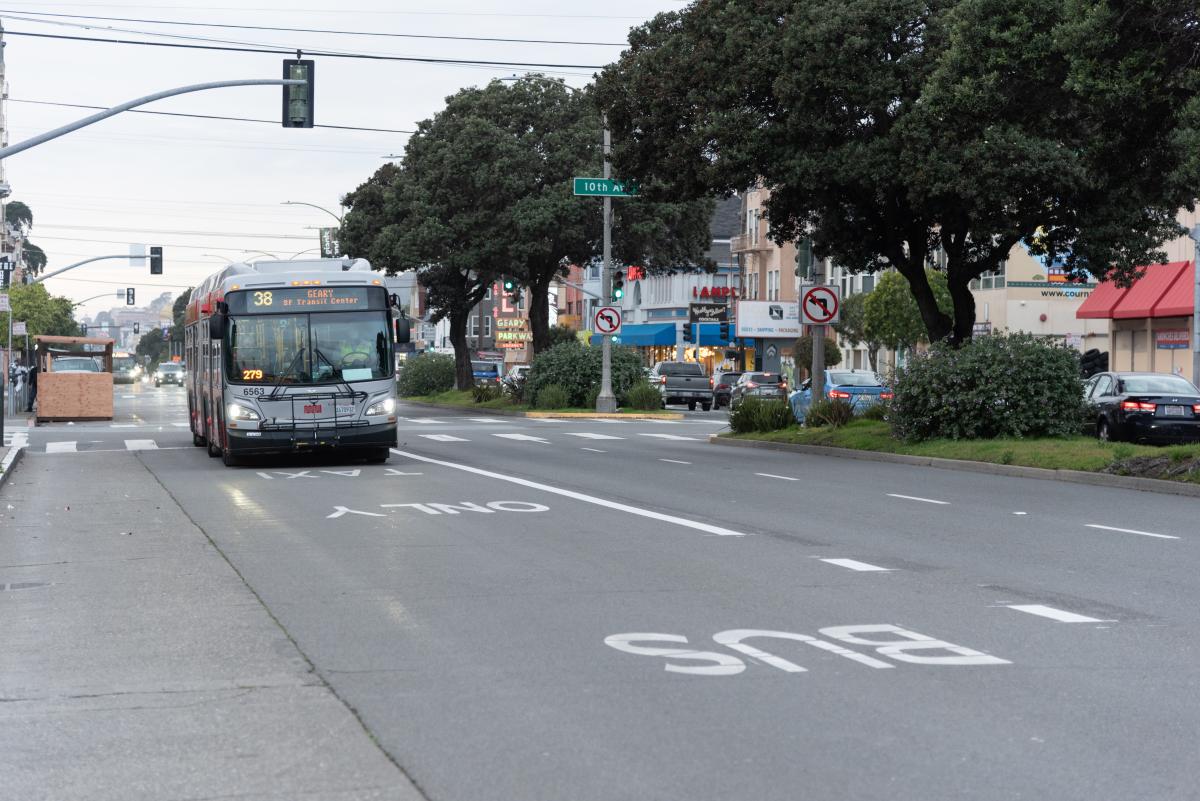
Photo of the 38 Geary bus on a transit lane passing a shared space

San Francisco's response to the COVID-19 pandemic included implementing temporary emergency transit lanes 

Our COVID-19 response has challenged us to break down silos, think creatively, and expedite processes and practices that have traditionally required long lead times. We designed and implemented creative uses of public space that opened new avenues for enjoying San Francisco even in a time of physical distancing. In the midst of a once-in-a-lifetime public health crisis, our staff has risen to the occasion and has delivered projects keen on keeping San Franciscans moving. Now, a walk across any San Francisco neighborhood is characterized by its Slow Streets, outdoor dining configurations, and new opportunities to rediscover the type of outdoor recreation synonymous with San Francisco. Iconic areas like the Great Highway, Golden Gate Park, and the top of Twin Peaks are now more accessible to more people than ever before.

Here's a snapshot of some of SFMTA’s accomplishments over the past year, by the numbers:

  • Slow Streets
    • Implemented 25 temporary corridors, comprising 44 lane miles.
    • Making first three permanent; comprising 8 miles on Page, Sanchez, and Shotwell streets.
    • Surveying residents along all 25 Slow Streets corridors; with plans to present results to the SFMTA Board in July 2021
  • Vision Zero
    • Installed 80 miles of street safety improvements in 2020 (more than 30 of which are on the High Injury Network)
    • Implemented
      • 6.5 new miles protected bikeways
      • 11 miles with slower speed limits
      • >300 continental crosswalk upgrades
      • >150 signals upgraded additional crossing time for people walking
      • >60 signals upgraded with leading pedestrian intervals
  • Taxi industry support - distributed:
    • 14,504 gloves
    • 3,469 masks
    • 830 hand sanitizers
    • 87 gallons of disinfectant refills
    • 259 rolls of paper towels
    • 822 plastic shields installed between front and rear seat
  • Streetscape Improvements:
    • 16,171 COVID-related signs installed by the Sign Shop
    • Jammed parking meters reduced to < 2% citywide, before pandemic >30%
    • Installed 1,069 bike racks
    • Daylighted almost 1,500 corners
    • Permits for over 8,000 shared bikes/scooters/mopeds
      • 174,000 trips in January

71% of San Francisco residents were within 1/4 mile of a shared mobility option such as a bike (classic and e-bike), power scooter, or e-moped by January of 2021.

Muni:

  • Sanitized 800+ transit vehicles twice per day; hired 43 additional car cleaners along with three assistant supervisors and one manager
  • Distributed 627,074 masks between July 2020 and March 2021
    • To SFMTA employees – 434,349
    • To members of the public – 192,725

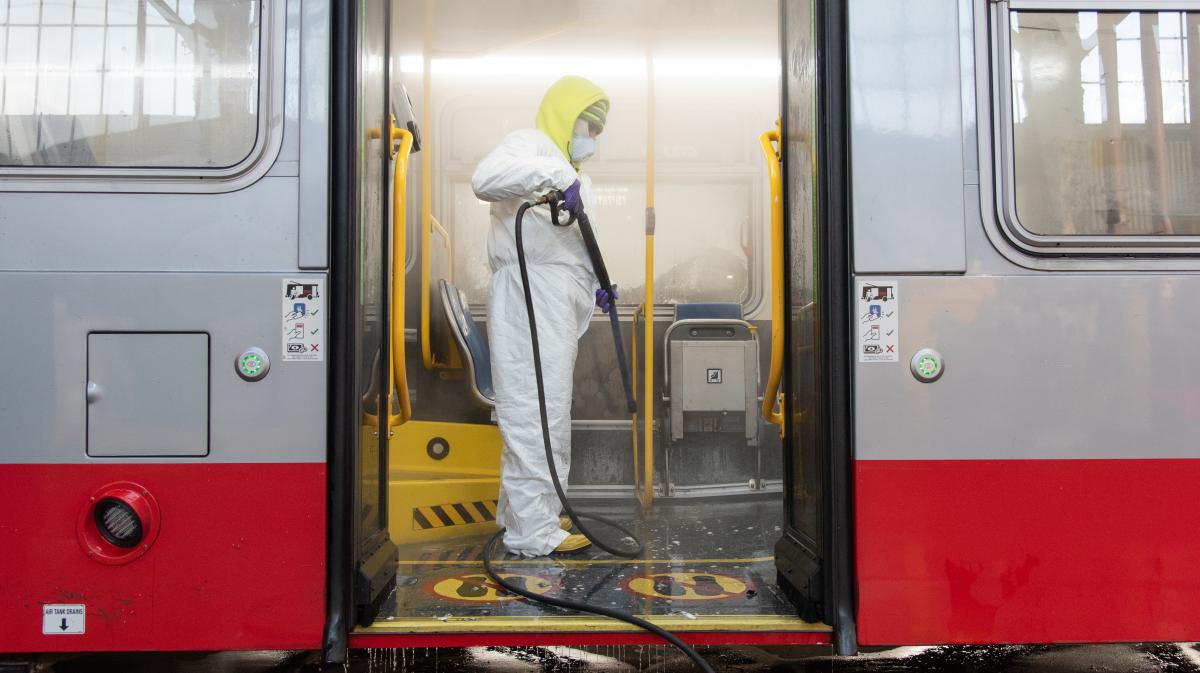
Photo of a car cleaner sanitizing a Muni bus

A car cleaner sanitizes a Muni bus before it's returned to service

COVID-19 has led to personal impacts to so many of us.  Over the course of this last year, 246 SFMTA employees have tested positive for COVID-19, and sadly we lost two colleagues to the virus.  Many more colleagues have been affected by illness or loss of their family members or friends. 

Through proactive safety measures, the SFMTA has been able to minimize transmission of COVID in the workplace.  With the widescale spread of COVID in society, 4.1% of staff have tested positive for COVID, which is consistent with regional rates and is less than half of statewide infection rate of 8.9%. 

With the release of a vaccine, we look forward to supporting the city and its economic recovery. Our Transportation Recovery Plan is our framework for expanding our transportation services and operations as the Public Health Orders are modified and demand for travel increases. Our staff has answered the call to serve, and we will continue to step up and keep San Francisco moving. We look forward to seeing you aboard Muni and taking a bike ride or stroll. Be sure to check out our website and our COVID-19 page for any updates on our service and programs.


Published March 16, 2021 at 10:12PM
https://ift.tt/3rTF8fr

June 10 Muni Service Changes Adds Service on Connector Routes

June 10 Muni Service Changes Adds Service on Connector Routes By Clive Tsuma The 38R Geary Rapid will run every 6 minutes starting June 1...